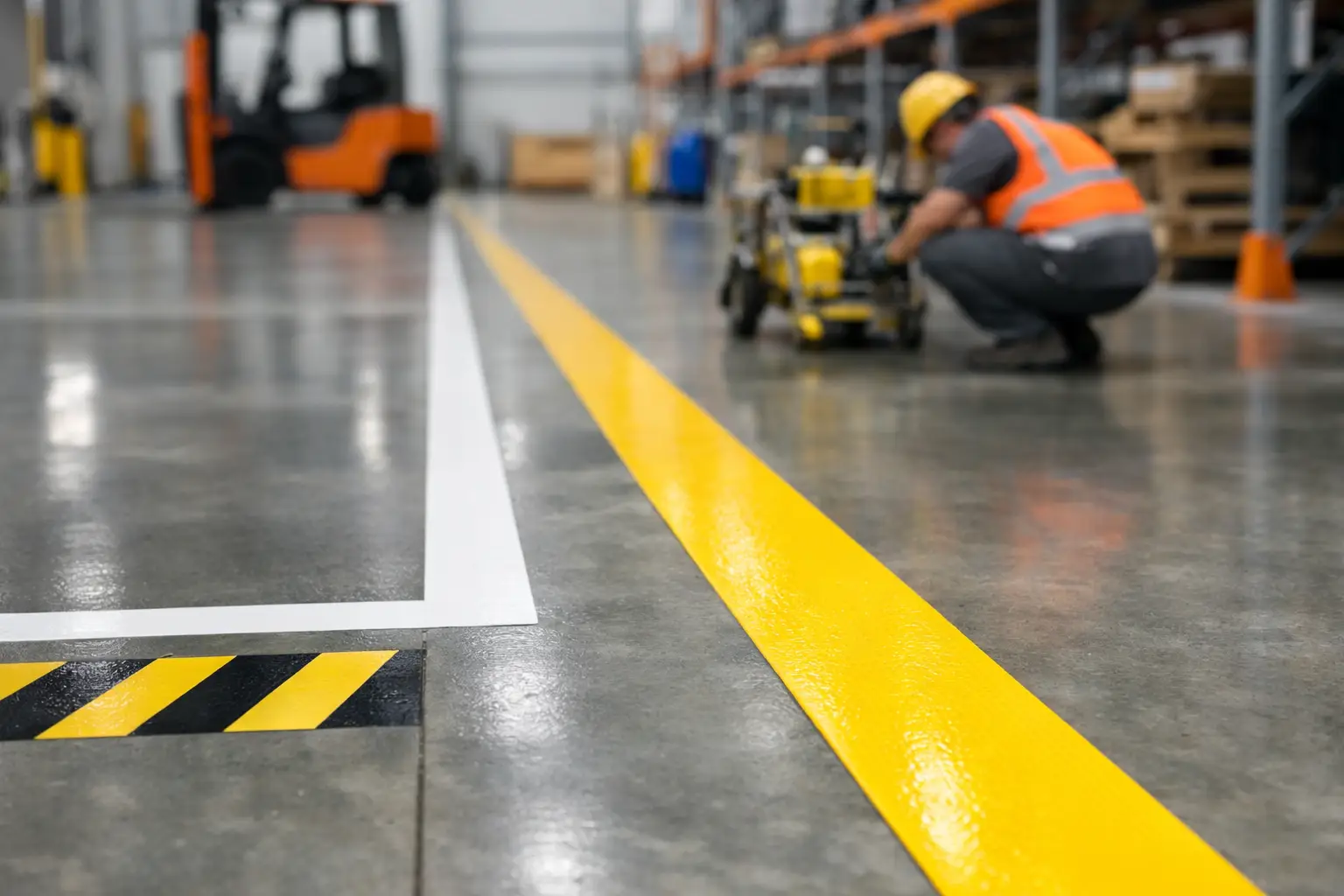
A forklift cutting across a faded pedestrian lane is not a paint problem. It is an operational risk. In active facilities, industrial floor line marking affects traffic control, safety separation, visual discipline, and how well a site holds up under daily movement, abrasion, spills, and cleaning.
For warehouses, factories, service yards, and logistics spaces, line marking needs to do more than look neat on handover day. It has to stay visible under tire wear, resist peeling at turning points, and remain bonded to the slab or coated floor. If the system is poorly selected or the surface is not prepared correctly, the markings fail fast, and the site ends up paying twice - once for the original work and again for disruption, rework, and avoidable safety exposure.
Why industrial floor line marking fails early
Most premature failures come from the same set of site conditions. The floor may be dusty, oil-contaminated, moisture-affected, or already coated with a weak surface layer. In some facilities, the marking is applied over an aging epoxy floor with poor adhesion. In others, the concrete is sound but the top surface has laitance, tire residue, or cleaning chemical buildup. When that is not addressed before application, the line may dry, but it will not hold.
Traffic type matters just as much as the substrate. Pedestrian lanes, forklift routes, pallet staging zones, and loading approaches do not wear at the same rate. Tight forklift turns and braking points create concentrated abrasion. Battery charging bays and production areas may also see chemical drips or frequent washdowns. A standard light-duty marking product may look acceptable at first, but it will not survive in those zones for long.
Temperature and downtime windows also affect performance. Fast-track projects often push line marking into narrow shutdown periods. That can be managed, but only if the system is selected around cure time, ventilation, and site access requirements. Rushing the process without matching product and schedule is where many facilities lose durability.
Choosing the right industrial floor line marking system
There is no single best material for every facility. The right choice depends on floor condition, traffic load, exposure, and how much shutdown time the operator can allow.
Paint-based systems are often used for quick applications and lower-load areas. They can work for pedestrian demarcation, light-duty storage zones, and utility markings where wear is moderate and reapplication is acceptable as part of routine maintenance. The advantage is speed and lower initial cost. The trade-off is service life. In heavy-use industrial settings, paint usually becomes a short-cycle solution.
Epoxy-based markings are a stronger option when adhesion, chemical resistance, and cleaner edge definition are required. On properly prepared concrete or compatible coated floors, epoxy can deliver a durable finish for internal industrial environments. It is commonly selected where facility teams need a more permanent system and can support the required curing window.
Polyurethane systems are useful where flexibility, UV stability, or certain performance characteristics are needed. They can be a practical choice in mixed-use areas or semi-exposed conditions, depending on the site. As with epoxy, performance depends heavily on substrate testing and surface preparation.
Thermoplastic and heavy-duty prefabricated systems may suit selected applications such as external traffic zones or specialized industrial routes, but they are not automatically the right answer indoors. Their suitability depends on slab condition, operating temperature, and installation method.
What matters most is not the product label. It is whether the system has been specified around the actual floor, the actual traffic, and the actual maintenance demands.
Surface preparation decides the result
If industrial floor line marking is treated as a finishing task instead of a floor system task, the result is usually weak. Surface preparation is where durability is won or lost.
A proper assessment should check for contamination, moisture issues, delamination in existing coatings, cracking, patch repairs, and surface hardness. If the floor has oil penetration, old adhesive traces, or peeling epoxy, these have to be removed or isolated through the right repair method before marking begins. Mechanical preparation is often necessary to create a sound profile for bonding. On some jobs that may mean grinding. On others, localized scarifying or repair of failed coating sections is required first.
This is also where many line marking contractors underperform. They may be able to apply straight lines, but that is not enough on industrial sites with damaged or compromised floors. If the floor itself needs remediation, the marking scope should be integrated with floor repair, recoating, or surface restoration. Otherwise, the new lines are only as reliable as the weak layer beneath them.
Line layout should match actual site movement
Good line marking is not just visible. It should make the site easier to operate.
That means the layout has to follow real traffic patterns, not just an ideal plan copied from another warehouse. Pedestrian crossings should connect natural walking routes. Forklift lanes should allow for turning radius, aisle width, rack access, and loading behavior. Staging boxes should reflect actual pallet dimensions and operational flow. Safety exclusion zones around panels, fire equipment, charging stations, and machinery should be practical enough that teams will respect them in daily use.
Too much marking can be as ineffective as too little. When every area is boxed, striped, hatched, and color-coded without clear hierarchy, operators start ignoring all of it. A better approach is to prioritize high-risk movement, critical access paths, and mandatory clearance zones, then build the rest of the layout around those needs.
Color, visibility, and compliance considerations
Most facilities use a combination of yellow, white, red, green, or blue markings, but color selection should be based on function and contrast, not habit alone. The floor color matters. So does lighting level. A bright yellow line on a dusty beige slab may not perform as well visually as expected. On darker epoxy floors, white may offer better lane definition in some areas, while hazard zones may still require yellow-black striping for stronger visual warning.
Site standards, client specifications, and insurance or audit requirements may also influence the marking plan. In regulated or multi-user facilities, consistency matters. If one area uses red for fire equipment exclusion and another uses red for scrap storage, confusion is built into the floor. The coding system needs to be simple enough for teams and visitors to understand immediately.
Where facility managers should be careful on pricing
Low-cost line marking quotes often leave out the work that makes the system last. Surface cleaning may be minimal. Mechanical preparation may be excluded. Edge masking, crack treatment, compatibility checks with existing coatings, and traffic phasing may all be reduced to save price. On paper, the quote looks competitive. On the floor, the result starts failing at wheel paths and corners within a short period.
For active industrial facilities, the real cost is not just material and labor. It is downtime, access restriction, rework scheduling, and the operational disruption of doing the same area again. A stronger specification with proper preparation usually delivers lower lifecycle cost even if the initial number is higher.
This is why experienced contractors approach floor line marking as part of a wider maintenance scope. If a warehouse floor also has coating wear, concrete dusting, joint damage, or moisture-related defects, those issues should be addressed as part of the planning stage. At Promax Contracting, that practical site-first approach is how industrial maintenance work avoids repeat failure.
When remarking is enough - and when it is not
Not every faded line requires a full floor rehabilitation. If the substrate is sound, the existing coating is bonded, and wear is limited to the top visual layer, remarking may be the right move. This is common in managed warehouses that maintain markings on a planned cycle.
But if the floor shows peeling coating, widespread abrasion, substrate weakness, or contamination-related failure, simple repainting is usually a false economy. The markings may improve appearance briefly, then fail again because the base problem was never solved. In those cases, local floor repair, recoating, or a more durable floor system should come first.
The difference is not cosmetic. It affects whether the site gets a maintenance touch-up or another avoidable callback.
What a good contractor should assess before starting
Before any marking layout is finalized, the contractor should inspect traffic intensity, slab or coating condition, contamination risk, curing constraints, and shutdown windows. They should also confirm whether the floor needs repair, whether the selected material is compatible with the substrate, and how the work will be phased to avoid unnecessary interruption.
That is especially important in large operational facilities where line marking intersects with broader maintenance issues such as epoxy floor wear, joint deterioration, waterproofing-related moisture ingress, or external loading exposure tracked into the building. A contractor who understands those connections will usually give better long-term recommendations than one focused only on paint application.
Industrial floors do not fail for one reason, and line marking does not succeed for one reason either. The best results come from matching layout, preparation, and material to the reality of the site. If the markings are expected to control movement, support safety, and stay visible under pressure, they need to be treated as part of the facility's operating system, not just a finishing detail.
If your lines are fading faster than they should, the question is not what color to repaint. The better question is what the floor is telling you before the next failure shows up.
Talk to Promax
Need this on your roof? Call +971 56 727 4205 or request a free inspection. Promax provides EPDM metal-roof, concrete and industrial waterproofing across Dubai and the UAE with up to a 15-year warranty.