A leaking roof in a warehouse is rarely just a roof problem. It becomes damaged stock, downtime, safety risk, rusted steel, stained insulation, electrical exposure, and repeated patchwork that keeps coming back after every rain. That is why choosing among waterproofing companies in uae should be treated as an operational decision, not a basic maintenance purchase.
In the UAE, waterproofing work is exposed to more than rainfall. Roofs and wall interfaces deal with standing water, thermal movement, UV exposure, dust buildup, blocked drainage, failed sealants, corroded fasteners, and aging sheets or concrete surfaces. A contractor that only applies a coating without diagnosing the source of failure usually leaves the real problem in place.
What separates strong waterproofing companies in UAE
The gap between an average contractor and a capable one usually shows up before the first material is installed. Serious waterproofing contractors start with inspection, defect mapping, and system selection based on substrate condition, usage, and exposure. They want to know whether the issue comes from membrane failure, roof laps, gutter backflow, pipe penetrations, skylight junctions, parapet cracks, or structural movement.
This matters most on industrial and commercial buildings. A warehouse roof, factory shed, cold storage unit, or service building does not fail in one simple way. Water ingress often travels. The visible leak point inside may be several meters away from the actual entry point on the roof. If a contractor is not set up to inspect methodically, the repair can look complete while the building continues to absorb moisture.
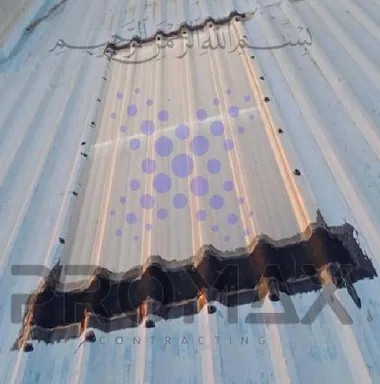
A reliable contractor should also be comfortable working across mixed scopes. Many failures involve more than waterproofing material alone. Rusted roof sheets, damaged purlins, loose screws, failed gutters, cracked concrete, open joints, and poorly sealed penetrations may all need attention in the same job. When one contractor can inspect, fabricate, repair, seal, and maintain, the result is usually more controlled and more durable.
Start with diagnosis, not price
Price matters, but early price comparison often causes the biggest mistakes. Two waterproofing proposals may look similar on paper while covering completely different levels of work. One contractor may price surface coating only. Another may include substrate preparation, crack treatment, screw replacement, joint detailing, drainage correction, and protective finishing. The cheaper number can become the expensive option once leaks return.
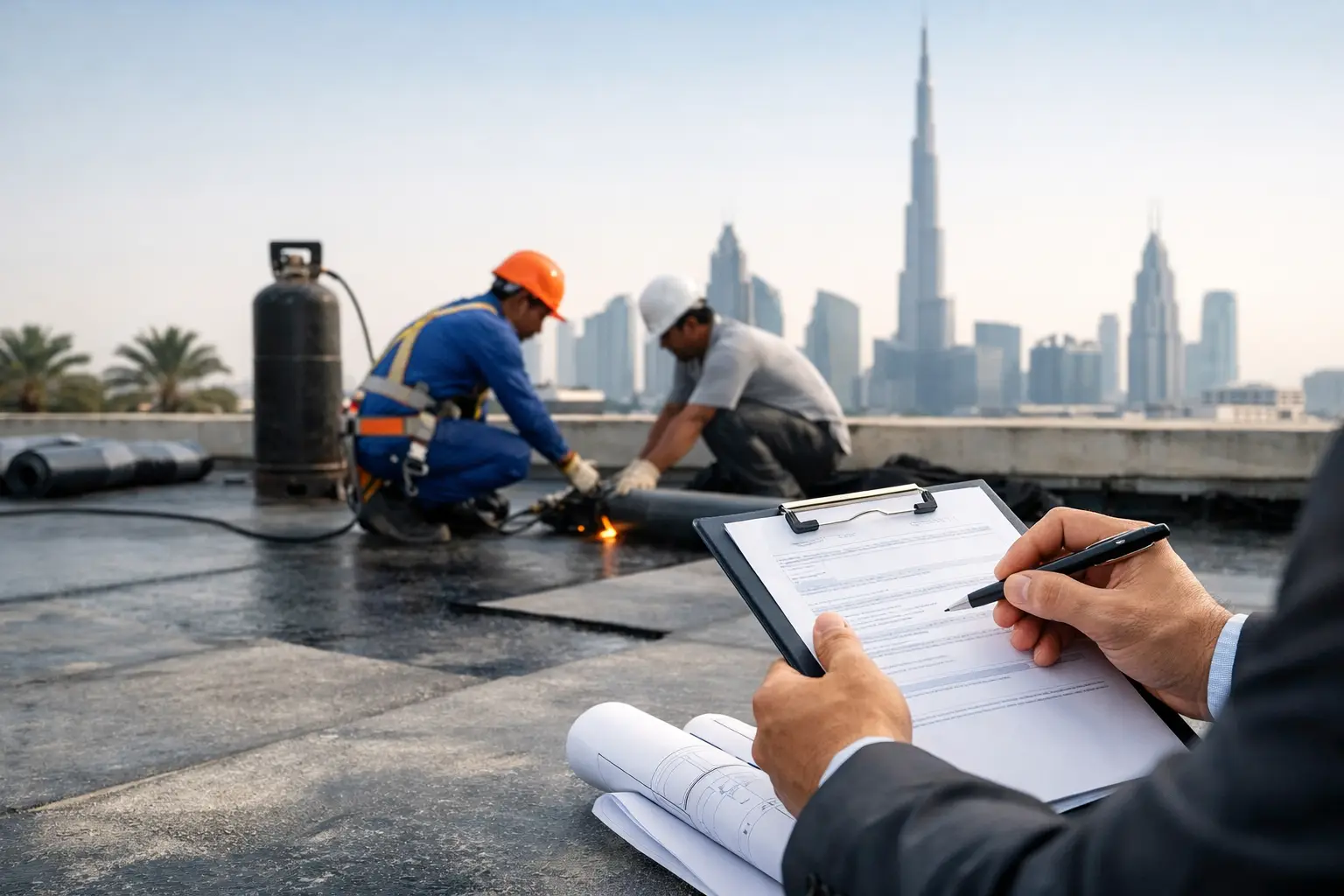
A proper assessment starts with the inspection process. Ask how the contractor identifies the source of water ingress. Ask whether they inspect roof slopes, drainage points, flashing conditions, sheet overlaps, expansion joints, and penetrations. Ask if they document findings with photos and mark defective zones. If they move straight to quoting without technical review, that is a warning sign.
Commercial clients should also look at how the contractor handles root cause versus symptom repair. If water is entering because of gutter overflow, lap failure, or fastener corrosion, recoating the surrounding area alone is not enough. Good waterproofing work is often a combination of sealing, replacement, treatment, and detailing.
Systems matter, but suitability matters more
Not every waterproofing system belongs on every roof. That sounds obvious, yet many failures come from mismatched material selection. Concrete roofs, metal roofs, exposed service decks, wet areas, planter zones, and skylight interfaces all behave differently. The right system depends on substrate type, movement, weather exposure, access level, and service life expectations.
For large metal roofs, the contractor should understand issues like fastener sealing, overlap treatment, corrosion control, sheet condition, and the behavior of waterproofing under expansion and contraction. For concrete roofs, crack bridging, surface preparation, ponding areas, and parapet connection details usually define performance more than the product label itself.
This is where technical depth becomes useful. Contractors that work with engineered membrane systems, EPDM applications, joint detailing, and surface restoration methods are generally better prepared for industrial conditions than companies focused only on cosmetic coating jobs. The product matters, but the detailing and installation quality matter more.
Execution capacity is where most jobs succeed or fail
Many contractors sell waterproofing. Fewer can execute difficult roof rehabilitation work on active facilities without creating new problems. Commercial and industrial buyers should ask practical questions about access, safety controls, crew supervision, work sequencing, and site protection.
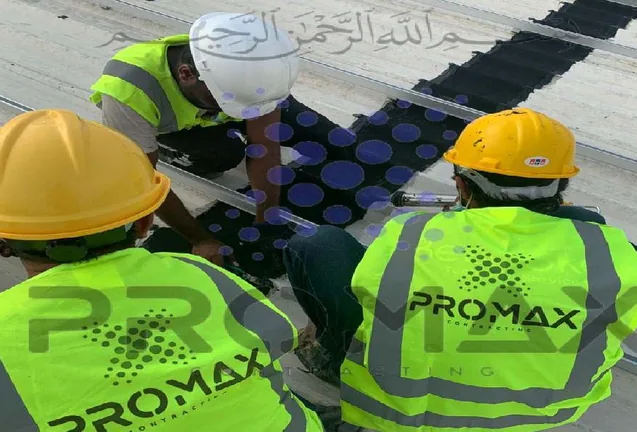
A good contractor should be able to explain how they manage operations on occupied buildings, how they isolate active leak zones, and how they protect stock, equipment, and pedestrian areas during the work. If fabrication is needed for gutters, flashings, metal trims, supports, or replacement sections, that capability should be addressed early rather than added later as a variation.
Execution also includes surface preparation. On failed projects, poor preparation is one of the most common reasons waterproofing systems break down early. Contaminated substrates, loose rust, trapped moisture, weak concrete, and unsealed transitions can compromise even premium materials. Buyers should expect a clear method statement for cleaning, repair, priming, detailing, and application thickness where relevant.
What commercial clients should check before awarding
When screening waterproofing companies in uae, the most useful questions are not marketing questions. They are field questions. What similar facilities have they handled? Do they work on warehouses, factories, labor accommodations, schools, retail roofs, and utility buildings, or only small residential jobs? Can they repair roof components and drainage systems in addition to applying membranes or coatings? Do they provide inspection-based recommendations or generic packages?
It is also worth checking responsiveness after award. Waterproofing is not just about installation day. Commercial properties need contractors who can return quickly if weather exposes a missed junction, a drainage line fails, or an adjacent area begins leaking. After-sales support is not a soft extra in this sector. It is part of risk control.
Documentation should also be reviewed carefully. A serious proposal should identify defect areas, scope boundaries, exclusions, substrate assumptions, and the repair system being applied. Vague quotations create disputes later, especially on older roofs where hidden deterioration may appear once work begins.
Why industrial buildings need a different standard
Industrial sites in the UAE face a harsher maintenance profile than many standard commercial buildings. Heat cycling, vibration, roof-mounted equipment, service penetrations, dust load, and corrosion all increase the chance of waterproofing failure. In these environments, patch repairs done without system thinking usually become repetitive maintenance.
The contractor should understand building envelope behavior, not just waterproofing products. Water ingress can come through failed roof laps, open wall joints, HVAC curbs, skylight perimeters, sagging gutters, or rusted fixing points. Treating one leak point while ignoring surrounding deterioration often shifts the problem instead of solving it.
This is why many facility teams prefer specialized contractors with broader repair capability. A company that can inspect, seal, replace damaged components, restore metal surfaces, and support related fabrication is often better positioned than a supplier-led applicator with a narrow scope. For industrial clients, coordination saves time and reduces interface risk.
What a dependable scope usually includes
The best waterproofing scopes are precise. They define where the leaks originate, what substrate repairs are required, how joints and penetrations will be treated, whether gutters or flashings need replacement, and what protective layers or finishing systems will be used. They also account for access constraints and phased work if the facility must stay operational.
For many commercial roofs, a dependable scope may involve crack repair, EPDM-based detailing, membrane or coating application, screw treatment, rust removal, gutter rehabilitation, pipe penetration sealing, and waterproofing around skylights or parapets. Not every roof needs all of that, but many leak-prone sites need more than a single-layer fix.
At this stage, contractor attitude matters. The right partner will explain where patching is acceptable and where full-area rehabilitation is more cost-effective. Sometimes a targeted repair is the smart move. Sometimes repeated localized repairs only delay a larger failure. Honest advice is worth more than a fast promise.
For property teams evaluating options, the most practical choice is usually the contractor that combines inspection discipline, technical system knowledge, repair depth, and fast site response. That operating model is what companies such as Promax Contracting are built around, especially on warehouses, industrial sheds, and high-exposure commercial roofs where leakage, corrosion, and drainage failure cannot be treated casually.
A waterproofing contractor should leave you with fewer variables, not more. If the inspection is thorough, the scope is technically grounded, and the team can execute repairs around real site conditions, the work has a far better chance of lasting through the next season instead of becoming another emergency call.
Talk to Promax
Need this on your roof? Call +971 56 727 4205 or request a free inspection. Promax provides EPDM metal-roof, concrete and industrial waterproofing across Dubai and the UAE with up to a 15-year warranty.