A leak over a warehouse aisle, moisture staining under a roof lap, or repeated seepage around pipe penetrations usually starts as a small maintenance issue. It turns into damaged stock, insulation failure, rust spread, and emergency shutdown risk when the wrong team treats it like a patch job. If you are searching for the best waterproofing contractor Abudhabi has for a commercial or industrial site, the real question is not who is cheapest. It is who can inspect correctly, specify the right system, and execute without creating the same problem again in six months.
What defines the best waterproofing contractor Abudhabi facilities can rely on
For industrial and commercial buildings, waterproofing is not a single product. It is a system decision tied to roof type, drainage condition, substrate movement, heat exposure, corrosion level, and access constraints. A contractor may claim to do waterproofing, but that does not mean they can handle a large-span warehouse roof, an aging metal shed, a concrete slab with multiple service penetrations, or a gutter line that has already failed in several places.
The best waterproofing contractor for this kind of work usually shows strength in five areas. First is inspection quality. A serious contractor does not quote from photos alone when the building has active leakage, rusting fasteners, open joints, failed sealant lines, or suspected membrane damage. Second is system knowledge. They should be able to explain when EPDM, liquid-applied treatment, joint resealing, sheet repair, gutter replacement, or localized metal rehabilitation is the right path.
Third is execution capacity. Large facilities need teams that can manage access, safety, material handling, and weather timing without disrupting operations. Fourth is detail treatment. Many leaks are not caused by the field area of the roof but by skylight edges, upstands, roof screws, valleys, flashing transitions, and pipe penetrations. Fifth is after-sales response. Waterproofing failures often show up first at the details, so follow-up support matters.
Why contractor selection matters more in industrial buildings
In residential work, failure may affect one room. In a factory, warehouse, or logistics building, one weak waterproofing detail can affect inventory, machinery, electrical systems, and internal finishes at the same time. That changes how the contractor should approach the job.
A good industrial waterproofing contractor works backward from operational risk. They look at where water is entering, how it is traveling, what has already corroded, and whether the building needs only a waterproofing layer or a broader roof rehabilitation package. If gutters are undersized, metal sheets are loose, purlins are affected, or flashing lines are poorly fabricated, no membrane alone will solve the problem for long.
This is where many buyer decisions go wrong. A low quote often isolates the visible symptom while ignoring the assembly around it. The result is another service call, more water ingress, and a second spend that could have been avoided with better technical judgment the first time.
How to evaluate a waterproofing contractor before you hire
Start with their inspection process. Ask what they need to assess before recommending treatment. If the answer is little more than area measurement and price per square foot, that is a warning sign. A capable contractor should ask about roof type, age, previous repairs, active leakage points, drainage pattern, substrate condition, and whether operations below can tolerate phased work.
Then review how they diagnose details. Water rarely enters exactly where it appears inside the building. It may travel along sheet laps, structural members, insulation paths, or slab cracks before showing below. Contractors with field experience understand this and inspect transitions carefully rather than selling broad coating work by default.
Material selection is another test. There is no single best system for every roof. EPDM-based solutions are strong where flexibility, weather resistance, and long-term sealing performance are needed, but they still depend on proper surface preparation and edge detailing. Liquid systems can work well in complex geometry, but substrate condition and application control matter. Metal roofs may also need screw treatment, rust removal, sheet replacement, or custom-fabricated flashing before any waterproofing layer is applied.
Finally, ask who is actually doing the work. Some companies sell the job well and subcontract the execution to crews with limited supervision. For commercial clients, that creates inconsistency in workmanship, safety control, and response time. A contractor with direct execution capability, site supervision, and fabrication support usually has better control over quality.
Best waterproofing contractor Abudhabi: what commercial buyers should ask
The strongest questions are practical. What is causing the leak, not just where is it visible? What preparatory repairs are required before waterproofing starts? Which areas need replacement instead of treatment? How will drainage be corrected if ponding is part of the issue? What warranty scope is tied to materials, and what is tied to workmanship?
You should also ask how the contractor handles penetrations, parapet junctions, skylight edges, gutters, and roof-mounted equipment bases. These details separate experienced waterproofing teams from general maintenance crews. On large facilities, the leak source is often one of these transitions rather than the open roof surface.
Documentation matters too. A clear scope with marked repair zones, treatment methodology, material specification, and exclusions reduces disputes later. It also helps consultants, project managers, and procurement teams compare proposals on technical merit instead of price alone.
Common failure points a serious contractor should catch
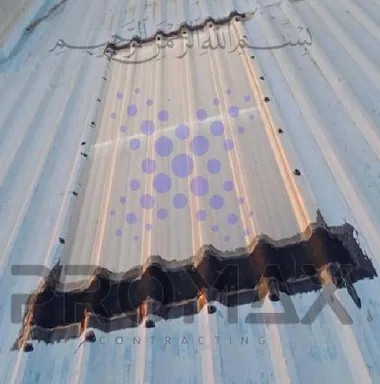
On metal roofs, recurring failures often come from aged fasteners, loosened overlaps, damaged sealant, corroded sheets, and poor ridge or gutter connections. If the contractor does not inspect these points closely, the repair plan may be incomplete from day one.
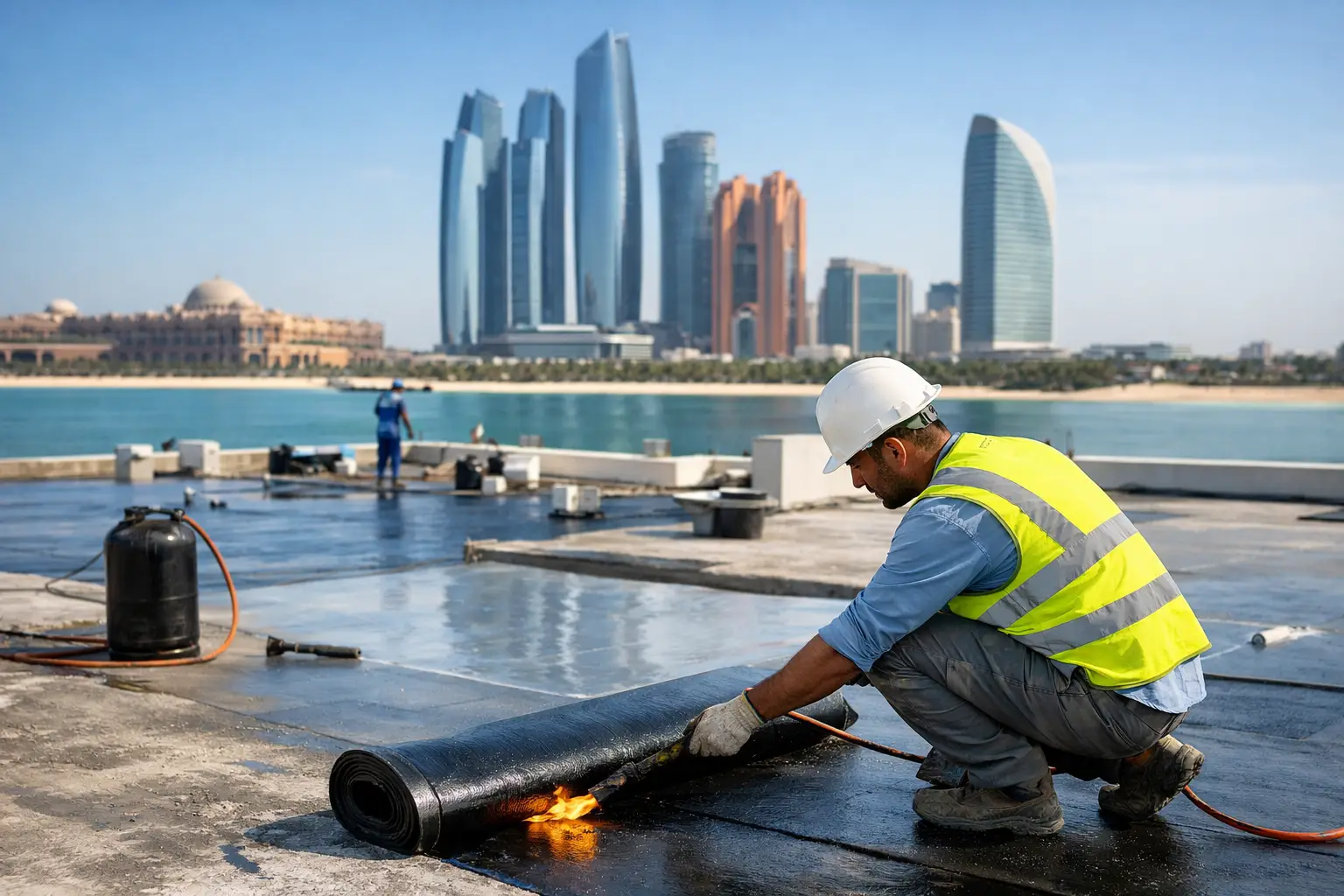
On concrete roofs, the main issues are often hairline cracking, failed joints, poor slope, water ponding, parapet upturn defects, and deterioration around service entries. A proper solution may involve crack treatment, joint repair, surface preparation, membrane installation, and drainage correction together.
Gutters are another major source of hidden leakage. Overflow, joint opening, rust perforation, poor support alignment, and blocked outlets all push water back into the building envelope. In many industrial sites, gutter rehabilitation or replacement is as important as roof membrane work.
Skylights, duct curbs, and pipe penetrations deserve special attention because they move differently from the surrounding roof. A contractor that treats them with the same generic method used on flat field areas is asking for callbacks.
The trade-off between emergency patching and long-term repair
There are times when immediate containment is necessary. Active leakage over operations, storage, or electrical areas may require urgent temporary sealing to reduce damage. That is a valid first step. The problem comes when temporary work is sold as a full solution.
A reliable contractor will tell you when a patch is only buying time and when a section needs proper rehabilitation. This honesty matters. Short-term emergency work has value, but only if it leads to a planned permanent repair based on inspection findings.
For procurement teams, this is often the right balance: stabilize the issue fast, then approve a defined corrective scope after technical review. It protects operations without locking the site into repeated reactive spending.
What a strong contractor relationship looks like
The best results usually come from contractors who can stay involved beyond the first repair. Waterproofing is not always one-and-done, especially on older industrial assets. Buildings with heat stress, roof traffic, multiple penetrations, and past repair history benefit from periodic inspection and maintenance planning.
A contractor with engineering support, field crews, fabrication capability, and responsive after-sales service can address adjacent issues before they become leaks. That matters on facilities where one vendor relationship is expected to cover inspection, repair detailing, sheet metal adjustment, gutter work, and long-term roof protection. In that environment, companies such as Promax Contracting stand out when they combine inspection discipline with execution speed and practical site coordination.
If you are comparing options, do not just ask who can apply waterproofing. Ask who can diagnose why the system failed, correct the surrounding defects, and stay accountable after handover. That is usually the difference between another repair cycle and a durable fix that protects the building the way it should.
Talk to Promax
Need this on your roof? Call +971 56 727 4205 or request a free inspection. Promax provides EPDM metal-roof, concrete and industrial waterproofing across Dubai and the UAE with up to a 15-year warranty.