A warehouse rarely fails all at once. It starts with a roof fastener backing out, a gutter holding water, a skylight curb opening up, or a joint that was sealed once and forgotten. That is why choosing the best waterproofing systems for warehouses is not just about product selection. It is about matching the system to the roof type, leak source, operating conditions, and expected service life.
For facility managers and industrial property owners, the wrong waterproofing approach usually costs more than the original leak. Water ingress damages stock, insulation, electrical runs, ceiling systems, steel members, and floor safety. It also creates repeat shutdowns, emergency callouts, and patchwork repairs that never address the real failure point. The better approach is to look at the warehouse as a full envelope system - roof sheets, laps, penetrations, joints, gutters, drainage, and exposed details all working together.
What makes a warehouse waterproofing system effective
The best-performing systems do three things well. First, they bond properly to the actual substrate on site, whether that is metal roofing, concrete, old membranes, parapet upstands, or fabricated flashing details. Second, they remain stable under heat, UV exposure, movement, and standing water. Third, they can be installed with proper detailing around weak points such as skylights, pipe penetrations, valley gutters, roof laps, and expansion joints.
This is where many warehouse projects go off track. A coating may perform well on clean, prepared metal but fail quickly on corroded sheeting. A membrane may be excellent across large field areas but underperform if drainage remains poor. A sealant-only repair may stop a local leak for a short period but will not solve widespread fastener failure or deteriorated panel laps. In warehouse environments, the system is only as good as the inspection, surface preparation, and detail treatment behind it.
Best waterproofing systems for warehouses by application
EPDM membrane systems
EPDM remains one of the most dependable options for large warehouse waterproofing projects, especially where long-term weather resistance and flexibility matter. It performs well on roofs exposed to strong sun, thermal cycling, and movement. In practical terms, that makes it a strong fit for large-span structures, aging industrial roofs, and facilities where repeated minor movement can open weaker systems over time.
A properly installed EPDM system gives consistent coverage across broad roof areas while also allowing detail treatment around penetrations and edge conditions. It is particularly effective when the roof requires more than local patching but does not yet justify full replacement. The trade-off is that installation quality is critical. Poor substrate preparation, weak seam execution, or unresolved drainage issues can shorten service life. For warehouses, EPDM works best when paired with proper edge detailing, joint treatment, and drainage correction rather than treated as a simple overlay.
Liquid-applied waterproofing coatings
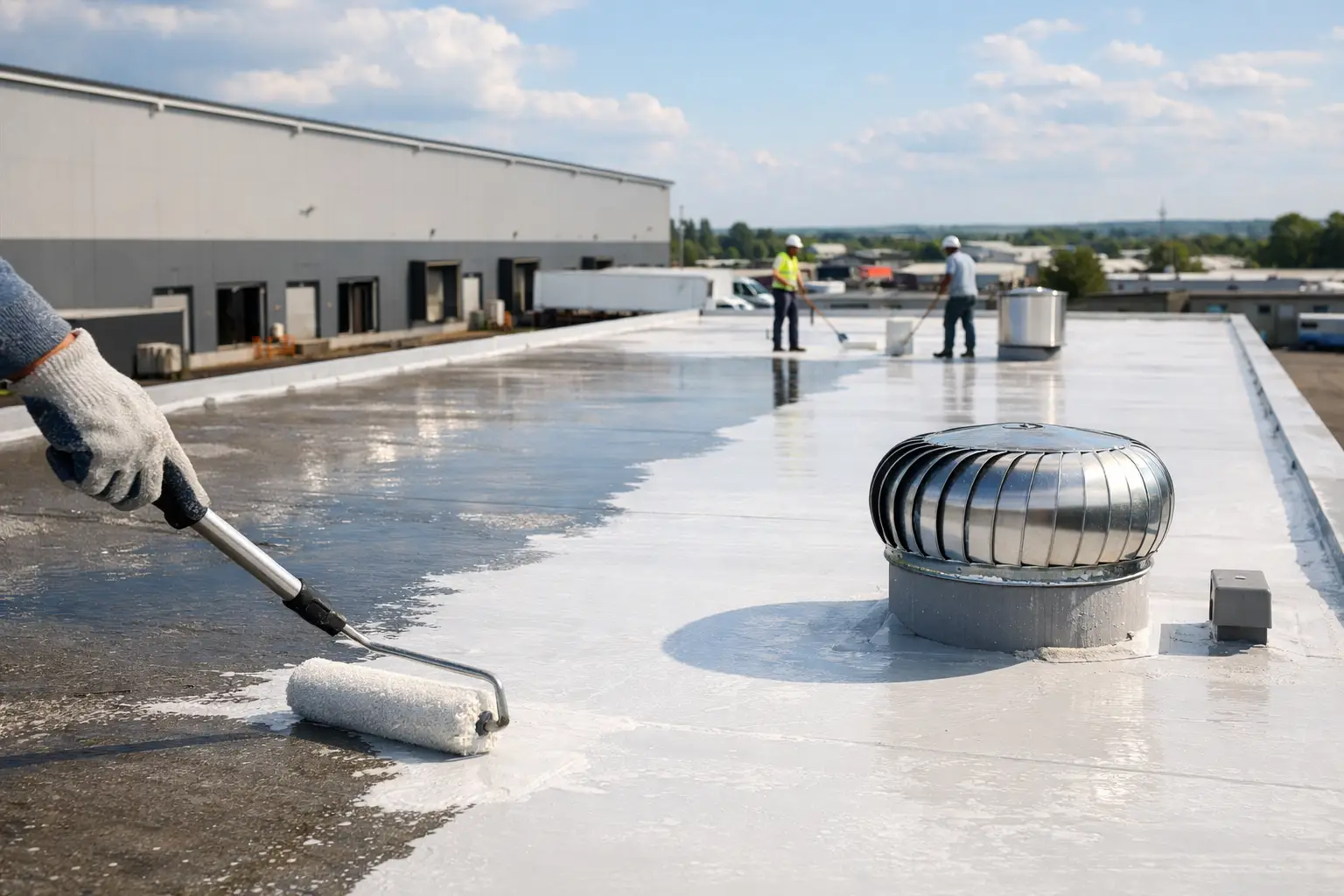
Liquid systems are often selected for complex roof geometries where penetrations, curbs, supports, and irregular transitions make sheet application difficult. They can be useful on metal roofs, concrete roof slabs, canopy sections, and localized areas that need a continuous waterproof layer without many seams.
Their strength is adaptability. A liquid-applied membrane can conform around details that would otherwise need multiple fabricated pieces or difficult membrane cuts. That said, not all liquid coatings are equal. Film thickness, curing conditions, UV resistance, and substrate compatibility all matter. In a warehouse setting, liquid systems can perform very well for detail zones and rehabilitation work, but they should not be treated as a universal answer for every roof. If the substrate is unstable, badly rusted, or poorly prepared, the coating will only follow the weakness underneath.
Metal roof waterproofing systems
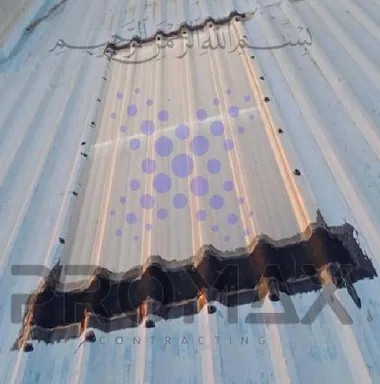
For sheeted warehouse roofs, waterproofing often needs to address more than surface exposure. Leaks commonly come through side laps, end laps, screw points, flashing joints, ridge details, and gutter interfaces. In those cases, the best system is usually a combined treatment rather than one material used everywhere.
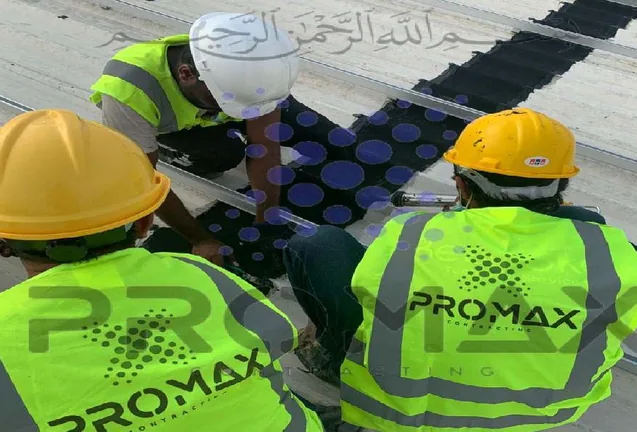
A proper metal roof waterproofing scope may include fastener replacement or treatment, rust removal, lap sealing, patch repairs, flashing fabrication, and membrane or coating application over prepared sections. This is more effective than isolated sealant work because it deals with the routes water actually follows. Metal roofs expand, contract, and vibrate. Any system installed over them has to tolerate movement and maintain adhesion over time.
Joint and penetration sealing systems
Some warehouse leaks are not field-area failures at all. They come from service penetrations, pipe sleeves, cable entries, AC stands, exhaust bases, and expansion joints. These are high-risk points because they combine movement, water exposure, and difficult geometry.
For these details, the best waterproofing system is a reinforced, detail-focused assembly using compatible primers, tapes, sealants, flashing components, and protective membrane layers. A low-cost sealant bead applied over an active joint is rarely enough. In industrial buildings, penetrations need a system approach that accounts for movement, heat, and maintenance access. This is especially true where multiple contractors have modified the roof over time and left mixed materials behind.
Concrete roof waterproofing systems
Some warehouses and logistics buildings include concrete roof areas, service decks, or podium-type sections. These require a different strategy from metal roofing. Concrete can crack, absorb moisture, and hold contamination that affects adhesion. The right system depends on whether the issue is slab porosity, active cracks, failed old membrane, or water entering through joints and parapet transitions.
For concrete surfaces, liquid membranes and sheet membranes are both common options, but the decision should be based on condition and access. Where cracks and movement are active, crack treatment and joint detailing become as important as the membrane itself. Where there is ponding, drainage redesign may be needed before any waterproofing layer is applied.
The most common reason warehouse waterproofing fails
The most common failure is not material weakness. It is incomplete scope. Many warehouse roofs receive partial repairs when the leak pattern is already systemic. A contractor seals a visible gap but does not address wet insulation, blocked gutters, rusted fasteners, failed flashing, or open lap joints ten feet away. The building stops leaking for a few weeks or one season, then the problem returns in a different location.
That is why inspection matters more than product marketing. A serious waterproofing contractor should assess roof condition, drainage paths, substrate stability, corrosion level, penetration details, and access limitations before recommending a system. On large facilities, testing and sectional investigation are often necessary because the visible leak point inside the warehouse may be far from the actual entry point on the roof.
How to choose the best waterproofing systems for warehouses
Start with the roof type and failure mode. If the building has a metal roof with widespread lap and fastener issues, a detail-heavy metal roof rehabilitation system will usually outperform random coating repairs. If the roof has broad exposure, recurring movement, and aging surfaces, EPDM may provide better long-term value. If the roof is full of curbs, supports, and service penetrations, a liquid-applied system may solve detail complexity more efficiently.
Then look at operations. A warehouse that cannot tolerate interruption may need phased installation, off-hour access, or systems with manageable cure times. A facility storing moisture-sensitive goods may justify a more comprehensive scope because the cost of one leak event is higher than the cost of preventive treatment. A short-term leased property may choose targeted waterproofing in critical zones, while an owner-operated industrial site usually benefits from a longer service-life approach.
Finally, consider support after installation. Waterproofing is not only a materials package. It is also documentation, workmanship, detail execution, and response when a new issue appears. The strongest projects are usually the ones backed by a contractor that can inspect, fabricate flashing, treat corrosion, correct drainage, and handle related repair items under one scope. That reduces interface gaps between trades and speeds up resolution.
Where owners get the best return
The best return usually comes from solving the roof as an operating asset, not as an isolated leak ticket. That means combining waterproofing with gutter correction, skylight treatment, rust control, joint repair, and preventative maintenance where needed. In practice, warehouse owners save more when they stop recurring water entry at the envelope level than when they keep paying for emergency patching after every storm.
This is where an execution-driven contractor adds value. Promax Contracting typically approaches warehouse waterproofing this way - inspect first, define the actual failure path, match the right membrane or coating system, and complete the detail work that determines whether the repair lasts.
If you are comparing systems, do not ask only which material is best. Ask which system fits your roof condition, your building use, and your risk tolerance. That is usually where the real waterproofing decision gets made.
Talk to Promax
Need this on your roof? Call +971 56 727 4205 or request a free inspection. Promax provides EPDM metal-roof, concrete and industrial waterproofing across Dubai and the UAE with up to a 15-year warranty.