A roof leak in a warehouse is rarely just a roof leak. It usually shows up as damaged stock, interrupted operations, ceiling staining, corrosion around purlins, failed insulation, and a maintenance team under pressure to fix the problem fast. That is why selecting among waterproofing companies in Dubai should never be treated as a basic vendor comparison. For industrial and commercial facilities, the contractor’s inspection method, repair scope, material system, and response speed all affect how long the fix will actually last.
Dubai buildings face a hard combination of heat, UV exposure, dust, thermal movement, occasional heavy rain, and aging roof details that were never designed for years of patchwork repairs. In that environment, waterproofing is not just about applying a membrane. It is about understanding where water enters, how the substrate has deteriorated, and what supporting repairs are needed so the waterproofing system does not fail at the first weak point.
What separates strong waterproofing companies in Dubai
The gap between an average contractor and a specialized waterproofing team usually becomes clear at the inspection stage. A weak contractor looks at the visible leak point and prices a coating. A capable contractor checks slopes, ponding areas, open joints, gutter capacity, pipe penetrations, skylight edges, screw conditions, flashing details, rusted roof sheets, concrete cracks, parapet connections, and previous repair layers.
This matters because many leaks are secondary symptoms. Water may appear inside below a joint, but the actual entry point could be several meters away. On metal roofs, failed fasteners, lap joints, corroded sheets, and thermal expansion can all work together. On concrete roofs, the problem may be hairline cracking, membrane fatigue, poor detailing around upstands, or drainage issues rather than a single membrane puncture.
A serious contractor also understands that waterproofing often overlaps with fabrication and repair works. If gutters are undersized or rusted through, membrane application alone will not solve overflow. If roof sheets are structurally weak, surface treatment without replacement may only delay failure. If insulation below the roof has already been compromised, the repair strategy has to address more than surface protection.
What commercial clients should evaluate first
For facility managers and engineers, the first question is not price. It is scope accuracy. A low quote built on incomplete diagnosis usually turns into repeat callouts, temporary patching, or a second contractor being brought in later to correct the original work.
Start by reviewing whether the contractor can clearly explain the leakage path and the repair logic. If the proposal only says waterproof coating application, that is not enough for a large commercial or industrial asset. A proper scope should identify substrate condition, surface preparation, joint treatment, detail treatment, membrane or coating type, required sheet repairs, drainage corrections, and protection of surrounding areas during execution.
The second point is system suitability. Different roof conditions require different approaches. EPDM-based systems, liquid-applied membranes, bituminous treatments, crack injection, sealant replacement, and localized metal rehabilitation each have their place. The right choice depends on substrate type, movement, exposure, geometry, and the expected service life. There is no one universal solution, and contractors who sell one product for every problem usually create long-term risk.
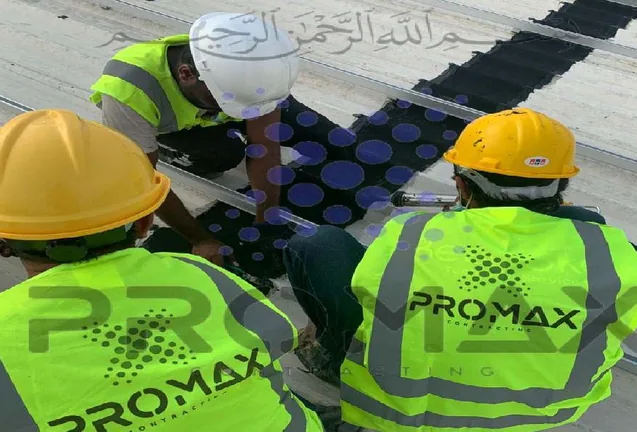
The third point is execution capacity. Many waterproofing failures happen because details are poorly installed, not because the material itself is wrong. Large roofs, operating facilities, and complex penetrations need disciplined surface preparation, trained installers, and active site supervision. Industrial buyers should ask who is doing the work, how areas will be phased, and how quality will be checked before handover.
Common problem areas that need more than coating
On warehouses, factories, and large sheds, some areas fail more often than others. Roof laps, end joints, pipe penetrations, AC supports, skylight perimeters, gutters, and wall-to-roof junctions are common weak points. These details move, collect debris, or stay wet longer than open field areas, so they need more attention than a broad coating pass.
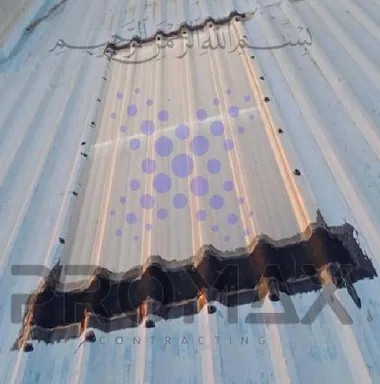
Metal roofs are especially sensitive to fastener condition and corrosion. If screws are loose, missing, or rusted, water can bypass even a new surface layer. If panels have corrosion around overlaps or fixing points, restoration may require sheet replacement, screw treatment, purlin checks, and sealing at multiple layers before the final waterproofing system is applied.
Concrete roofs bring a different set of issues. Cracks, construction joints, parapet intersections, and ponding areas can all break down a standard treatment if they are not properly prepared. In many cases, the contractor needs to combine crack repair, slope correction, joint sealing, and membrane work. That is why broad claims about full waterproof protection should always be tested against the actual roof condition.
Why after-sales response matters as much as installation
Commercial clients often focus heavily on the installation period, but after-sales response is just as important. Even a well-executed system may need follow-up inspection after rain, particularly on older roofs with multiple existing conditions. If the contractor disappears after payment, the client is left managing defects, access coordination, and operational risk alone.
Reliable waterproofing companies in Dubai typically stand out by how they handle callouts, inspection reports, and maintenance support after completion. That includes documented handover, clear defect accountability, and the ability to return quickly if a specific area needs adjustment. For facilities that operate around inventory, machinery, or tenants, that responsiveness is not a bonus. It is part of the service.
This is also where contractor structure matters. A company with in-house technical teams, fabrication capability, and field supervision can usually address related defects faster than a vendor that depends entirely on outsourced labor. If a leaking roof also needs gutter replacement, flashing fabrication, sheet repairs, or access system adjustments, a broader execution model reduces delay and coordination gaps.
How to compare proposals without missing the risk
When two waterproofing proposals look similar on paper, the real differences are often hidden inside surface preparation, detail coverage, and exclusions. One contractor may include cleaning, rust treatment, joint reinforcement, penetration detailing, and drainage corrections. Another may only include a topcoat over existing conditions. The price gap can look large, but the scope gap is usually the real issue.
It also helps to review how the contractor handles live-site constraints. Warehouses, factories, schools, and occupied commercial properties cannot always stop operations for repair work. Access timing, safety control, weather planning, material handling, and protection of equipment below the work area all affect project performance. A contractor that understands industrial environments will address these practical conditions early instead of treating them as site surprises.
Documentation is another useful indicator. Professional contractors issue structured inspection findings, material recommendations, work sequence details, and completion records. That does not mean every project needs overcomplicated paperwork. It means the client should be able to see what was found, what was repaired, and what system was installed.
The value of a contractor that can see the full envelope
Waterproofing does not exist in isolation. Many roof leaks are connected to aging gutters, failing sealants, corroded metal surfaces, damaged skylights, weak flashing, or poor transitions between building elements. Contractors who only handle one narrow repair item may solve a visible symptom while leaving adjacent failure points untouched.
That is why many commercial clients prefer a specialist that can inspect, fabricate, repair, seal, coat, and maintain under one scope. A one-stop contractor reduces handoff errors and makes responsibility clearer. For facilities with recurring leakage or widespread roof deterioration, that integrated approach is usually more cost-effective than splitting the work across multiple vendors.
Promax Contracting follows that execution model by combining inspection, waterproofing, roof rehabilitation, metal repair, fabrication support, and after-sales response for industrial and commercial sites. For clients dealing with recurring leaks, roof corrosion, or drainage-related damage, that kind of service depth can make the difference between another temporary patch and a repair program that actually holds.
The right contractor is not the one with the broadest promises. It is the one that can inspect accurately, explain the failure, repair the supporting defects, install the right system, and respond when the building needs support again. When you are reviewing waterproofing companies in Dubai, that is the standard worth paying for.
Talk to Promax
Need this on your roof? Call +971 56 727 4205 or request a free inspection. Promax provides EPDM metal-roof, concrete and industrial waterproofing across Dubai and the UAE with up to a 15-year warranty.