A roof leak over a warehouse aisle, production line, or tenant unit is rarely just a roof issue. It turns into damaged stock, safety exposure, shutdown risk, mold growth, rusted steel, and repeat repair costs that keep coming back because the original source was never properly diagnosed. This commercial roof waterproofing guide is written for facility managers, engineers, and property teams who need durable waterproofing decisions, not temporary patchwork.
What commercial roof waterproofing actually needs to solve
On a commercial building, waterproofing is not only about stopping visible water entry. The system also has to deal with ponding water, thermal movement, UV exposure, roof traffic, equipment penetrations, failed laps, aging fasteners, gutter overflow, and corrosion around metal interfaces. In industrial and warehouse environments, these issues often exist together.
That is why a waterproofing scope should be built around the roof condition, the substrate, and the building operation below. A concrete roof with hairline cracking needs a different treatment strategy than a long-span metal roof with loose screws and rust at overlaps. A clean office building roof may allow broad replacement access, while an operating factory often requires phased execution with minimal disruption.
The right approach starts with identifying where water enters, how it travels, and what is causing the failure. In many cases, the leak point visible inside is not directly under the roof defect. Water can migrate along insulation, deck profiles, purlins, or service penetrations before it appears indoors.
Commercial roof waterproofing guide for common roof types
Metal roofs
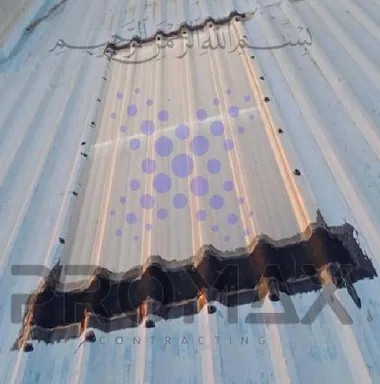
Metal roofs are common on warehouses, logistics sheds, workshops, and industrial units. They fail in predictable ways. Fastener loosening, washer deterioration, rust formation, lap joint separation, failed sealant lines, and thermal expansion can all create water entry paths.
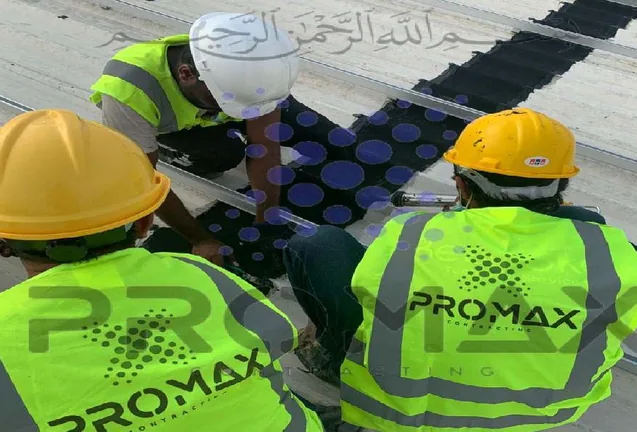
A proper system for metal roof waterproofing usually includes surface preparation, rust treatment where required, screw inspection and replacement, treatment at laps and penetrations, and installation of a membrane or coating system suited to metal movement. EPDM-based systems are often selected where long-term elasticity and joint performance matter. The detail work is the difference between a roof that performs and a roof that leaks again at every penetration.
Concrete roofs
Concrete roofs present a different challenge. Cracks, porous surfaces, failed old coatings, movement at construction joints, and weak upturn detailing around parapets are common failure points. Concrete also traps moisture differently than metal, so surface condition and moisture content matter before any system is applied.
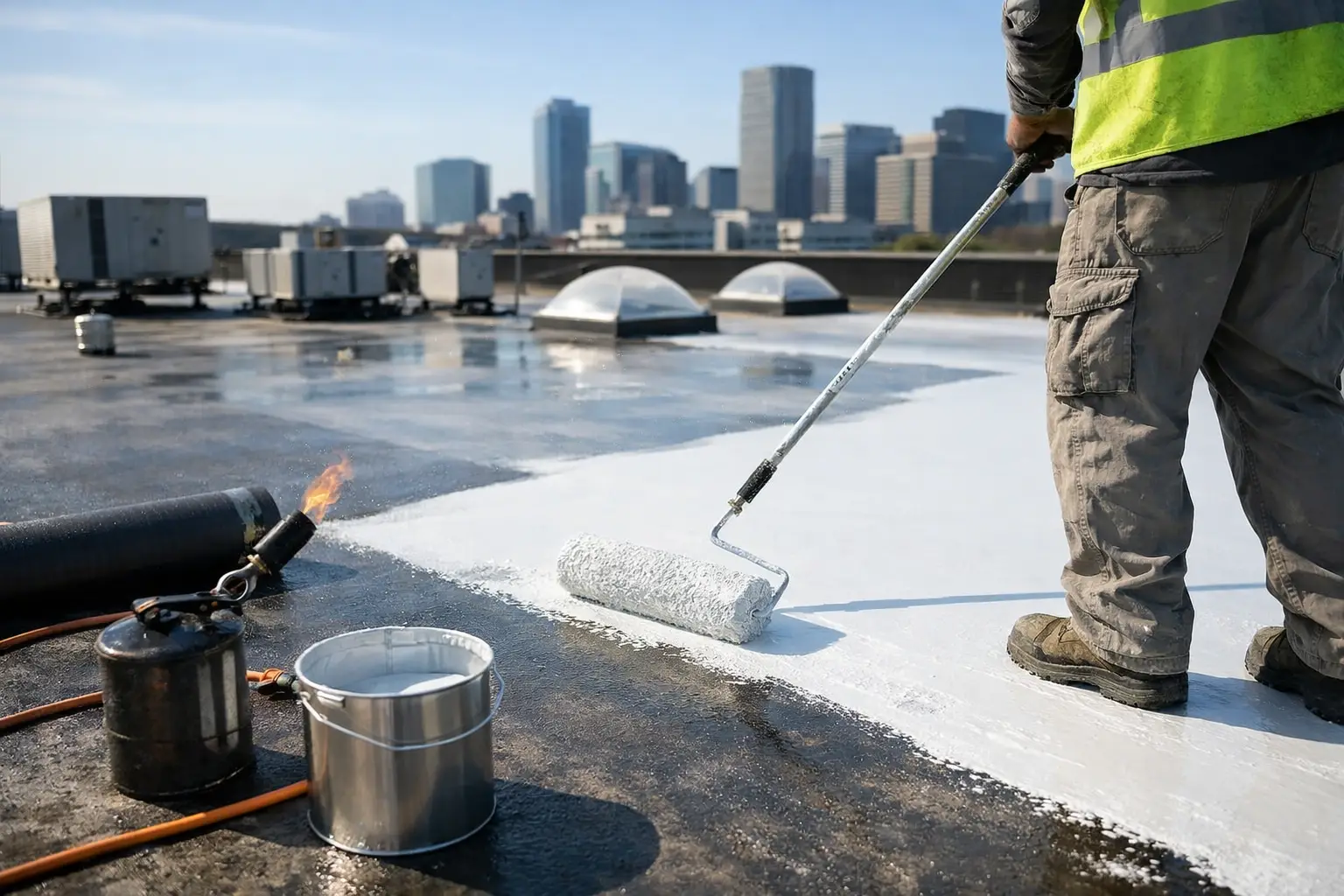
Waterproofing for concrete roofs may involve crack treatment, local repair mortar, primer application, reinforced membrane installation, and detailing around drains, upstands, ducts, and equipment bases. If the roof already has multiple old layers, partial removal may be necessary. Installing a new waterproofing layer over an unstable substrate only hides the problem for a short time.
Roofs with penetrations and service equipment
Commercial roofs rarely stay simple. Skylights, exhaust fans, ducts, cable trays, solar supports, access frames, and pipe penetrations all interrupt the waterproofing plane. These areas fail earlier than field areas because they combine movement, vibration, and difficult geometry.
A good contractor does not treat penetrations as an afterthought. They build the waterproofing scope around them. That can mean prefabricated flashing details, pipe collar systems, reinforced membrane corners, metal curb repairs, and slope correction around service bases.
Inspection comes before material selection
Many owners start by asking which waterproofing product is best. The better question is which system matches the roof condition and failure mode. Product-first thinking is how many commercial roofs end up with expensive coatings over wet insulation, membranes over active corrosion, or sealants over open structural movement.
A proper inspection should document roof age, substrate type, previous repairs, drainage layout, ponding zones, failed details, corrosion, crack patterns, insulation condition, and access limitations. Moisture mapping and localized opening-up may also be justified on larger assets. Without this step, the scope is guesswork.
This is also where cost decisions become clearer. A lower-cost patching program can be valid if the roof is still structurally sound and failures are localized. If the roof has system-wide deterioration, repeating local repairs usually costs more over two to three rainy seasons than a planned rehabilitation.
Choosing between repair, overlay, and replacement
Not every leaking roof needs full replacement. Not every aging roof should be patched either. The correct decision depends on service life, substrate integrity, operational risk, and budget timing.
Repair is practical when defects are isolated and the surrounding roof remains sound. This often works for limited fastener failure, local punctures, isolated joint defects, or a small number of penetration leaks.
Overlay or rehabilitation is appropriate when the roof structure is viable but the waterproofing layer has reached the end of its performance. This can include membrane upgrades, reinforced coating systems, or roof-wide treatment after extensive preparation and detailing.
Replacement is usually the right call when corrosion has compromised metal sheets, trapped moisture has destroyed insulation, concrete deterioration is widespread, or previous repair history shows repeated failure. Replacement costs more upfront, but it reduces risk when the existing roof has become unreliable as a base.
The drainage issue many buildings ignore
A waterproofing system will struggle if drainage is poor. Blocked outlets, undersized gutters, bad slope, sagging channels, and overflow points can turn a manageable roof into a constant leak source. In heavy rainfall, water finds weaknesses faster under hydrostatic pressure and standing water conditions.
This is why drainage corrections often need to be included in the waterproofing scope. Gutter replacement, downpipe repair, drain box modification, overflow provision, and localized slope improvement can be just as important as the membrane itself. If drainage is ignored, even a good waterproofing installation can be pushed beyond its intended performance.
Why detailing matters more than product brochures
Most commercial roof failures start at transitions, not open roof areas. Parapet upturns, roof-to-wall joints, skylight perimeters, lap edges, anchor points, and pipe penetrations are the first places to inspect and the first places to execute correctly.
This is also where contractor capability shows. Good detailing requires fabrication support, field measurement accuracy, trained installation teams, and supervision that understands how the roof behaves in service. A technically strong waterproofing contractor will pay close attention to terminations, overlaps, fastener treatment, edge security, and compatibility between new and existing materials.
If two proposals look similar on paper but one includes detailed treatment of joints, penetrations, gutters, and corroded sections, that proposal usually reflects a more realistic understanding of site conditions.
What to expect from a reliable waterproofing scope
A serious commercial roof waterproofing guide should be honest about execution. Good waterproofing is not just material supply. It is inspection, substrate preparation, repair sequencing, detail treatment, installation control, and post-completion support.
At minimum, a strong scope should define surface preparation requirements, repair areas, membrane or coating build-up, penetration detailing, drainage corrections, termination methods, and inspection procedures. It should also state what is excluded. Ambiguity in commercial maintenance contracts usually becomes a variation later.
For occupied facilities, method statements and access planning matter too. Work over live operations may require phased zones, night work, fire controls, temporary weather protection, or special safety access systems. The best contractor is not always the cheapest bidder. It is often the one that understands how to execute without creating a second problem on the ground.
Maintenance after waterproofing is not optional
Even a high-quality waterproofing system needs periodic inspection. Roofs age under UV, heat, dust, movement, and service traffic. Drains clog. New equipment gets installed. Other trades damage details without reporting it.
A practical maintenance program includes regular inspection after storms, cleaning of drains and gutters, review of penetrations, and repair of accidental damage before it spreads. For industrial properties, this is especially important where rooftop access is frequent and equipment is regularly modified.
Owners who treat waterproofing as a one-time purchase usually end up paying for emergency response later. Owners who treat it as an asset protection program extend roof life and avoid disruption.
If your building has recurring leaks, rusting roof sections, failed gutters, or waterproofing that has been patched too many times, the next step should be a technical inspection, not another tube of sealant. Companies such as Promax Contracting focus on this kind of site-led diagnosis and execution because the real fix starts with understanding the roof as a working system. The best time to address a roof problem is before the next storm tests every weak point at once.
Talk to Promax
Need this on your roof? Call +971 56 727 4205 or request a free inspection. Promax provides EPDM metal-roof, concrete and industrial waterproofing across Dubai and the UAE with up to a 15-year warranty.