A concrete roof usually does not fail all at once. It starts with hairline cracking at movement joints, ponding around low spots, weak detailing at pipe penetrations, or old patchwork that lets water travel below the surface. That is why effective concrete roof waterproofing solutions have to address the whole roof system, not just the visible leak point.
For commercial and industrial facilities, the cost of getting this wrong is rarely limited to the roof slab. Water ingress can damage insulation, electrical runs, stock, ceiling finishes, machinery zones, and production schedules. In hot climates, the roof is also under constant thermal movement, which means any system chosen for waterproofing has to manage expansion, UV exposure, and drainage without creating new weak points.
Why concrete roofs leak even when the slab looks sound
Concrete is durable, but it is not naturally waterproof in service conditions. It is porous, it expands and contracts, and it develops cracks over time. On large warehouse roofs, factory roofs, and service buildings, these issues are amplified by long spans, multiple penetrations, equipment supports, and inconsistent slopes.
In many cases, the leak seen inside the building is not directly below the roof defect. Water can enter at one point, track along the slab or through construction joints, and appear several feet away. That is why a proper inspection matters before specifying a membrane or coating. If the contractor skips diagnosis and goes straight to product application, the system may look complete but still fail during the next heavy rain.
Common failure points include roof cracks, parapet wall junctions, pipe penetrations, drain surrounds, expansion joints, and deteriorated previous coatings. Standing water is another major issue. Even a high-quality system can be shortened by poor drainage design or blocked outlets.
Concrete roof waterproofing solutions for commercial buildings
The right system depends on roof condition, traffic level, movement, exposure, and whether the objective is repair, rehabilitation, or full long-term protection. There is no single product that fits every slab.
Liquid-applied waterproofing systems
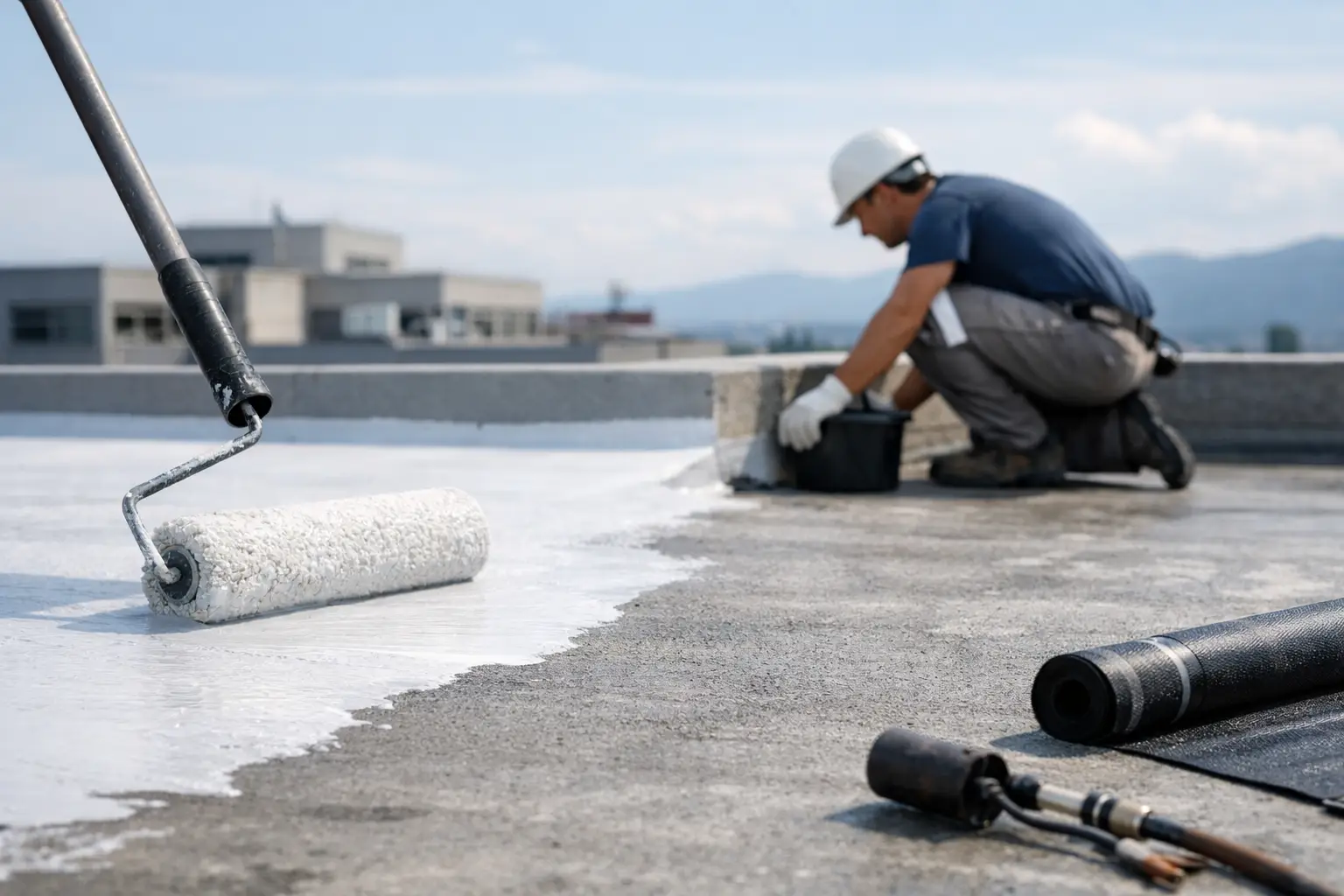
Liquid-applied systems are widely used on concrete roofs because they can form a continuous membrane over irregular surfaces and detailed areas. They are especially useful where the roof has multiple upstands, penetrations, and service bases that are difficult to treat with sheet materials alone.
The advantage is coverage continuity. A properly applied liquid membrane can seal complex shapes and reduce the number of lap joints. The limitation is that performance depends heavily on surface preparation, film thickness control, curing conditions, and applicator discipline. If the substrate is damp, contaminated, or unstable, adhesion problems can develop early.
These systems are often a good option for refurbishment projects where the concrete remains structurally sound and the roof geometry is complicated. They are less forgiving when applied over unresolved cracks or movement zones without reinforcement detailing.
Sheet membrane systems
Sheet membranes remain one of the most reliable concrete roof waterproofing solutions when long-term durability and predictable thickness are priorities. EPDM-based systems are particularly effective in demanding roof rehabilitation work because they handle movement well and can provide durable coverage over large areas.
A sheet membrane system is only as good as its detailing. Around outlets, terminations, corners, and penetrations, the workmanship has to be precise. Poor seam treatment or rushed edge termination can compromise an otherwise strong membrane field. For industrial facilities, this is where experienced installation teams make the difference.
Sheet systems are often preferred where roof access is controlled, where long service life is a priority, and where the owner wants a defined membrane build-up rather than a site-formed coating layer.
Cementitious and crystalline treatments
These are used in specific applications, usually where negative-side moisture control, internal damp resistance, or substrate treatment is part of the requirement. They can support a waterproofing strategy, but they are not always sufficient as the primary exposed roof membrane on their own.
For exposed commercial roofs facing strong sun, standing water, and structural movement, these systems usually need to be considered carefully within the wider roof build-up. They are more effective when matched to the right substrate condition and exposure profile.
Crack injection and localized repair systems
If the roof problem is isolated, targeted repair may be possible. Crack filling, joint repair, concrete patching, and detail sealing can stop active ingress and restore specific failed areas. This can be cost-effective when the roof is generally in serviceable condition.
The risk is using localized repair on a roof that has already reached system-wide failure. If multiple areas are deteriorating, patching can become a repeating maintenance expense. A good inspection should separate isolated defects from signs that the entire waterproofing layer has aged out.
What good waterproofing design looks like in practice
The membrane itself is only part of the solution. Durable roof treatment depends on how the system is built around real site conditions.
Surface preparation comes first. The concrete has to be cleaned, sound, and properly profiled. Loose coatings, dust, laitance, oil contamination, and failed repair materials must be removed. If moisture is trapped in the slab, that has to be assessed before selecting primers or membranes.
Cracks need to be classified, not just filled. Static hairline cracks can be treated differently from active movement cracks. Construction joints and expansion joints need flexible detailing, not rigid patch material that will reopen under thermal stress.
Drainage cannot be ignored. A waterproof membrane over a roof with poor falls is still a roof with a problem. If water ponds for extended periods, membrane stress increases and defects show up faster. In many roof rehabilitation projects, correcting outlets, improving falls, or rebuilding drain zones is just as important as membrane installation.
Terminations also matter. Waterproofing fails early at edges, upturns, parapets, and penetrations when these details are not mechanically secure and weather-tight. That is why inspection should cover metal flashings, coping interfaces, skylight zones, pipe sleeves, and equipment bases as part of the same scope.
Choosing the right concrete roof waterproofing solutions
For facility managers and project teams, selection should be based on roof condition and building risk, not just material cost per square foot. A lower upfront price can become expensive if shutdowns, internal damage, and repeat repairs follow.
If the roof has widespread cracking, repeated leakage, and failed old coatings, a full rehabilitation system is usually more practical than continued patching. If the roof is relatively new but has isolated leakage at penetrations or joints, focused repair and detail treatment may be enough. If the facility runs sensitive equipment or storage below, the specification should favor longer-life systems with dependable detailing and controlled installation methods.
Climate exposure should also drive the decision. In high-heat regions, UV resistance and movement tolerance are essential. A system that performs well in mild conditions may not last under constant thermal cycling and rooftop service activity.
This is also where a specialist contractor adds value. Inspection, testing, system recommendation, fabrication support for flashings or metal works, and after-sales response all affect long-term performance. Promax Contracting typically approaches these projects as building envelope problems rather than simple coating jobs, which is the right mindset for industrial assets with operational exposure.
Why maintenance still matters after installation
Even the best waterproofing system should not be left unchecked for years. Roofs on warehouses and plants collect dust, debris, and service traffic damage. Drains clog. Unauthorized penetrations get added. Mechanical works disturb completed details.
A maintenance plan helps protect the investment. Periodic inspection can catch early defects at joints, terminations, drains, and penetrations before they turn into interior leakage. This is especially important after storms, rooftop equipment changes, or other contractor activity.
The goal is not constant repair. The goal is to keep a good system performing as designed and to prevent small defects from developing into slab-level deterioration, corrosion of embedded steel, or disruption inside the facility.
When replacement is better than another patch
Many owners delay full roof treatment because patch repairs appear cheaper in the short term. Sometimes that is reasonable. But if leaks are recurring across multiple zones, if old membranes are losing adhesion, or if the slab and details have already been compromised, more patchwork only extends uncertainty.
A proper roof assessment should tell you whether the roof is still repairable in a controlled way or whether the risk profile now justifies system replacement. The right answer depends on age, defect spread, occupancy sensitivity, and how costly water ingress would be for operations.
A concrete roof should protect the building, not create a standing maintenance issue. The most effective approach is usually the one that starts with diagnosis, matches the system to real site conditions, and treats details with the same seriousness as the main roof area.
Talk to Promax
Need this on your roof? Call +971 56 727 4205 or request a free inspection. Promax provides EPDM metal-roof, concrete and industrial waterproofing across Dubai and the UAE with up to a 15-year warranty.