A forklift starts chattering across one aisle, tires leave dust where the floor used to be sealed, and a small chip near a joint turns into a growing break line. That is usually how epoxy floor repair enters the maintenance budget - not as a cosmetic issue, but as an operational one. In warehouses, plants, service yards, and back-of-house commercial spaces, floor failure affects safety, cleaning, traffic flow, and long-term concrete protection.
Epoxy systems are built to take abuse, but they are not permanent under every load profile and every site condition. Heavy point loading, substrate movement, impact damage, poor surface preparation, moisture vapor pressure, chemical exposure, and cleaning practices all affect service life. The right repair approach depends on what failed, why it failed, and whether the damage is isolated or systemic.
When epoxy floor repair is the right solution
Not every damaged epoxy floor needs full replacement. In many commercial facilities, localized epoxy floor repair restores serviceability faster and at a lower cost, especially when the substrate is still sound and the original coating system remains well bonded over most of the area.
This is common when damage is limited to wheel paths, loading zones, corner impacts, construction cuts, isolated blistering, or worn topcoat sections. A properly executed repair can stop delamination from spreading, restore chemical and abrasion resistance, and reduce trip hazards without taking an entire floor out of service.
That said, patch repair is not always the best answer. If peeling is widespread, moisture-related debonding is recurring, or the slab has multiple cracks reflecting through the coating, spot treatment may only delay a larger intervention. A contractor should inspect adhesion, slab condition, joint movement, and moisture behavior before recommending the scope.
What usually causes epoxy floor failure
Most floor failures are not random. They follow a pattern, and the pattern tells you how to repair the floor properly.
Poor substrate preparation
This remains one of the biggest reasons coatings fail early. If the concrete was not mechanically prepared to the correct profile, or if dust and laitance were left behind, the epoxy may bond only to weak surface material rather than to sound concrete. Under traffic and thermal cycling, that bond breaks down.
Moisture from below the slab
In humid climates and hard-working facilities, moisture vapor transmission is a serious factor. If hydrostatic pressure or vapor movement pushes upward through the slab, blistering, bubbling, and delamination can appear even when the coating product itself is high quality. In these cases, repair work without moisture control often fails again.
Impact, traffic, and point loading
Forklifts, pallet jacks, steel wheel equipment, dropped tools, and constant turning movements create concentrated stress. Over time, the topcoat wears, the body coat thins, and exposed zones begin to chip or fracture. Racking areas, dock approaches, and intersections typically show the earliest signs.
Chemical and thermal exposure
Oil, solvents, acids, hot washdown, and sudden temperature shifts can soften or stress the coating system. If the original specification did not match the service environment, the floor may discolor, lose gloss, soften, or separate from the substrate.
Joint and crack movement
Epoxy is durable, but it is not a cure for structural movement. Where active joints, slab cracks, or settlement are present, rigid repairs can re-crack if the underlying movement is not addressed. This is why repair details around control joints and moving cracks need careful system selection.
How a proper repair assessment is done
A reliable repair program starts with inspection, not with material selection. The floor should be mapped by damage type and severity. Sounding tests, pull-off adhesion checks, moisture testing, and substrate review help determine whether the issue is surface wear, bond failure, slab distress, or a combination of all three.
The inspection should also consider how the space is used. A warehouse with high forklift density needs a different repair approach than a food prep room, mechanical plant, showroom, or utility corridor. Cure time, slip resistance, chemical exposure, cleaning methods, and shutdown windows all affect the repair specification.
At this stage, decision-makers usually need a clear answer to three questions: Can the damage be isolated, will the repaired area visually blend with the existing floor, and how long can the floor stay in service after the work is completed? Those answers shape the method.
Common epoxy floor repair methods
There is no single repair method for every damaged floor. The scope depends on coating thickness, substrate condition, service requirements, and the reason the floor failed in the first place.
Chip and spall repair
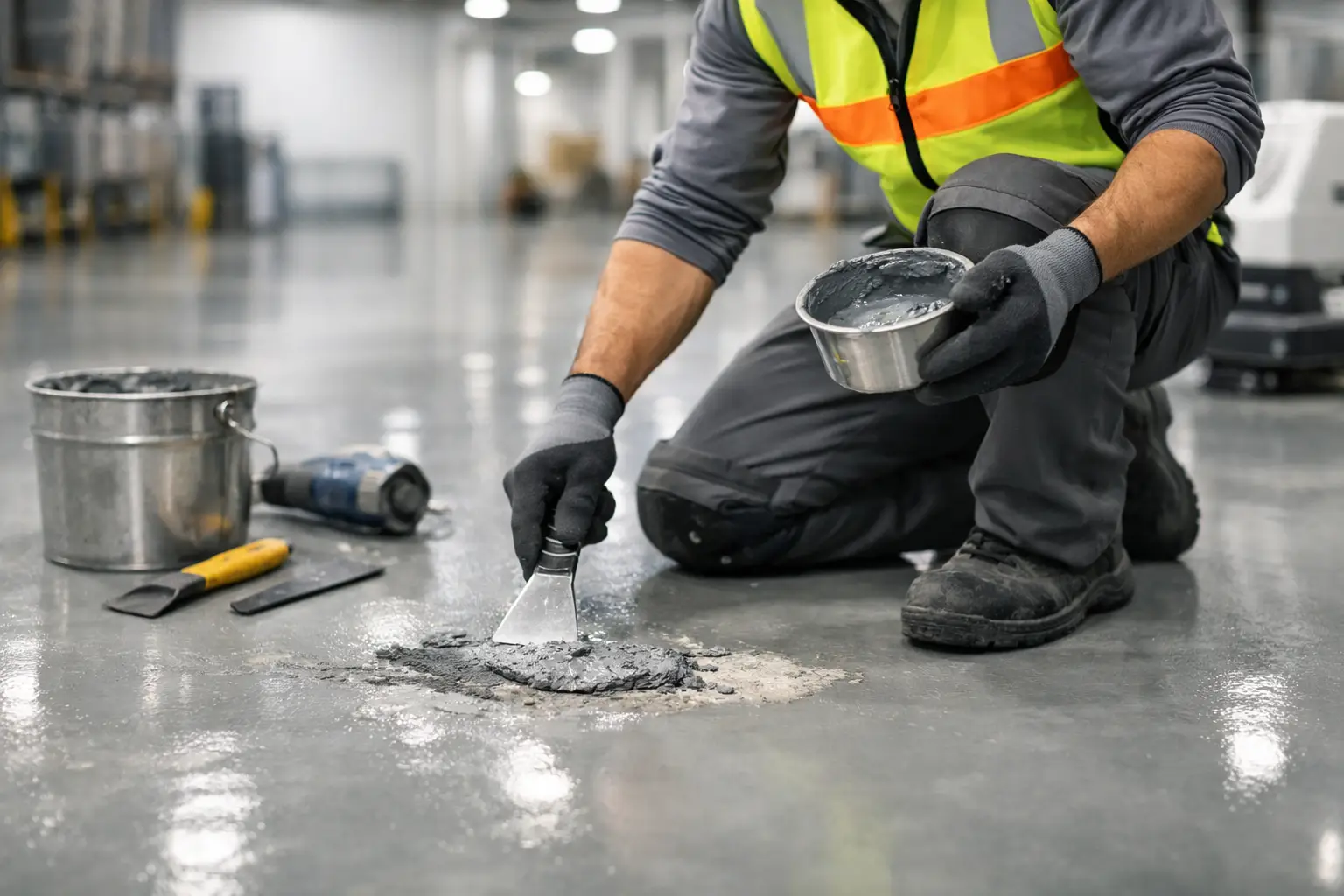
For localized impact damage, the broken area is cut back to sound edges, weak material is removed, and the exposed concrete is prepared mechanically. A compatible repair mortar or epoxy patching compound is then installed, leveled, and finished with the appropriate primer and topcoat. Edge integrity matters here. If the perimeter is weak, the patch will fail at the transition.
Delaminated coating removal and recoating
If the epoxy has lifted but the slab underneath is sound, the failed section is removed fully, not just trimmed at the visible peel line. The area is then ground or shot blasted, primed if required, rebuilt to the correct thickness, and top coated to restore protection. Partial delamination should never be coated over. Any loose bond left in place becomes the next failure point.
Crack and joint treatment
Cracks are routed, cleaned, and filled with a repair material suited to expected movement. Static cracks can often be stabilized and overcoated. Moving joints need flexible joint systems or dedicated sealant details rather than rigid filling alone. If joint movement is ignored, the new coating will reflect the same distress pattern.
Worn surface refresh
Some floors do not have structural coating failure. They are simply worn out at the top layer. In these cases, mechanical abrasion, surface cleaning, and application of a new topcoat can restore performance. This only works when the existing layers remain well adhered and contamination has been properly removed.
When partial repair becomes false economy
Facility teams often request spot repair to control immediate cost, and in many cases that is the right move. But there is a point where patching becomes more expensive than a controlled resurfacing program.
If damage is spread across multiple traffic lanes, if repairs keep returning in the same operational zones, or if the coating system no longer matches current loading and chemical exposure, piecemeal repairs may create ongoing shutdowns without solving the core issue. A full recoating or system upgrade may deliver better lifecycle value, even if the initial scope is larger.
This is especially true where moisture mitigation, slope correction, or substrate rehabilitation is needed before recoating. The floor should be treated as part of the building asset, not as a recurring cosmetic patch item.
Planning repairs without disrupting operations
In active commercial environments, the repair method is only half the job. The other half is execution planning. Access zones, cure schedules, ventilation, odor sensitivity, equipment movement, and safety segregation must be coordinated before work begins.
For some facilities, phased repair by aisle or bay is the most practical path. For others, a short shutdown with extended shifts gives better overall efficiency. Fast-return materials can help, but speed should not come at the expense of preparation quality. A floor that reopens quickly and fails early is not a saving.
Experienced contractors structure floor repairs around traffic patterns, loading hours, and operational criticality. That includes protecting adjacent finishes, sequencing surface preparation, and making sure repaired sections tie back into the existing system properly. Promax Contracting approaches this type of work with the same site-led planning used in other industrial maintenance scopes - inspect first, isolate the cause, and execute the repair around real operating conditions.
What facility managers should ask before approving a repair
Before issuing a purchase order, ask what caused the failure, how the substrate will be prepared, whether moisture testing has been done, what product build-up is proposed, and how long the repaired area needs before traffic returns. Also ask whether the repaired section is expected to color match exactly. In many older floors, performance matching is realistic, while visual blending may vary.
The more important question is whether the contractor is repairing symptoms or fixing the system. Good epoxy floor repair protects the slab, restores serviceability, and reduces repeat maintenance. It is not just about filling damaged spots with resin and rolling on fresh color.
A damaged floor rarely improves by waiting. Once coating failure opens the concrete to impact, moisture, and contamination, the repair scope usually grows. Early action gives you more options, better phasing, and a stronger chance of keeping a localized issue from becoming a full-floor shutdown.
Talk to Promax
Need this on your roof? Call +971 56 727 4205 or request a free inspection. Promax provides EPDM metal-roof, concrete and industrial waterproofing across Dubai and the UAE with up to a 15-year warranty.