A warehouse floor usually starts getting attention only after operations feel the damage - dust buildup on stored goods, tire marks that will not lift, oil staining near service bays, or surface wear that keeps spreading across traffic lanes. That is where the epoxy flooring vs concrete sealer decision becomes practical, not cosmetic. For facility managers and project teams, the right choice affects maintenance cycles, cleaning effort, downtime planning, and how long the slab keeps performing under real operating load.
Epoxy flooring vs concrete sealer: the basic difference
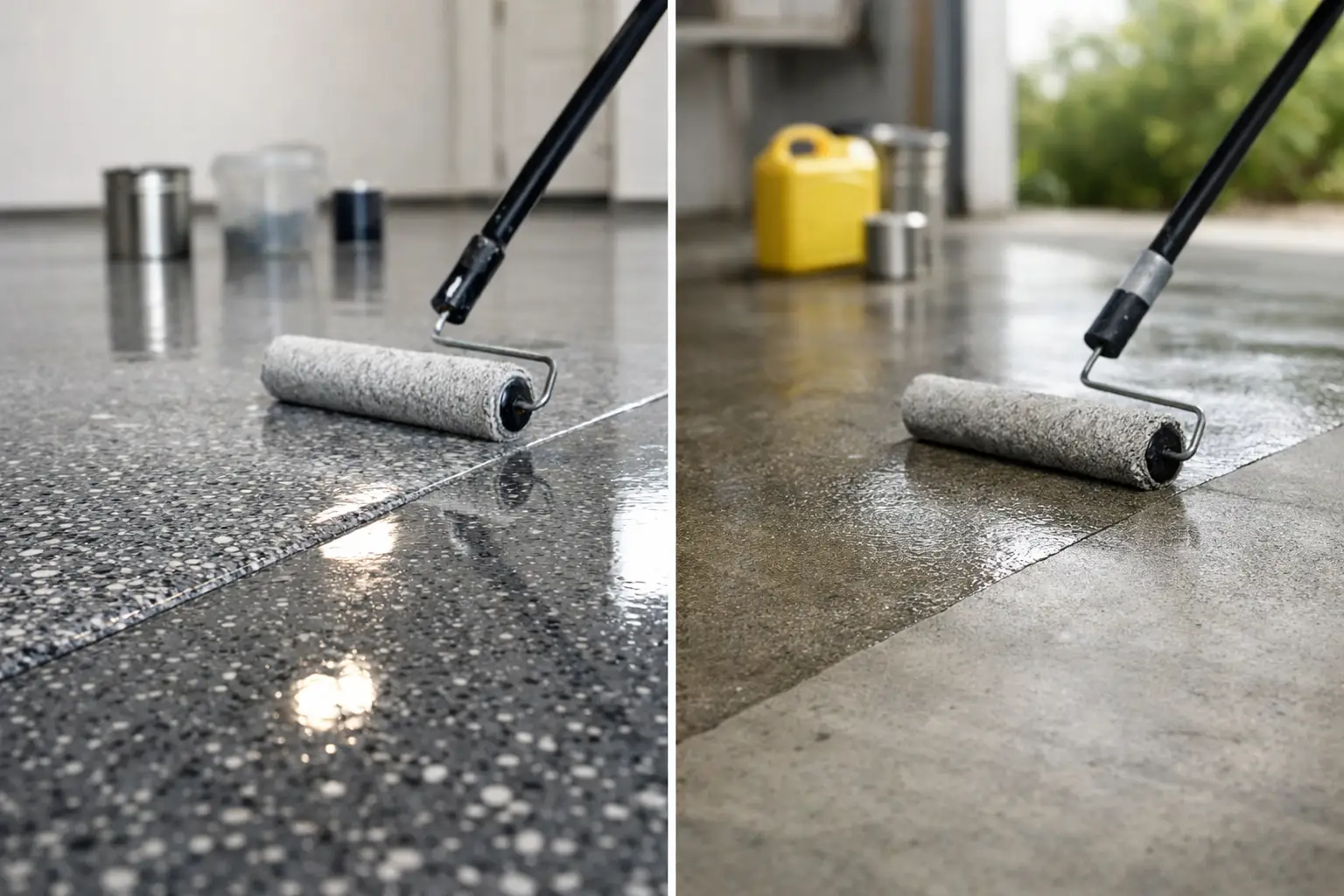
Epoxy flooring is a surface system that builds a protective layer over prepared concrete. It is designed to improve chemical resistance, abrasion performance, surface uniformity, and in many cases appearance. Depending on the system, it can also add slip-resistant texture, line marking capability, and a more controlled finish for production or storage areas.
A concrete sealer is different. It does not create the same build thickness as epoxy. Its main job is to penetrate or coat the concrete to reduce dusting, limit water or contaminant absorption, and make the slab easier to maintain. In simple terms, a sealer protects the concrete you already have, while epoxy creates a more engineered wearing surface on top of it.
That distinction matters because these systems are not interchangeable in every facility. One is usually selected when the floor needs higher performance. The other is often enough when the objective is basic protection and lower upfront spend.
When epoxy flooring is the better system
Epoxy flooring is usually the stronger option in industrial and commercial environments where the slab sees regular traffic, staining risk, washdowns, or process-related wear. If forklifts run on fixed routes every day, if pallets are dragged, if oils and chemicals are part of normal operations, or if dust control is critical, epoxy gives you a more controlled finish than a standard sealer.
In warehouses, production areas, workshops, loading zones, and service facilities, epoxy can reduce concrete dusting significantly while also improving cleanability. That matters in spaces where floor contamination affects inventory, equipment, or housekeeping standards. A sealed slab may reduce dust, but it usually does not deliver the same level of surface integrity over time under repeated mechanical stress.
Epoxy also makes sense when visual control is part of operations. Marked walkways, color-zoned work areas, and brighter floors that improve light reflectance are not minor details in active facilities. They support safety, traffic control, and easier inspection of leaks or spills.
The trade-off is that epoxy demands more from the installation process. Surface preparation has to be right. Moisture conditions need to be checked. Cracks and damaged sections may need repair before coating work starts. If the slab has contamination, laitance, or previous failed coatings, those problems have to be addressed first or the new system will fail early.
Where epoxy can fall short
Epoxy is not the answer for every slab. If the floor has ongoing moisture vapor transmission, weak concrete, or major structural cracking, applying epoxy without solving the underlying issue is a short-term fix. The coating may blister, debond, or reflect the same substrate failure through the finished surface.
It also brings more downtime than a simple sealer in most cases. Facilities with tight operating schedules need to plan access, curing windows, and area isolation carefully. The higher material and labor cost can still be justified, but only when the performance demand is real.
When a concrete sealer makes more sense
A concrete sealer is often the practical choice for lower-demand areas or for clients who need to improve slab protection without committing to a full coating system. Storage rooms, utility areas, secondary circulation spaces, and lightly used commercial floors can perform well with the right sealer, especially when the main concern is dust reduction or limiting stain absorption.
For some exterior or semi-exposed slabs, sealers also make more sense because they work with the concrete rather than forming a thicker film that may not suit the environment. The exact product type matters here. Penetrating sealers and film-forming sealers behave differently, and selecting the wrong one for the traffic level or exposure condition can lead to disappointing results.
From a project execution standpoint, sealers are usually faster and less disruptive to install. Preparation is still important, but the system is generally simpler, the cost is lower, and return-to-service can be quicker. For owners managing large portfolios, that can be enough reason to use sealers in non-critical areas and reserve epoxy for zones with heavier operational demands.
Where sealers have limitations
A sealer is not a substitute for a true industrial flooring system. It will not give the same impact resistance, coating build, or long-term surface renewal under aggressive use. If a slab is already powdering heavily, if chemical spills are common, or if hygiene standards require a more sealed and uniform surface, a basic sealer may only delay the need for a better solution.
Sealers also vary widely in performance. Some improve appearance briefly but wear off quickly in traffic lanes. Others provide penetration and dust control but little resistance to abrasion. That is why product selection should follow the site condition, not just the budget line.
Cost is not just about material price
On paper, concrete sealer usually wins on initial cost. Material consumption is lower, installation is simpler, and project duration is shorter. For facilities needing a quick improvement with minimal shutdown, that can be the right call.
But the epoxy flooring vs concrete sealer comparison changes when you calculate service life, maintenance effort, and floor-related disruption. A cheaper system that needs frequent reapplication or does not protect against operational damage can become more expensive over time. This is especially true in facilities where floor failure affects production, forklift movement, inventory cleanliness, or safety compliance.
Epoxy often carries a higher upfront price because it is a system, not just a treatment. Surface grinding or shot blasting, crack repair, priming, body coat application, topcoat selection, and curing control all add cost. Yet when the slab is central to operations, that investment can reduce cleaning labor, extend maintenance intervals, and slow concrete deterioration.
The real deciding factors on site
The right specification usually comes down to four field questions. First, how much traffic and abuse does the slab actually see? Second, what contaminants are present - water, oils, chemicals, cleaning agents, or abrasion from movement and loading? Third, what downtime can the facility tolerate? Fourth, what is the condition of the existing concrete?
These questions sound basic, but they are where many flooring decisions go wrong. Teams sometimes select epoxy because it looks more permanent, even when the slab condition is poor and moisture is unresolved. Others choose a sealer for budget reasons when the floor clearly needs a higher-build protective system.
A proper site inspection should review substrate strength, cracking, contamination, previous treatments, drainage behavior, and moisture condition before any recommendation is made. In large industrial assets, this assessment is more valuable than comparing product brochures.
Choosing for warehouses, plants, and commercial facilities
For warehouses and logistics facilities, epoxy is often justified in loading areas, forklift paths, dispatch zones, and service bays. A sealer may still be suitable in low-traffic storage sections or utility rooms where the performance demand is lower.
For manufacturing plants and workshops, the decision leans heavily on process exposure. If there is oil, heat, washdown, mechanical wear, or the need for defined safety zones, epoxy is usually the better fit. If the floor use is light and the objective is mainly dust reduction, a sealer can be a cost-effective option.
For commercial buildings, back-of-house service areas may benefit from epoxy where cleaning standards and durability matter. In less demanding support spaces, a quality sealer may be sufficient. The point is not to coat every square foot the same way. It is to match the floor system to the operational risk.
Promax Contracting typically approaches these decisions from the substrate upward - inspect first, identify exposure conditions, and then specify the system that suits the site rather than forcing a standard package.
What to do before you choose
Before approving either system, get the slab inspected by a contractor who understands preparation, moisture behavior, and long-term facility use. Ask what prep method is required, what failure risks exist in the current concrete, how much downtime is needed, and what maintenance the finished floor will require. If those answers are vague, the specification is probably not ready.
The best flooring decision is rarely the cheapest line item or the heaviest coating by default. It is the one that fits the building, the traffic, the exposure, and the maintenance reality. If your floor only needs basic protection, a sealer can do that efficiently. If the slab is part of daily operations and failure carries a real cost, epoxy usually earns its place.
Talk to Promax
Need this on your roof? Call +971 56 727 4205 or request a free inspection. Promax provides EPDM metal-roof, concrete and industrial waterproofing across Dubai and the UAE with up to a 15-year warranty.