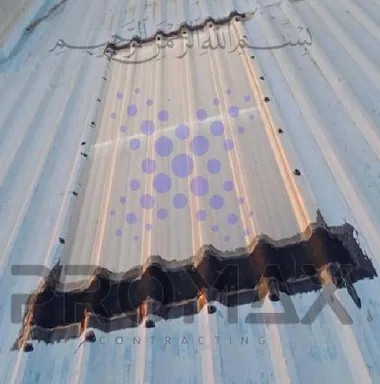
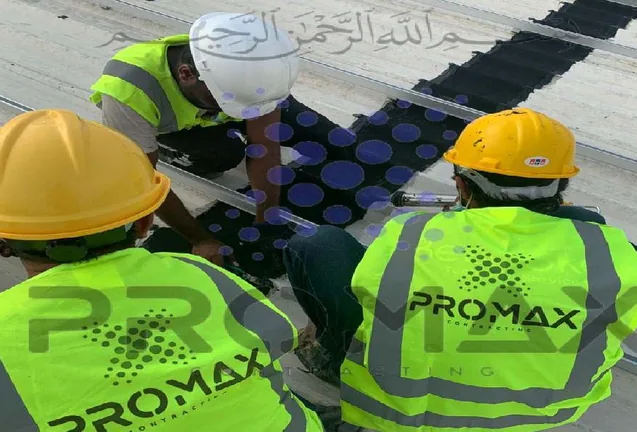
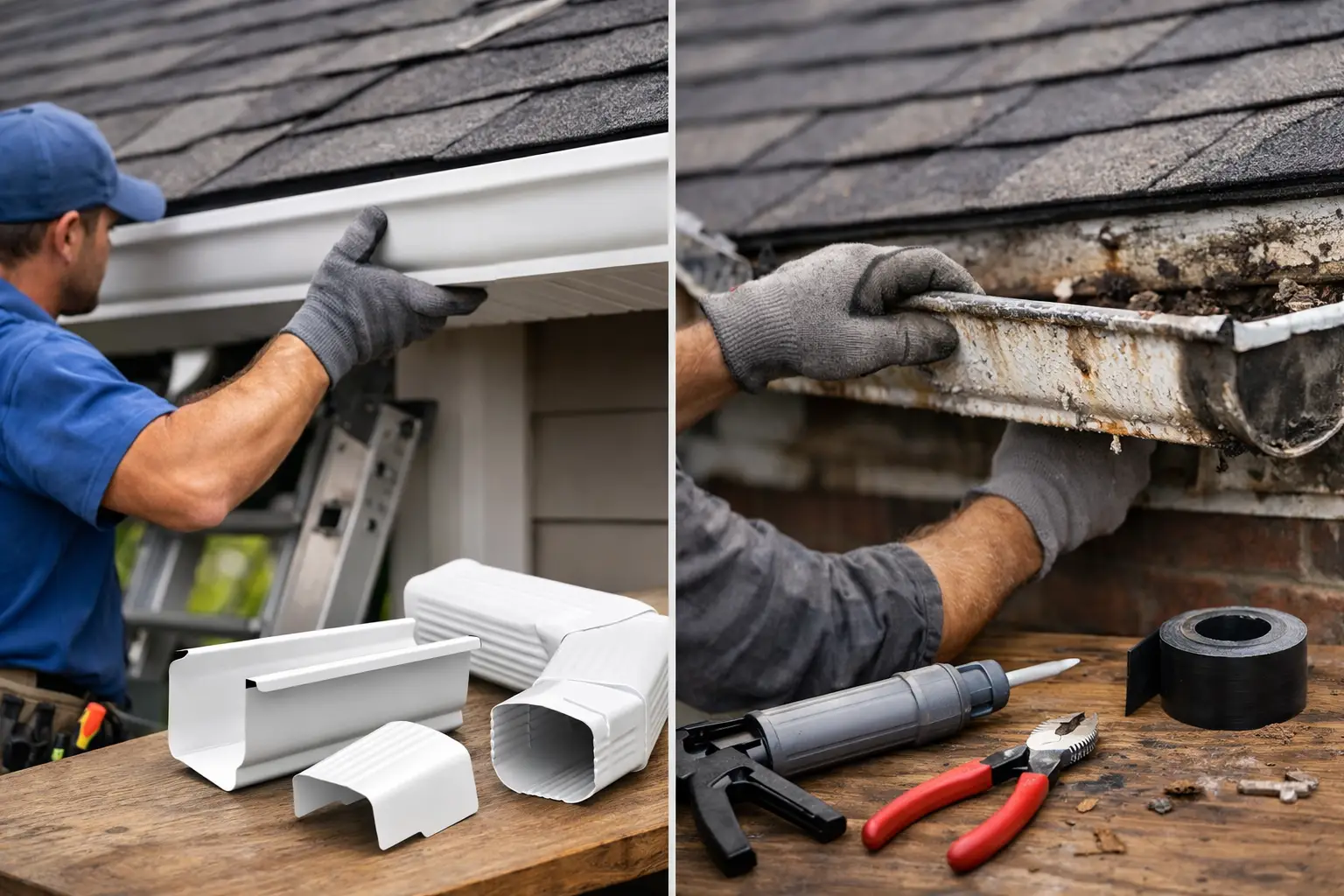
A leaking gutter on a commercial roof is rarely just a gutter problem. It usually shows up alongside ponding water, edge corrosion, stained cladding, damaged soffits, and water tracking into loading bays or wall joints. That is why gutter replacement versus gutter repair has to be assessed as a building-envelope decision, not a quick patching exercise.
For warehouses, factories, and large roof spans, the wrong call can keep maintenance costs low for a month and high for the next three years. Repair can be the right option when defects are isolated and the base metal is still sound. Replacement makes more sense when failure is systemic, drainage geometry has been compromised, or corrosion has already reduced service life beyond practical recovery.
How to judge gutter replacement versus gutter repair
The first question is not whether the gutter leaks. The first question is why it leaks. A joint opening at one connection is very different from a gutter run that has lost slope, has multiple perforations, and shows rust at brackets, end caps, and outlets.
In commercial and industrial buildings, gutters fail in a few predictable ways. Metal expands and contracts, sealants age, standing water accelerates corrosion, supports deform, outlets choke, and previous repairs create weak points where incompatible materials meet. On older facilities, the visible leak may be the last symptom, not the first.
A proper site inspection should look at joint integrity, metal thickness, bracket condition, outlet performance, section alignment, fastener corrosion, and any related roof edge defects. If the inspection stays limited to the wet spot below, the recommendation will usually miss the actual cause.
When repair is the right decision
Gutter repair is usually justified when the damage is localized and the system still has structural integrity. That includes isolated joint leaks, a failed outlet connection, minor punctures, small sections of surface rust, or limited sagging caused by a few loose supports.
In these cases, a technically sound repair can restore performance without disturbing the full run. Depending on the gutter type, that may involve resealing joints, replacing short damaged sections, correcting bracket spacing, reworking outlets, treating corrosion, or applying a compatible waterproofing detail at critical transitions.
Repair also makes sense when the rest of the roof drainage system is in acceptable condition and the gutter profile is still correctly sized for the roof area. If water is moving properly and only one section is failing, replacing the entire system may not be cost-effective.
That said, repair only works when the substrate is worth saving. If the metal has thinned significantly, new sealant and patchwork may stop leakage briefly but will not restore long-term reliability. A contractor should be clear about that instead of selling a low-value fix that simply delays replacement.
When replacement is the better investment
Replacement becomes the stronger option when defects are repeated, widespread, or tied to the design and condition of the full system. If one leak turns into five, if rust is present along long stretches, or if the gutter no longer maintains proper fall toward the outlets, repair starts losing value quickly.
This is especially true on industrial buildings where drainage loads are high and overflow can affect stock, equipment, access ways, or electrical areas. A gutter that regularly holds water is not just underperforming. It is actively accelerating its own failure.
Full replacement should be strongly considered when inspection shows extensive corrosion, recurring joint separation, chronic standing water, deformed sections, failed support steel, or undersized capacity. The same applies when previous patch repairs are layered across the run and no longer provide a stable base for further work.
In many cases, replacement is also the opportunity to correct what was wrong from the start. That may mean adjusting slope, upgrading material thickness, fabricating better outlet details, improving support spacing, or coordinating gutter works with roof edge waterproofing and downpipe connections. For large facilities, this matters more than the immediate repair cost because the real objective is controlled drainage over time.
Cost is not just repair price versus replacement price
Many building owners compare gutter repair and gutter replacement as if the decision starts and ends with the quotation total. In practice, the better comparison is short-term spend versus lifecycle cost.
A small repair is cheaper today, but only if it prevents the next failure. If access equipment, shutdown coordination, and repeated emergency attendance are needed every rainy period, the lower initial price stops being economical. This is common on older warehouse and factory roofs where maintenance teams keep authorizing minor fixes while corrosion continues underneath.
Replacement costs more upfront because it includes demolition, fabrication, new support components, installation, sealing, and sometimes related edge treatment. But if it removes chronic leakage, protects wall lines, and reduces emergency maintenance, the total operating cost may be lower over the service life.
There is also risk cost. Water ingress near storage zones, production areas, and service corridors can affect operations, safety, and asset condition. Decision-makers should factor in disruption, not just metal and labor.
Signs your gutter is beyond practical repair
Some field conditions usually point toward replacement rather than another repair cycle. One is active corrosion through the metal rather than surface oxidation only. Another is long-run misalignment where water cannot drain even after cleaning. Repeated joint failures across multiple sections are another warning sign, especially when thermal movement has already stressed the system.
Watch for staining on external walls below the gutter line, overflow marks at roof edges, corrosion at brackets, and patchwork from several repair campaigns. These signs often mean the problem is distributed through the system, not limited to one leak point.
If the gutter is integrated with aging roof-edge details, replacement may also need to be coordinated with waterproofing and flashing work. Treating the gutter alone while leaving failed adjacent details in place can produce a false sense of completion.
What a professional assessment should include
For commercial properties, a useful recommendation should not be guesswork from ground level. The contractor should inspect the full drainage path, from roof discharge to gutter run to outlet and downpipe. That includes checking whether the water volume is appropriate for the gutter size and whether blockages or design limitations are contributing to overflow.
Measurements matter. Slope, section distortion, material thickness, outlet condition, bracket spacing, and corrosion spread all help determine whether repair is technically responsible. Where fabrication is needed, dimensions should be taken accurately so replacement sections fit without creating new stress points.
A good assessment should also distinguish between cosmetic deterioration and performance failure. Surface rust can often be treated if the metal remains sound. Perforation, section loss, and widespread seam failure are different. They indicate a declining system, not a surface issue.
At Promax Contracting, this kind of evaluation is where the decision gets clearer. On industrial and commercial sites, gutter recommendations need to align with roof condition, waterproofing details, and access constraints, not just the visible leak.
Repair or replace depends on timing too
Timing affects the quality of the outcome. If the building is already in reactive mode during heavy rain, the priority may be temporary containment followed by a full inspection once conditions are safe. Emergency patching has its place, but it should not be confused with a final solution.
Planned replacement is usually more controlled, more accurate, and less disruptive than repeated emergency repair. It allows for fabrication, material selection, access planning, and coordination with occupied areas. That is particularly important on facilities where roof access, loading operations, or tenant activity cannot be interrupted casually.
On the other hand, not every aging gutter needs immediate replacement. If inspection confirms that deterioration is limited and drainage geometry remains intact, a targeted repair program with monitoring can be the smarter decision. The key is honesty about remaining service life.
The best gutter decision is the one that matches actual condition, not the cheapest line item or the most aggressive sales pitch. When a gutter still has sound structure, repair can be efficient and practical. When the failures are systemic, replacement is usually the more controlled and cost-effective path. The right move starts with a serious inspection and ends with a system that keeps water moving where it belongs.
Talk to Promax
Need this on your roof? Call +971 56 727 4205 or request a free inspection. Promax provides EPDM metal-roof, concrete and industrial waterproofing across Dubai and the UAE with up to a 15-year warranty.