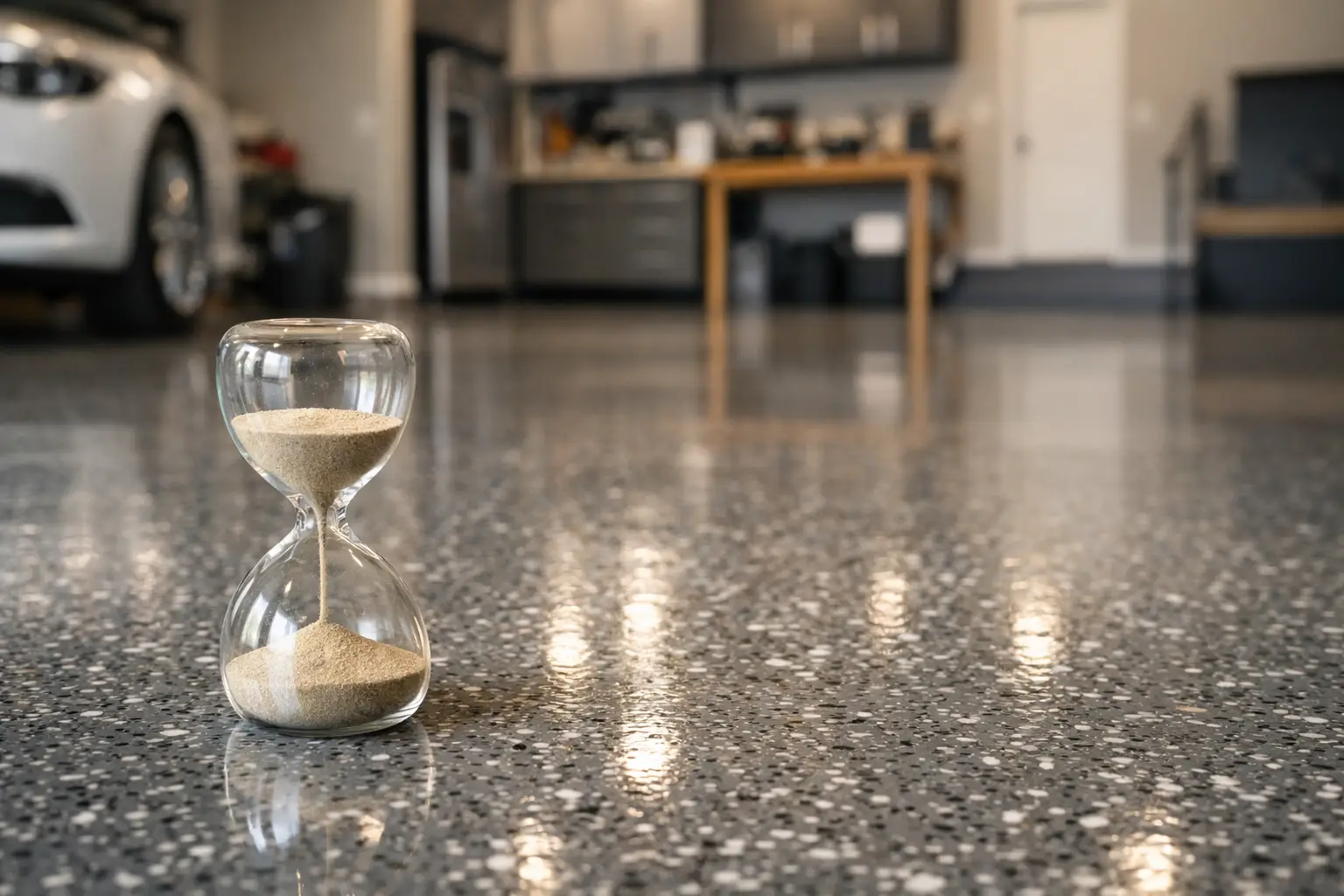
A forklift turning on a warehouse corner will tell you more about floor performance than a showroom sample ever will. In commercial and industrial facilities, the real question is not just how long does epoxy flooring last, but how long it will keep performing under traffic, chemical exposure, cleaning cycles, impact, and heat.
The short answer is that a properly installed epoxy floor can last around 5 to 10 years in demanding commercial settings, and longer in lighter-use areas. In some controlled interiors, it can perform well beyond that. But lifespan is never just about the coating itself. Surface preparation, concrete condition, moisture levels, traffic pattern, chemical load, and maintenance discipline all have a direct effect on service life.
How long does epoxy flooring last in real facilities?
For most industrial and commercial properties, epoxy flooring should be evaluated by use case rather than by a single advertised number. A storage room with foot traffic is not comparable to a loading zone with pallet jacks, rolling loads, and frequent washdowns.
In light-duty applications such as offices, back-of-house utility rooms, and low-traffic retail support areas, epoxy can often last 8 to 12 years or more. In medium-duty environments such as workshops, service corridors, and commercial kitchens with controlled cleaning practices, 5 to 8 years is a realistic range. In heavy-duty facilities such as warehouses, factories, production units, and logistics spaces, the lifespan may fall closer to 3 to 7 years before recoating or localized repair becomes necessary.
That does not mean the system has failed at year five. It often means the top surface is showing wear, gloss loss, scratching, or localized delamination in high-stress zones. A floor can still be serviceable while no longer looking new. For facility managers, that distinction matters. The right question is whether the floor is still protecting the concrete and supporting operations safely.
What has the biggest impact on epoxy floor lifespan?
The single biggest factor is preparation. If the slab was not mechanically prepared to the correct profile, if oil contamination remained in the concrete, or if moisture vapor issues were ignored, the coating may fail early no matter how good the product specification looks on paper.
Epoxy is only as reliable as the bond to the substrate. On industrial sites, weak adhesion usually starts below the surface. Concrete laitance, hidden moisture, old coatings, cracks, and patchwork repairs all create failure points. This is why site inspection and substrate testing are not optional steps. They are part of the system.
Traffic is the next major factor. Constant turning movement from forklifts and pallet jacks creates concentrated abrasion, especially at joints, ramps, and loading bays. Hard wheels, dragged metal equipment, and point loads from racks can wear the coating much faster than general foot traffic. If the floor was specified without accounting for actual operational loads, the service life drops quickly.
Chemical exposure also changes the equation. Oil, solvents, acids, cleaning agents, and process chemicals can stain, soften, or degrade the surface over time. Some epoxy systems are formulated for chemical resistance, but not all of them perform equally under sustained exposure. In maintenance planning, there is a big difference between occasional spills and daily chemical contact.
Temperature and moisture matter as well. In hot environments, near process equipment, or in facilities with frequent wet cleaning, coating stress increases. In the Gulf region and other harsh climates, moisture transmission through concrete can be especially destructive when ignored during specification. Blistering, peeling, and bond loss often trace back to vapor pressure issues rather than product weakness.
Why some epoxy floors fail early
Early failure usually comes from one of four issues: poor surface preparation, wrong system selection, improper installation conditions, or lack of maintenance.
Poor preparation is the most common cause. If the slab was not shot blasted or diamond ground correctly, the epoxy cannot achieve a proper mechanical bond. If cracks and joints were treated as cosmetic issues instead of structural movement points, coating failure follows.
Wrong system selection is another recurring problem. A thin decorative coating may look acceptable on day one, but it is not built for a warehouse aisle carrying repeated rolling loads. Likewise, a standard epoxy may not be the right answer for thermal shock, heavy impact, or severe chemical attack. In those cases, a heavier build system or a different resin may be more suitable.
Installation timing also matters. Applying epoxy over damp concrete, during unsuitable ambient conditions, or without observing cure requirements can reduce performance before the floor is even put into service. Fast project schedules often create flooring problems later.
Then there is maintenance. Even a good system will wear out faster if dirt, sand, and metal debris are left on the surface and ground into the coating by traffic. Abrasive contaminants act like sandpaper. Routine cleaning is not cosmetic. It is part of asset protection.
How to tell whether an epoxy floor is nearing the end of its service life
Most epoxy floors do not fail all at once. They show progressive signs that the protective layer is thinning or losing bond. The earliest visible symptom is usually wear in traffic lanes, turning points, and workstations. You may see dull patches, loss of texture, or clear differences between active zones and low-use areas.
After that, scratches deepen, the finish becomes harder to clean, and localized peeling may appear around cracks, joints, drains, or edges. In chemical areas, staining and softening can develop. In wet conditions, blistering or bubbles may indicate moisture-related bond loss.
If the concrete substrate is becoming exposed, dusting starts, or patch repairs are spreading across multiple areas, the floor should be professionally assessed. At that stage, delaying action usually increases repair scope. A recoat is far more cost-effective than waiting for substrate deterioration, safety complaints, or operational shutdowns.
Can epoxy flooring last longer with maintenance?
Yes, and in many facilities the difference is significant. An epoxy floor that receives planned cleaning, periodic inspection, and targeted repair can outlast an identical floor that is ignored.
Good maintenance is straightforward. Keep abrasive debris off the floor. Clean spills quickly, especially chemicals and oils. Monitor joints and cracks before they undermine the coating edge. Use protective pads or wheel controls where point loading is severe. Review traffic patterns if repeated turning damage is concentrated in one zone.
Periodic recoating also extends system life. In many commercial properties, the base system remains sound while only the top wear layer is deteriorating. Recoating at the right time restores protection and appearance without the cost of full removal. That only works, however, if deterioration is caught early enough.
This is where a contractor with inspection capability adds value. The objective should not be to sell replacement every time a floor shows wear. It should be to determine whether the floor needs cleaning protocol changes, localized repair, recoating, or a full system upgrade.
Choosing the right epoxy system for longer service life
If durability is the priority, specification should start with the operating environment. Floor use, wheel type, load class, cleaning regime, chemical exposure, moisture condition, and downtime tolerance all need to be considered before selecting thickness, build-up, and finish.
For example, a thin coating may be enough for low-traffic utility areas, while production floors and warehouses typically need a heavier duty system with stronger build and better abrasion resistance. Slip resistance may also be necessary, but it has to be balanced with cleanability. A rough floor can improve traction yet trap contaminants if the environment requires strict hygiene.
Concrete repair before coating is equally important. If the slab has spalling, cracks, weak zones, or contamination, no coating system will compensate for those defects on its own. Proper detailing at joints, drains, corners, and termination points is part of long-term performance.
Experienced contractors approach epoxy flooring the same way they approach waterproofing or roof rehabilitation: inspect first, define the failure risks, prepare the substrate correctly, and install the system that matches service conditions rather than budget assumptions alone. That approach generally delivers better lifecycle value than choosing the lowest initial price.
When epoxy may not be the right answer
Epoxy is a strong solution, but not for every floor. If the slab has active moisture vapor transmission, severe thermal cycling, or exposure to chemicals beyond standard epoxy resistance, another system may be more suitable. If the facility cannot tolerate long cure times, that also affects product choice.
This is where technical review matters. The question is not whether epoxy is good or bad. The question is whether the proposed system matches the substrate and the operation. A flooring failure in a warehouse, plant, or service yard is not just a finish issue. It can affect safety, hygiene, maintenance cost, and uptime.
For buyers managing large facilities, the practical answer to how long does epoxy flooring last is this: long enough to be a solid asset, but only when the floor is designed, prepared, and maintained for the way the site actually operates. If you want years, treat the floor like a working system, not a surface treatment.
Talk to Promax
Need this on your roof? Call +971 56 727 4205 or request a free inspection. Promax provides EPDM metal-roof, concrete and industrial waterproofing across Dubai and the UAE with up to a 15-year warranty.