
A gutter leak rarely stays a gutter leak for long. On a commercial building, warehouse, or industrial shed, a failed joint or rusted section can send water into wall panels, soak insulation, stain facades, and overload drainage points below. If you are dealing with active seepage and want to know how to repair leaking gutters, the first priority is not cosmetic sealing. It is identifying where water is escaping, why the section failed, and whether the repair needs patching, resealing, slope correction, or full replacement.
How to Repair Leaking Gutters Starts With Inspection
The visible drip is not always the source of failure. Water travels. It can move along laps, sit behind debris, back up at outlets, or escape through pinholes several feet away from where it finally drops. That is why a proper repair starts with inspection under flow conditions, not guesswork.
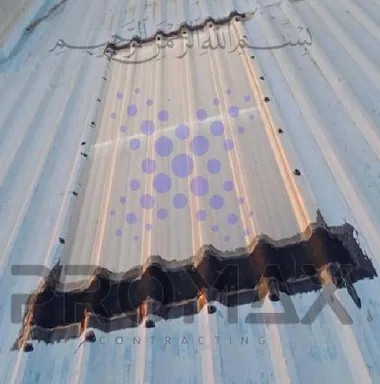
On industrial and commercial properties, the most common failure points are end caps, joints, outlet connections, support brackets, corroded bottoms, and sections distorted by poor fall. In older metal systems, repeated thermal movement often opens sealed joints over time. In coastal or high-heat environments, UV exposure and corrosion make basic sealant repairs short-lived unless the substrate is prepared correctly.
Before any repair, the gutter should be cleared of silt, leaves, nesting material, and standing water. If the line is blocked, the leak you see may actually be overflow caused by drainage restriction. This matters because sealing an overflow problem does not solve it. It only traps moisture and delays the real fix.
Identify the Type of Gutter Failure
Not every leak should be treated the same way. Hairline seam leaks can often be repaired with proper cleaning and sealant application. Localized punctures or rust holes may need a patch system. Loose or misaligned sections may need mechanical refastening and support correction. If there is widespread corrosion, repeated joint failure, or poor original fabrication, sectional replacement is usually more cost-effective than repeated spot repairs.
This is where many maintenance teams lose time and budget. They apply sealant to a system that has already lost structural integrity. For a short period, the leak appears controlled. Then the next rain event exposes more weak points.
A sound assessment typically asks four questions. Is the substrate still solid? Is the leak caused by a failed seal or a failed section? Is water ponding due to poor slope? And will the repair hold under thermal expansion, vibration, and weather exposure? If the answer to any of those raises concern, the repair scope needs to move beyond a basic patch.
Surface Preparation Is What Makes the Repair Last
If you want a repair to perform, surface preparation is non-negotiable. Sealants fail early when applied over dust, oxidation, wet surfaces, loose rust, or old unstable coatings. On metal gutters especially, the bond area must be mechanically cleaned and dried before any repair compound is used.
For light corrosion, wire brushing or abrasive cleaning may be enough. For more advanced oxidation, the area may need rust treatment before sealing or patching. Old cracked sealant should be removed back to a stable edge. If the joint is contaminated with oil, dirt, or loose sediment, the new material will not achieve proper adhesion.
In high-temperature environments, material selection also matters. Generic sealants can soften, crack, or pull away under movement. For that reason, professional repairs often rely on elastomeric or EPDM-compatible systems designed for outdoor exposure and metal movement. The right product depends on gutter material, joint type, and service conditions.
How to Repair Leaking Gutters at Joints and Seams
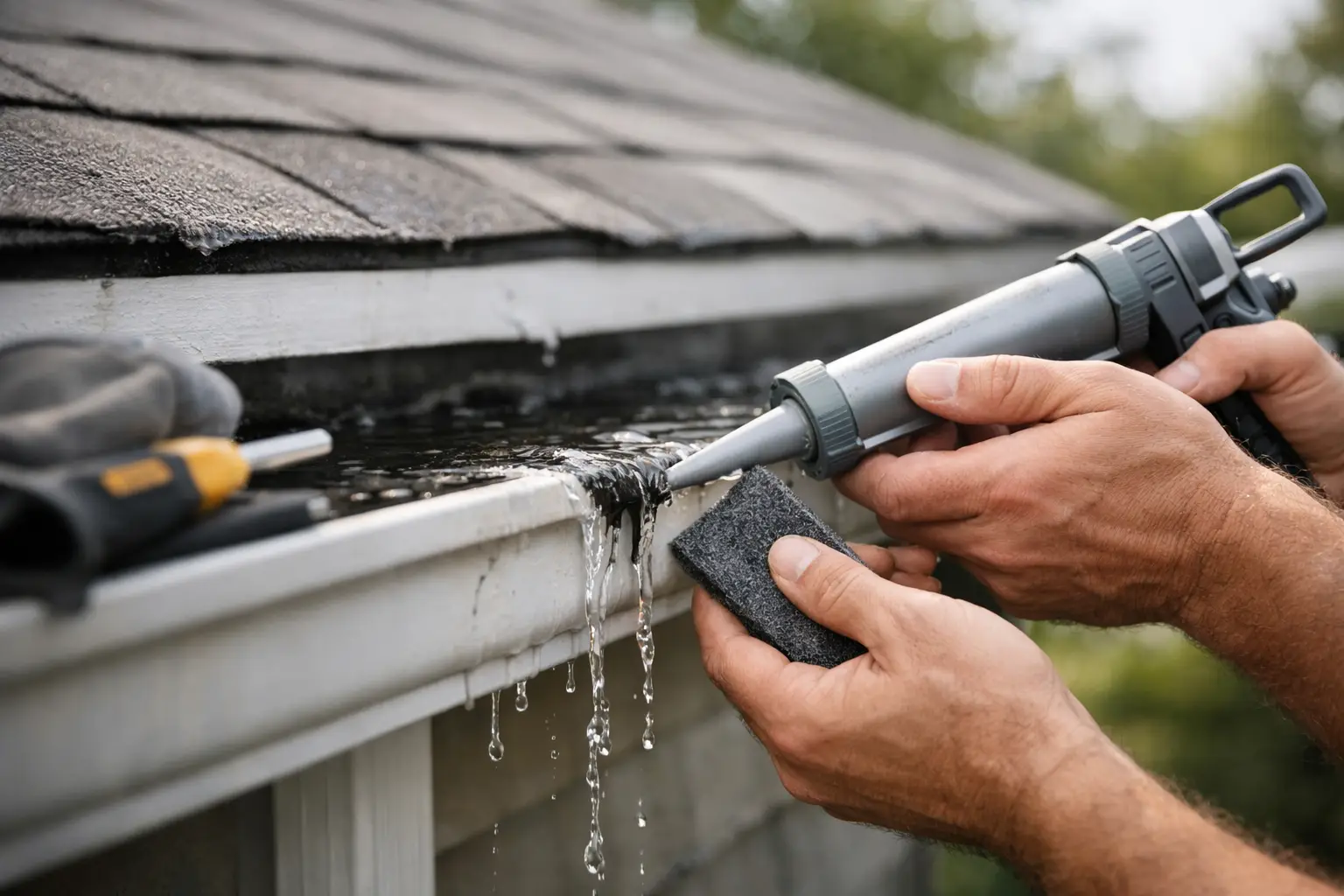
Joint and seam leaks are among the most common issues in sectional gutter systems. The correct repair method begins by exposing the full failed area, not just the point where water shows. Once cleaned and prepared, the joint is resealed with a compatible waterproofing compound, making sure the seal bridges the seam continuously without gaps.
If the seam has opened due to movement or poor fastening, it may also need mechanical correction before resealing. A sealant alone cannot compensate for a loose connection that continues to shift. In some cases, a reinforced tape or membrane strip is installed over the joint after sealant application to provide a more durable waterproof bridge.
This is especially useful on long gutter runs serving industrial roofs, where movement cycles are stronger and the risk of recurring seam stress is higher. The trade-off is that reinforced repairs take longer and require better detailing, but they usually outperform quick bead applications.
Repairing Holes, Rusted Areas, and Split Sections
Small holes and localized splits can often be repaired with a patch, provided the surrounding metal is still sound. The damaged area is cleaned, trimmed back if needed, and covered with a compatible patching system that extends beyond the defect onto stable substrate. The patch is then sealed around the edges to prevent capillary entry.
Where rust has thinned the gutter base over a larger area, patching becomes less reliable. The repair may hold briefly, but the remaining metal around it can continue deteriorating. In that case, cutting out the failed section and replacing it is the better option. This is common in box gutters and fabricated metal channels where corrosion starts at ponding points and spreads from the inside out.
If the gutter has multiple rust points along one run, repeated local patching often costs more over time than fabricating and installing new sections. For facility managers, this is usually the point where repair strategy should be reviewed from a lifecycle perspective, not just an emergency response perspective.
Correcting Slope, Support, and Outlet Problems
Some leaking gutters are not leaking because of holes at all. They leak because water is standing in the wrong place. Poor slope, sagging brackets, undersized outlets, or blocked downpipes can force water over seams and edges that would otherwise remain dry.
If a section is holding water, inspect support spacing and alignment. A sagging run may need bracket adjustment or replacement. A back-fall toward the building is more serious because it can direct water into the roof edge or wall junction. Outlet connections should also be checked carefully. These areas often fail due to constant flow concentration, debris accumulation, and movement around the penetration.
When correcting slope issues, the goal is controlled flow to the outlet without ponding. On larger commercial buildings, this sometimes requires partial refabrication rather than field bending. A well-executed repair restores drainage performance, not just watertightness at one point.
When Repair Is No Longer the Right Option
There is a point where repair stops being efficient. If gutters have extensive corrosion, recurring seam openings, failed supports, or undersized drainage design, you may be spending operational budget to preserve a system that no longer matches the building’s needs.
Replacement is often the better decision when leaks are repeated across multiple zones, when rust has affected structural stability, or when access costs make frequent minor repairs impractical. For industrial facilities, the real cost is not only the gutter work. It is downtime risk, facade damage, wet insulation, slip hazards, and interior water ingress affecting stock or equipment.
A contractor with fabrication and waterproofing capability can usually advise whether sectional replacement, liner installation, or a full new gutter system is the most durable route. That type of recommendation tends to be more accurate when it comes from site inspection, flow testing, and substrate assessment rather than photos alone.
Safety and Access Should Not Be an Afterthought
Gutter repairs on commercial and industrial buildings involve height, edge exposure, and often fragile roof zones or congested service areas below. Safe access planning matters as much as repair method. Temporary ladders may be fine for low residential work, but they are not a serious solution for high-bay warehouses, factories, or active operational sites.
Proper access equipment, permit control, and work sequencing reduce both risk and repair time. They also improve repair quality because technicians can prepare and detail the area correctly instead of rushing from unstable access positions. If the building remains operational during the work, drainage discharge and pedestrian protection should be controlled as part of the repair plan.
A Practical Standard for Long-Term Performance
If you are evaluating how to repair leaking gutters on a commercial or industrial property, the practical standard is simple. Clean the system fully, inspect under realistic conditions, classify the failure correctly, prepare the substrate properly, and choose between resealing, patching, support correction, or replacement based on actual condition - not short-term convenience.
That approach is how contractors like Promax Contracting handle leak problems that affect building envelopes, operations, and asset life. The goal is not to hide water for one storm cycle. The goal is to restore drainage performance with a repair that matches the building, the exposure, and the consequences of failure.
A leaking gutter is usually a small visible sign of a bigger drainage issue. Fix it with that in mind, and the repair has a much better chance of lasting through the next season instead of failing in the next rain.
Talk to Promax
Need this on your roof? Call +971 56 727 4205 or request a free inspection. Promax provides EPDM metal-roof, concrete and industrial waterproofing across Dubai and the UAE with up to a 15-year warranty.