
A roof leak around a pipe, curb, conduit, or vent rarely stays small for long. On industrial and commercial buildings, one failed flashing detail can lead to insulation damage, rusting steel, stained interiors, electrical risk, and repeated shutdowns for patch work. If you need to know how to seal roof penetrations, the first step is understanding that the sealant alone is never the system. Long-term performance comes from the right substrate prep, flashing method, membrane compatibility, and field execution.
Why roof penetrations fail so often
Most penetration leaks are not caused by one dramatic defect. They come from movement, heat, UV exposure, poor detailing, and incompatible repair materials layered over old repairs. Pipes expand and contract. Rooftop units vibrate. Steel roofs shift under temperature change. Concrete roofs crack slightly at transitions. If the penetration detail cannot move with the roof system, the seal breaks and water finds the gap.
Another common issue is overreliance on mastic or generic sealant. This is where many temporary repairs fail. A bead of sealant placed over dust, rust, or an open joint may stop water for a short period, but it does not replace proper flashing. On exposed commercial roofs, especially in hot and harsh climates, surface-applied patching without a full waterproofing detail usually becomes a repeat maintenance item.
How to seal roof penetrations the right way
The correct method depends on the roof type, the penetration type, and the condition of the surrounding area. A single approach does not work across metal roofs, concrete roofs, bituminous systems, and single-ply membranes. What stays consistent is the sequence: inspect, prepare, detail, reinforce, seal, and test.
Start with inspection, not product selection
Before any repair starts, the penetration must be inspected in context. That means checking the flashing condition, the roof deck or slab condition, fasteners, rust level, ponding patterns, nearby lap joints, insulation moisture, and the movement load around the opening. A pipe penetration on a warehouse metal roof behaves differently from a cable tray support on a concrete service roof.
This is where many repair scopes go wrong. Teams focus on the visible crack but miss the fact that the surrounding panel is corroded, the curb is loose, or the old flashing has separated from the substrate. If the base condition is weak, even a high-grade waterproofing material will fail early.
Surface preparation decides the life of the repair
No penetration seal should be installed over contaminated or unstable surfaces. On metal roofs, that usually means removing failed sealant, treating rust, tightening or replacing defective fasteners, and cleaning the area to a sound surface. On concrete roofs, preparation may involve grinding, crack opening, dust removal, and priming.
If the roof has old bitumen, silicone, acrylic, or mixed repair materials around the penetration, compatibility has to be checked carefully. Not all membranes and sealants bond reliably to old patches. In many cases, the failed repair layers should be removed and rebuilt instead of coated over again.
Choose a flashing system, not just a sealant
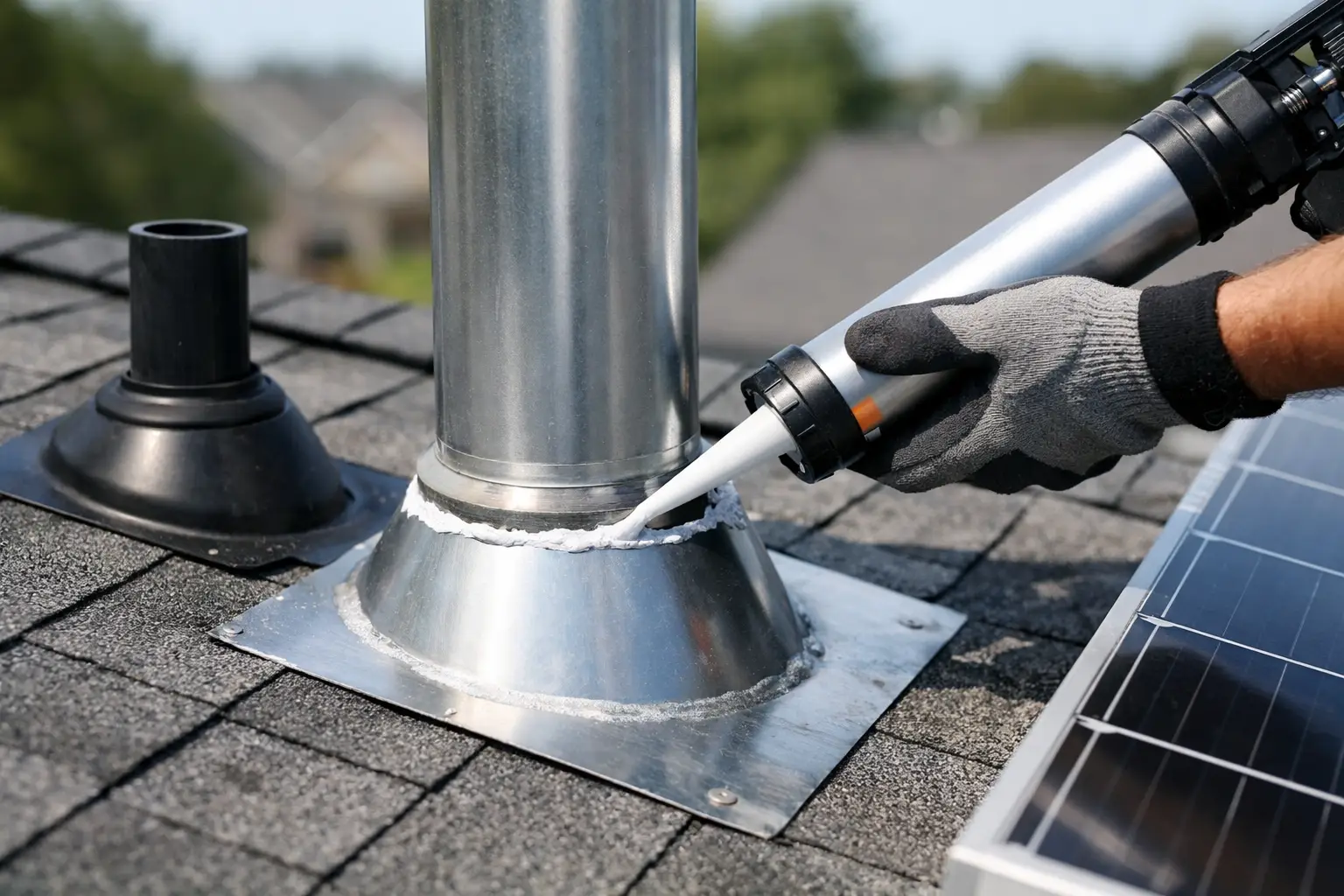
For most commercial applications, the durable solution is a flashing assembly that bridges movement and sheds water. That can include EPDM pipe boots, membrane flashing wraps, reinforced liquid-applied waterproofing, metal counterflashing, compression clamps, and termination bars depending on the detail.
Round pipe penetrations are often best sealed with a properly sized boot flashing system. The boot should fit tightly, be clamped correctly, and integrate with the roof membrane or waterproofing layer. If the pipe is oversized, irregular, or carries heat, the penetration may need a custom-fabricated flashing arrangement rather than an off-the-shelf boot.
Square penetrations, cable trays, ducts, and equipment curbs usually require more than one material. These details often need corner reinforcement, membrane upturns, edge termination, and weatherproof counterflashing. On aging roofs, tying the new detail into the existing system is the critical point. If the transition is weak, the repair fails at the perimeter, not the center.
Roof type matters more than most people expect
Metal roofs
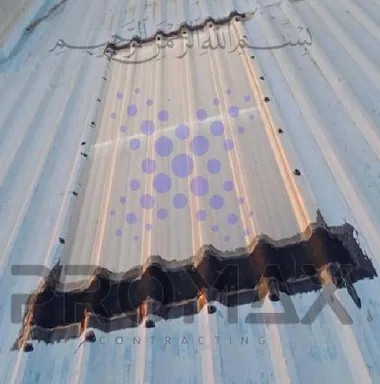
Metal roofs need detailing that can tolerate movement. Pipes, supports, and fixings on standing seam or screw-down systems are exposed to thermal cycling every day. If a rigid repair is locked across moving panels, stress builds quickly.
For metal roof penetrations, field teams usually need to address more than waterproofing. Corrosion treatment, fastener treatment, profile matching, fabricated saddles, and closure details may all be part of the repair. In some cases, the panel around the penetration is too deteriorated to seal reliably and local replacement becomes the smarter option.
Concrete roofs
Concrete roofs are less dynamic than metal roofs, but they bring different risks. Shrinkage cracks, substrate porosity, poor screed falls, and water migration under the surface can all affect penetration sealing. A pipe passing through a concrete slab may need crack treatment at the base, a reinforced membrane collar, and proper upturn detailing to remain watertight.
If water has already migrated below the top layer, surface repair alone may not be enough. Moisture trapped below coatings or membranes can cause blistering and debonding later.
Membrane roofs and coated systems
Single-ply roofs, bituminous membranes, and liquid-applied systems each have approved detailing methods. The repair material must match the existing roof or be engineered as a compatible overlay system. This is not a place for guesswork. Using the wrong sealant on the wrong membrane can weaken the bond or damage the roof surface.
Common mistakes when sealing penetrations
One of the biggest mistakes is sealing active movement joints as if they were static gaps. Another is leaving exposed fasteners, cut edges, or rusted collars untreated next to the repair. Water does not need much space to travel, and it often bypasses the visible patch.
A second issue is poor drainage around the penetration. If the repair sits in standing water, the service life drops. Penetrations installed in low spots or near blocked gutters require drainage correction along with waterproofing.
A third mistake is treating the symptom only once leakage has reached the interior. By that stage, insulation, purlins, decking, or ceiling systems may already be affected. The cost difference between early intervention and repeated internal damage can be significant on warehouses and production facilities.
When a penetration needs replacement, not resealing
Not every penetration can be saved with a repair detail. If the pipe sleeve is loose, the curb is distorted, the surrounding metal is perforated by rust, or the substrate is delaminating, sealing becomes a short-term measure. A proper scope may require cut-out and rebuild, local roof reinstatement, fabrication of new flashing components, and upgraded waterproofing around the opening.
This is especially true on older industrial buildings where multiple contractors have added equipment over time. It is common to find poorly cut openings, undersized curbs, exposed foam, unsealed anchor points, and mixed patch materials. In those cases, standard sealing methods do not address the root problem.
What facility teams should expect from a proper repair contractor
A serious penetration sealing scope should begin with site inspection and root-cause diagnosis, not a quick quote based on photos alone. The contractor should assess the roof system, identify failure points, recommend a repair method suited to the substrate, and explain whether the detail is repairable or needs replacement.
Execution also matters. Penetration sealing on active commercial sites must be planned around access, safety, weather exposure, and operational continuity. On large facilities, responsive after-sales support is just as important as the initial installation because leak behavior can shift across roof zones after rain or washdown cycles.
For this type of work, companies like Promax Contracting are typically engaged because they can combine inspection, waterproofing detail work, fabrication support, corrosion treatment, and maintenance follow-up under one execution team. That matters when the issue is not just one leaking pipe, but a roof system with multiple vulnerable points.
The best time to seal a roof penetration is before it becomes an interior damage claim. If there is staining, rust, damp insulation, or repeated patch failure around any rooftop opening, treat it as a system defect and not just a sealing issue. A well-detailed repair can stop the leak, but the real value is protecting the building, the operation, and the service life of the roof.
Talk to Promax
Need this on your roof? Call +971 56 727 4205 or request a free inspection. Promax provides EPDM metal-roof, concrete and industrial waterproofing across Dubai and the UAE with up to a 15-year warranty.