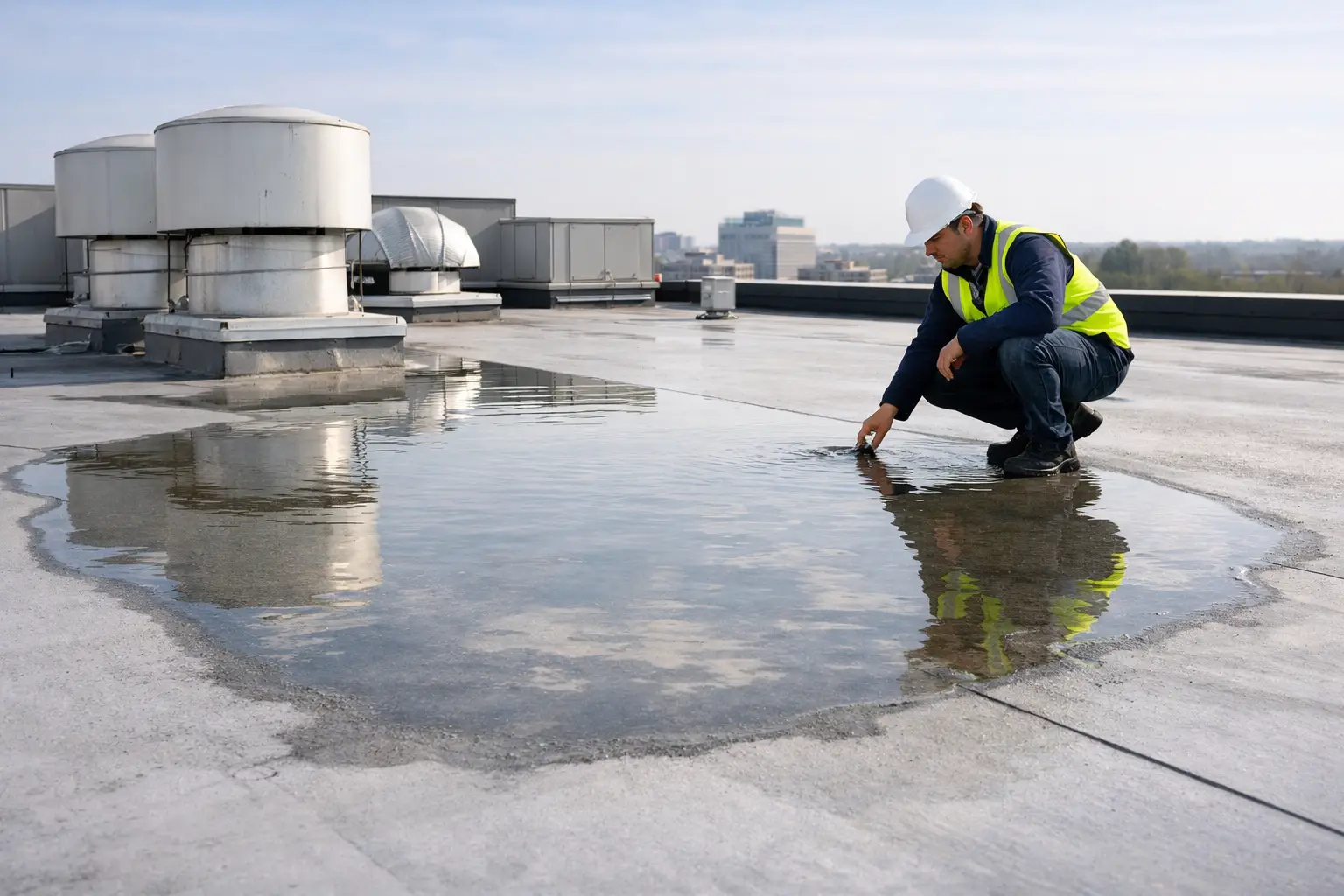
A shallow pool on a warehouse roof may look harmless after a storm, but standing water is rarely a minor maintenance issue. Knowing how to stop roof ponding means identifying why water is being held on the roof, then correcting the drainage path without compromising the waterproofing system. For commercial and industrial properties, that work protects operations below, reduces membrane deterioration, and helps prevent water ingress at joints, penetrations, and roof edges.
Ponding is generally defined as water that remains on a low-slope roof for more than 48 hours after rainfall, once normal drying conditions return. In hot climates, water can evaporate quickly and conceal drainage defects. When the next heavy rainfall arrives, the same low point can hold a much larger volume, adding load to the roof and exposing weak areas in the membrane.
Why Roof Ponding Needs Immediate Attention
Standing water accelerates the failure of a roof system. It can stress seams, soften vulnerable surface coatings, expose poorly treated fasteners, and allow debris to collect around drains. On metal roofs and older roof decks, repeated wetting can also contribute to corrosion around laps, gutters, screws, and structural connections.
The risk is not limited to leaks. Water weight increases rapidly. One inch of water weighs about 5.2 pounds per square foot. Across a broad depression on a factory or storage facility roof, that load can become significant, especially where the deck has already deflected or the supporting members show deterioration.
Ponding also creates a maintenance trap. A blocked drain causes water to collect, the water carries more dirt and debris into the low area, and the obstruction becomes worse over time. Treating only the visible puddle without correcting that cycle usually leads to repeat callouts and rising repair costs.
How to Stop Roof Ponding: Start With a Site Inspection
A proper roof inspection should take place after rainfall and again in dry conditions. The wet inspection shows where water collects and how it moves. The dry inspection allows the contractor to assess membrane condition, roof levels, drain details, flashing, expansion joints, and substrate defects without standing water obscuring the surface.
The inspection should establish whether the issue is caused by drainage blockage, insufficient roof slope, a depressed deck, failed insulation, damaged membrane, undersized drainage capacity, or a combination of these conditions. This distinction matters. Cleaning a drain may solve a maintenance issue, but it will not correct a structural low point. Installing a new drain may help a large catchment area, but it will not resolve a membrane failure around an existing outlet.
For large facilities, the roof should be mapped by drainage zone. This identifies the high points, low points, flow direction, outlet locations, overflow provisions, and areas where water crosses seams or transitions. Water testing can be useful when the route is unclear, but it must be controlled so that water is not forced into vulnerable details.
Clear and Repair the Existing Drainage System
The fastest corrective action is often restoring the drainage system already in place. Roof drains, scuppers, gutters, downpipes, and strainers must be free of leaves, packaging debris, sediment, loose coating material, and corrosion buildup. A drain that appears open from the roof surface may still be restricted further down the outlet pipe.
Drainage repairs should also check for damaged strainers, loose clamping rings, deteriorated seals, cracked drain bowls, and improperly connected downpipes. At metal roofs, gutters require close attention for rusted sections, failed laps, poor fall, and overflow at joints. Water that bypasses a gutter during heavy rainfall can saturate wall interfaces and create leakage that is incorrectly blamed on the roof membrane.
Do not rely on routine cleaning alone if ponding returns to the same area. Repeated blockage can indicate inadequate drain capacity, poor placement, or a roof surface that does not direct water toward the outlet.
Correct Low Spots With Tapered Insulation or Regrading
When a roof has insufficient slope, the most durable solution is to create a controlled fall toward drains or scuppers. Tapered insulation is commonly used on low-slope commercial roofs to build gradual drainage paths while supporting a new waterproofing system above it. It is especially effective where ponding is widespread rather than confined to one isolated depression.
The design must account for roof height, parapet levels, door thresholds, equipment curbs, pipe penetrations, and existing drainage locations. Raising the roof level in the wrong area can redirect water toward a wall, trap water behind equipment, or reduce clearance at a critical detail. A slope plan should therefore be prepared before materials are installed.
For localized depressions, removing and rebuilding the affected area may be more practical than regrading the whole roof. The contractor may need to open the roof assembly, inspect the deck, replace compromised substrate materials, and rebuild the surface to the required level. This is often necessary when ponding is linked to deck deformation, wet insulation, or previous patch repairs that created an uneven surface.
Add Drainage Capacity Where It Is Actually Needed
A roof can have acceptable slope and still pond if its outlets cannot handle the water volume. This is common on large warehouse roofs where drainage layouts were designed for a different building configuration, where extensions changed the catchment area, or where roof-mounted equipment interrupts the natural water path.
Additional drains, scuppers, or overflow provisions can reduce the load on existing outlets. However, adding an outlet is not simply a cutting exercise. The new point must connect to a properly sized drainage route, be waterproofed into the roof system, and be located at a true low point. Otherwise, the roof may gain another penetration without gaining effective drainage.
Overflow drainage is particularly important for facilities where blocked primary outlets could allow water to rise against parapets or enter internal areas. It is a safeguard, not a replacement for primary drainage maintenance.
Restore the Waterproofing Around Vulnerable Details
Ponded water exposes every weakness in the roof assembly. Once drainage corrections are underway, inspect seams, laps, flashings, pipe penetrations, skylight curbs, equipment bases, and roof-to-wall terminations. These areas need compatible detailing that can tolerate water exposure and movement.
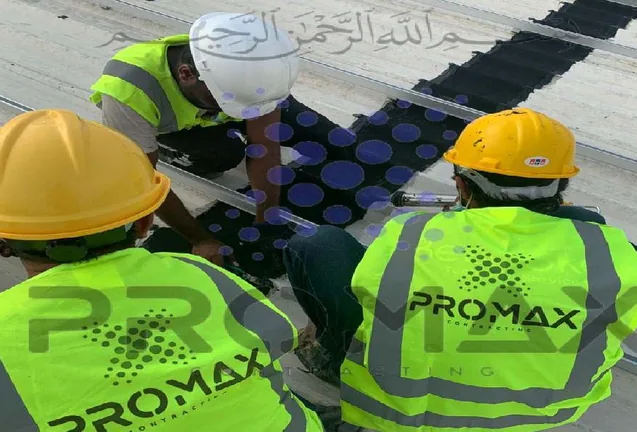
EPDM-based waterproofing systems can provide durable coverage for suitable roof conditions when installed over properly prepared substrates. The effectiveness of any membrane depends on surface preparation, seam treatment, adhesion, termination details, and protection at high-risk areas. Applying a coating or patch over trapped moisture, loose material, or active corrosion may provide a temporary appearance of repair while the underlying condition continues to deteriorate.
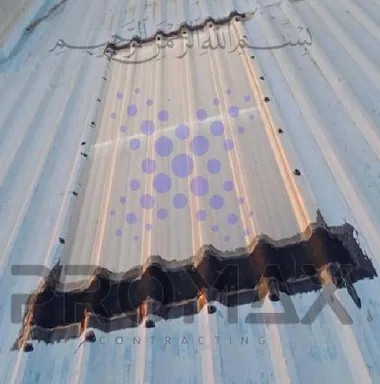
For metal roof rehabilitation, screw treatment, lap sealing, rust removal, replacement of corroded sections, and gutter restoration may need to be completed before the waterproofing system is installed. The roof must work as a complete assembly. Drainage, substrate condition, and membrane coverage cannot be treated as separate problems.
Build Ponding Checks Into the Maintenance Plan
After corrective works, maintenance should focus on preventing the same conditions from returning. Inspection frequency depends on roof type, surrounding trees, dust exposure, nearby construction activity, and the consequences of a leak inside the facility. At minimum, roofs should be checked before the rainy season, after major storms, and whenever drainage performance changes.
A practical maintenance record should track drain cleaning, observed ponding locations, membrane repairs, gutter condition, corrosion findings, and photographs of recurring low points. This gives facility teams evidence for planned capital repairs instead of waiting for an emergency leak.
For properties in Dubai, Abu Dhabi, Sharjah, and other UAE locations, heat, dust, and intense rainfall events can place different pressures on roof systems within the same year. Fast inspection after a storm is valuable because it identifies active ponding before debris dries in place and before water finds its way through an existing weak detail.
The right repair is the one that gives water a reliable route off the roof while protecting the system beneath it. If the source is uncertain, a detailed site assessment is usually less costly than repeating surface patches after every rainfall.
Talk to Promax
Need this on your roof? Call +971 56 727 4205 or request a free inspection. Promax provides EPDM metal-roof, concrete and industrial waterproofing across Dubai and the UAE with up to a 15-year warranty.