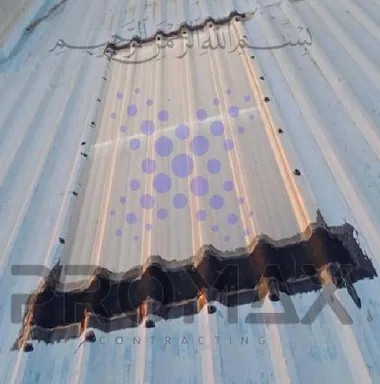
A metal roof rarely leaks through the middle of a panel first. It usually fails at the joints - side laps, end laps, fastener lines, ridge details, penetrations, and transitions where movement, heat, and water meet. If you are assessing how to waterproof metal roof joints, the real task is not just applying sealant. It is identifying why the joint is vulnerable, preparing the substrate correctly, and selecting a waterproofing system that can tolerate expansion, UV exposure, and standing water.
For warehouses, factories, sheds, and other large-span facilities, joint failure is more than a nuisance. It can damage stock, interrupt operations, corrode purlins, stain insulation, and create repeated maintenance costs. A short-term patch may slow the leak, but if the joint design, fastener condition, or sheet alignment is poor, the problem returns during the next heavy rain or thermal cycle.
Why metal roof joints fail
Metal roof joints are exposed to constant movement. Panels expand in daytime heat and contract at night. In hot industrial environments, that movement is significant, especially on long roof runs. If the original sealant hardens, the screws back out, or the lap detail was installed with weak compression, water starts tracking through the joint line.
Age is only one factor. Many leaks start because of rust at overlaps, failed washer seals, open end laps, poor slope-to-drainage coordination, or earlier repairs done with incompatible products. Bitumen smears, generic silicone, and surface coatings applied over dirt or oxidation often create a false sense of repair. They may stick for a while, but they do not always bond well to weathered metal or accommodate movement.
The location of the joint also matters. A side lap on a steep roof behaves differently from an end lap on a low-slope warehouse roof. End laps and gutter-side transitions are more exposed to driven rain and water backup, so they need more than a bead of sealant. They often need reinforced treatment with tape, membrane, or a full lap rebuild.
How to waterproof metal roof joints the right way
The correct approach starts with inspection, not product selection. Before any waterproofing is applied, the joint condition needs to be checked for loose fasteners, corrosion, panel distortion, failed existing sealant, trapped moisture, and structural movement. If the substrate is unstable, no sealant system will perform for long.
Start with cleaning and surface preparation
Surface preparation controls the outcome. Metal roof joints should be cleaned of dust, oxidation, oil, chalking, old loose sealant, and biological buildup. In many industrial settings, roofs also carry residue from exhaust, sand, or process contamination, which reduces adhesion.
A clean, dry, and mechanically sound surface is the baseline. Light rust may need wire brushing or abrasive preparation, followed by suitable rust treatment or primer depending on the system being installed. Heavy corrosion at the joint may require partial sheet replacement or fabricated cover flashing instead of direct sealing.
This is where many repairs fail. If a contractor applies sealant over unstable rust flakes, wet surfaces, or cracked mastics, the bond line is already compromised before the first rainfall.
Tighten or replace failed fasteners
A leaking joint is often tied to a fastening issue. Screws that have backed out even slightly can break the compression at the lap and create capillary entry points. Perished neoprene washers also allow water to pass through fixing points and migrate along the joint.
Fasteners should be checked for grip, corrosion, washer condition, and hole enlargement. Some can be re-seated. Others need oversize replacement fasteners or local sheet repair. If the joint is moving because the panel is loose, sealing over it will not solve the underlying failure.
Use the right sealant for metal movement
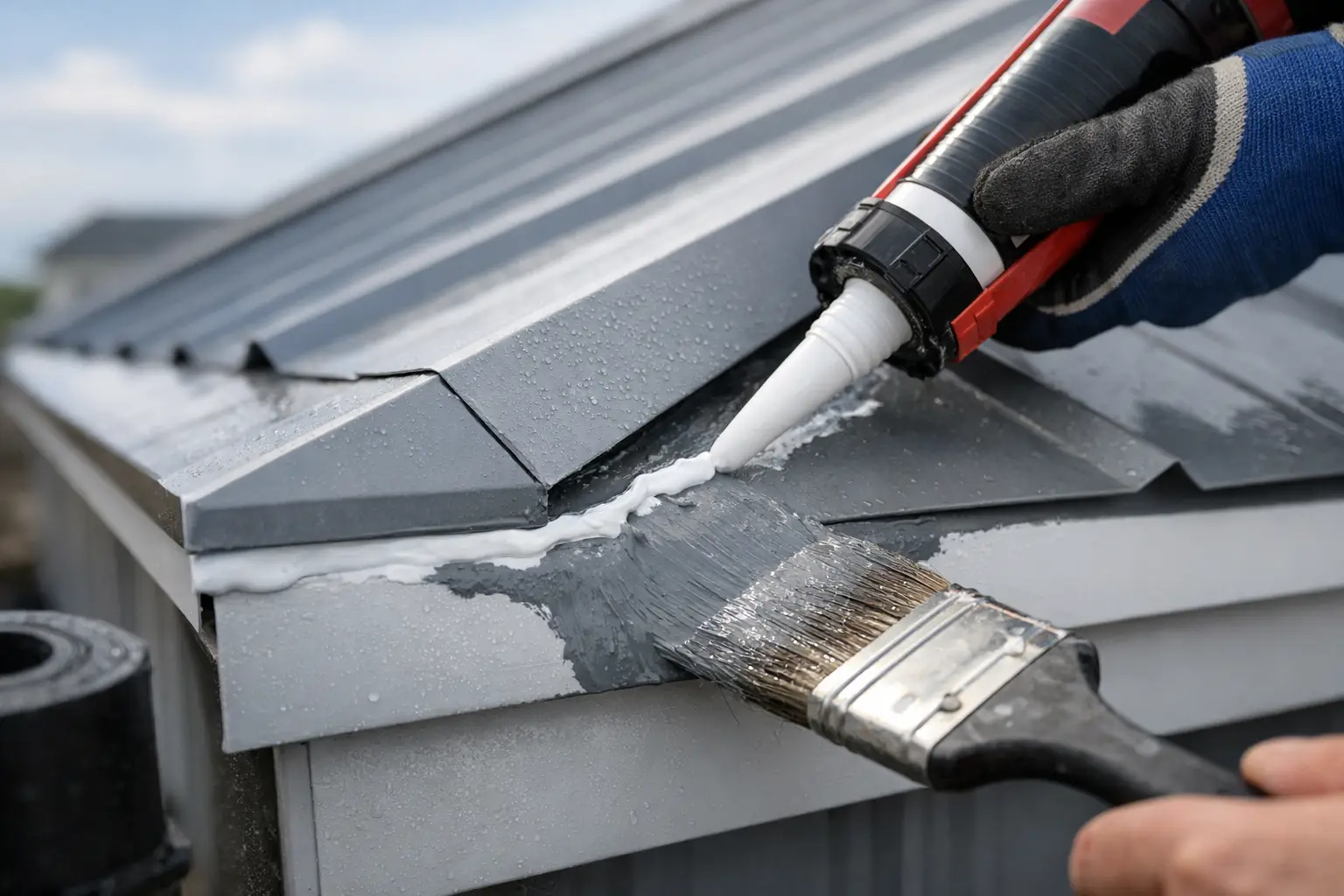
Not every sealant belongs on a metal roof. The product needs strong adhesion to coated metal, resistance to UV and weathering, and enough elasticity to tolerate thermal movement. For many industrial roof details, a high-performance polyurethane, MS polymer, or butyl-based jointing system is more appropriate than general-purpose silicone.
Butyl sealants and butyl tapes are commonly effective at laps because they stay tacky and compress well between metal surfaces. Liquid-applied sealants are useful at exposed edges, termination points, and irregular details. The choice depends on whether the joint is being rebuilt between sheets, reinforced on the surface, or treated as part of a larger membrane system.
One trade-off is that exposed sealant-only repairs are usually less durable than reinforced joint treatment. They are faster and lower cost, but on high-movement joints or low-slope roofs, they can require earlier maintenance.
Reinforcing the joint for long-term waterproofing
For joints with recurring leakage, surface reinforcement is often the better answer. This usually means applying a compatible primer where required, installing a seam tape or fleece-reinforced strip over the joint, and then encapsulating it within a waterproof coating or membrane detail.
When seam tape or membrane makes more sense
If the roof has multiple leaking laps, visible movement, or a history of repeated patching, a reinforced system gives better continuity than isolated sealant work. EPDM-based detailing, butyl seam tape, or elastomeric reinforcement strips can bridge minor movement and create a more consistent waterproof barrier.
This is especially useful on industrial roofs where access for future repairs is difficult or where internal operations cannot tolerate ongoing leakage. On large facilities, it is often more practical to treat all vulnerable joint lines in one planned campaign rather than wait for each leak point to develop.
Address end laps, penetrations, and transitions separately
The phrase how to waterproof metal roof joints covers more than panel overlaps. Penetrations at pipes, ducts, cable trays, and support brackets require a different detail than a straight lap seam. Ridge caps, valley gutters, roof-to-wall transitions, and skylight curbs also need shaped flashing, compression control, and proper drainage release.
These areas should not be treated with the same field method by default. A joint at a roof penetration may need a fabricated collar, membrane boot, or reinforced flashing patch. A transition detail may require termination bars, sealant backing, and edge protection. Good waterproofing comes from matching the repair detail to the joint geometry and water exposure.
Know when repair is not enough
Some metal roof joints cannot be reliably waterproofed without local reconstruction. If the metal sheets are badly corroded, the lap alignment is poor, the support below has deteriorated, or ponding water is persistent, surface treatment alone may only delay failure.
In those cases, the correct scope may include replacing rusted panels, renewing purlins, fabricating new gutter sections, correcting falls, or installing overflashing. This is a technical and commercial decision. A cheaper patch may look attractive in the short term, but if it leads to product damage, shutdowns, or repeated emergency callouts, the actual cost is higher.
A proper site inspection should separate cosmetic leakage symptoms from structural causes. That is particularly important on older warehouse and factory roofs where multiple repair layers can hide the real condition of the joint.
Execution matters as much as the material
Even a good waterproofing system can fail under weak workmanship. Joint sealing needs correct bead size, compression, overlap width, cure conditions, and weather timing. Reinforced details need wrinkle-free installation and full adhesion. Fastener treatment needs consistency across the roof zone, not just at the most visible leak point.
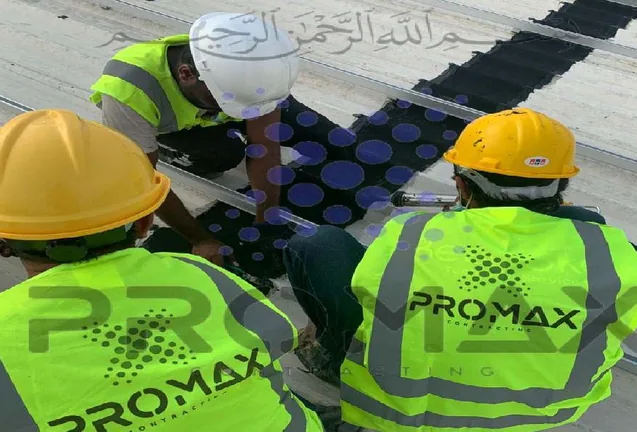
For occupied commercial and industrial buildings, execution planning also matters. Access equipment, safety lines, hot-weather working conditions, and operational restrictions all affect the repair quality. A contractor with roof waterproofing experience should be able to inspect, fabricate related metal components where needed, and coordinate the repair without creating new drainage or access problems.
That practical coordination is often what separates a durable repair from another temporary maintenance cycle. Companies such as Promax Contracting typically approach these works as a system - inspection, substrate repair, fastener treatment, joint detailing, membrane application where required, and after-sales response if a problem reappears.
How to judge whether the repair will last
A reliable metal roof joint repair should show full adhesion, clean edge detailing, stable fastener compression, and no untreated rust or open gaps at the joint line. Water testing may be appropriate on selected details, especially around penetrations and transitions. On larger facilities, documenting treated areas also helps future maintenance teams track roof condition and prioritize budget.
The best result is not a roof covered in random sealant. It is a controlled waterproofing detail designed around movement, drainage, and substrate condition. That is the difference between stopping one leak and extending the service life of the roof.
If your metal roof joints are leaking, the fastest fix is not always the right one. The right fix is the one that matches the joint type, site exposure, and condition of the roof so the repair keeps working after the next heat cycle and the next storm.
Talk to Promax
Need this on your roof? Call +971 56 727 4205 or request a free inspection. Promax provides EPDM metal-roof, concrete and industrial waterproofing across Dubai and the UAE with up to a 15-year warranty.