A leaking box gutter rarely stays a gutter problem for long. In a warehouse or factory, failed joints, standing water, and corroded channels quickly turn into roof edge deterioration, facade staining, stock damage, and shutdown risk. That is why industrial gutter waterproofing solutions need to be specified as a building protection system, not treated as a small patching job.
On industrial sites, gutters are exposed to more than rain. They deal with thermal movement, UV exposure, dust buildup, foot traffic during maintenance, vibration around roof accessories, and in many cases aggressive runoff from large metal roof areas. A solution that looks acceptable after installation can still fail early if it does not account for substrate condition, drainage fall, joint movement, and the way the facility actually operates.
What industrial gutter waterproofing solutions must solve
The first issue is not always the visible leak. In many facilities, the real cause sits underneath it - rusted steel, open lap joints, failed end details, screw penetrations, blocked outlets, or gutters that were never designed with enough fall. Applying a coating over that condition may slow water ingress for a short period, but it does not correct the mechanism of failure.
Effective industrial gutter waterproofing solutions need to do four jobs at once. They must stop active leakage, resist standing water, bridge movement at joints and terminations, and protect the gutter substrate against future corrosion. If any one of those requirements is missed, the system life drops sharply.
This is where site inspection matters. A contractor should check gutter dimensions, metal thickness, corrosion depth, outlet placement, internal supports, previous repair layers, and discharge performance during rainfall or flood testing. On older industrial roofs, gutter failure is often tied to surrounding roof sheet laps, parapet cracks, skylight details, or pipe penetrations. Treating the gutter in isolation can leave the leak path open.
The main system options and where each fits
There is no single material that suits every industrial gutter. The right choice depends on the gutter profile, substrate condition, amount of movement, service life target, and whether the repair must be done while operations continue.
EPDM lining systems
EPDM is one of the most dependable options for industrial gutters when the goal is long-term waterproofing with good movement tolerance. It works especially well in large box gutters and channels where thermal expansion and contraction are significant. Because the membrane remains flexible, it handles joint stress better than rigid or brittle repair materials.
A properly installed EPDM gutter lining is not just laid into place. The substrate needs preparation, corrosion treatment where required, detail reinforcement at corners and outlets, and secure terminations that will not peel under heat or water pressure. If the gutter has severe deformation or structural weakness, lining alone may not be enough. The base condition still has to be made sound.
For facilities in high-heat environments such as the Gulf, EPDM performs well when installed by teams familiar with surface preparation, adhesive compatibility, and edge detailing. Poor detailing at outlet sumps and end laps is where many membrane jobs fail, not in the field area.
Liquid-applied waterproofing systems
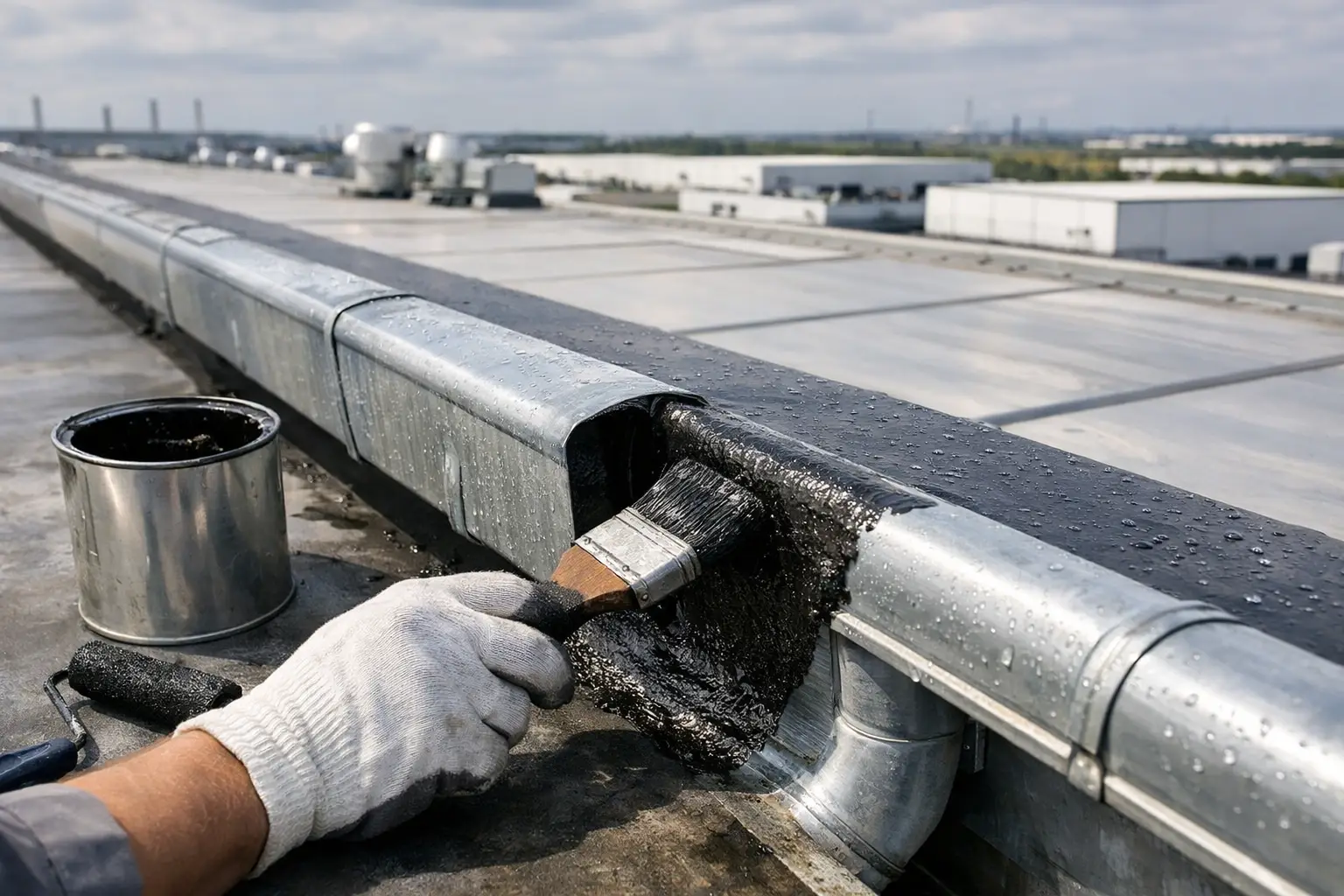
Liquid systems can be effective where gutters have irregular geometry, multiple penetrations, or difficult access. They create a continuous waterproof layer and can simplify detailing around brackets, outlets, and complex transitions. On refurbishment jobs, this can reduce the amount of dismantling required.
The trade-off is that liquid-applied systems are heavily dependent on application control. Film thickness, curing conditions, moisture on the substrate, and reinforcement at movement zones all affect performance. In industrial gutters with persistent standing water, not every liquid product is suitable. Product selection has to match the actual service conditions rather than the brochure claim.
Metal repair plus protective coating
If the gutter is still structurally sound but has localized corrosion, open seams, and coating breakdown, a combined repair approach may be the most cost-effective route. This usually involves rust treatment, mechanical repairs, sealing of laps and penetrations, and then a protective waterproof coating system.
This option works best when corrosion is surface-level to moderate and the original metal section can still perform. If the gutter base has perforations, heavy pitting, or deflection, coating over it may only delay replacement. The inspection should decide whether rehabilitation is technically justified or whether section replacement is the safer investment.
Partial or full gutter replacement
Some gutter conditions are beyond waterproofing alone. If support brackets have failed, outlets are incorrectly positioned, the slope is poor, or corrosion has materially reduced the metal thickness, replacement becomes the practical answer. In those cases, waterproofing should be integrated into the replacement design rather than added later as a separate repair layer.
For industrial sites, fabricated replacement sections can solve several recurring issues at once - larger discharge capacity, improved fall, better joint layout, and stronger corrosion protection. This is often the better long-term decision when repeated patch repairs have already consumed maintenance budget.
Why industrial gutters fail early
In many cases, the waterproofing material gets blamed for a problem caused by design or execution. The most common issue is trapped water. Once a gutter holds water for long periods, every weakness is amplified. Corrosion accelerates, debris settles, coatings stay immersed, and minor laps become active leak points.
Movement is another major factor. Long metal gutters expand and contract more than many repair systems can tolerate. If the waterproofing detail is rigid at joints, corners, or termination bars, splitting starts there first. This is why flexible membrane-based systems are often preferred in industrial settings with high roof temperatures.
Maintenance access also affects service life. Gutters on warehouses and factories are regularly crossed during servicing of roof equipment, signage, and skylights. If the repair system cannot handle occasional maintenance traffic, punctures and abrasion become a hidden failure point.
How to evaluate a contractor's recommendation
A credible recommendation should start with condition-based reasoning, not a standard product pitch. The contractor should explain whether the gutter problem is primarily leakage, corrosion, structural deterioration, inadequate drainage, or a combination of all four. That diagnosis determines the repair scope.
You should also expect clear detail treatment around outlets, expansion zones, end caps, overlaps, and roof-to-gutter transitions. These are the critical areas. Large uninterrupted sections are usually the easiest part of the work.
For industrial assets, execution capability matters as much as material choice. Surface preparation, sheet metal repair, fabrication support, safe roof access, and after-sales response all affect the result. A contractor that can inspect, repair substrate defects, install the waterproofing system, and respond quickly if rain testing reveals issues will generally reduce project risk. That execution-led approach is where specialized firms such as Promax Contracting tend to add the most value.
When repair is enough and when replacement is smarter
The answer depends on the remaining life of the gutter body. If the substrate is stable and the failure is concentrated at joints, penetrations, and coating breakdown, rehabilitation is usually justified. A well-designed waterproofing upgrade can extend service life significantly and avoid disruption to operations.
If the gutter has widespread perforation, chronic ponding due to bad slope, distorted sections, or repeated overflow because capacity is undersized, replacement may be the lower-cost decision over the full life cycle. The upfront spend is higher, but it removes the need for recurring emergency repairs and protects adjacent roof elements that may already be at risk.
Decision-makers should also consider operational exposure. A gutter above sensitive stock, electrical rooms, production lines, or finished interior spaces carries a higher consequence of failure. In those cases, conservative decisions are often the right ones.
What a durable specification looks like
A durable gutter waterproofing scope is built around inspection, cleaning, substrate repair, corrosion treatment, joint preparation, waterproof lining or coating application, and final water-flow verification. It should also include outlet checks and recommendations for debris management because even a good system underperforms if the drainage path is blocked.
The best results usually come from treating the gutter as part of the full roof drainage network. If downpipes are undersized, outlets are choked, or nearby roof sheets are leaking into the gutter edge, the repair should address those interfaces. Waterproofing works best when it is integrated with drainage correction and metal restoration, not isolated from them.
For facility managers and engineers, the main point is simple. Industrial gutter waterproofing solutions are worth the investment when they are matched to real site conditions, not selected by habit. The right repair can stop leakage, slow corrosion, and protect the wider roof system for years. The wrong one just buys time until the next storm. If your gutter is already showing leaks, rust, or overflow, the most useful next step is a proper site inspection before the damage spreads beyond the roofline.
Talk to Promax
Need this on your roof? Call +971 56 727 4205 or request a free inspection. Promax provides EPDM metal-roof, concrete and industrial waterproofing across Dubai and the UAE with up to a 15-year warranty.