
A leaking roof over production lines, corrosion spreading across metal sheets, failed drainage around a warehouse perimeter, or delaminating epoxy in a forklift zone usually does not start as a major capital issue. It becomes one when the wrong vendor is hired to patch it. That is why industrial maintenance contractor selection needs to be treated as a risk-control decision, not a price comparison exercise.
For facility managers, plant teams, procurement leads, and property owners, the real question is not whether a contractor can submit a quote. The question is whether that contractor can inspect correctly, identify the failure mechanism, execute safely in a live operating environment, and deliver a repair system that lasts beyond the next rain event or shutdown cycle. In industrial buildings, bad diagnosis is expensive, and weak execution is worse.
What industrial maintenance contractor selection should actually measure
Many tenders reduce contractor evaluation to commercial terms, manpower count, and a list of previous jobs. Those points matter, but they do not tell you enough. Industrial maintenance work is rarely one-dimensional. A roof leak may involve failed fasteners, degraded sealant, rusted purlins, thermal movement, blocked gutters, damaged skylight junctions, and poor previous patching all at once.
A suitable contractor must be able to look at the building as a system. That means understanding waterproofing, drainage, substrate condition, metal treatment, access constraints, fabrication needs, and sequencing around operations. If the contractor only treats the visible symptom, you will likely be paying again within months.
This is especially true in large warehouses, factories, logistics hubs, and utility-exposed buildings where heat, dust, standing water, and corrosion work together. In those settings, the quality of the inspection phase often predicts the quality of the result.
Start with technical fit, not vendor familiarity
A common mistake in industrial maintenance contractor selection is awarding specialized work to a general vendor because they are already approved for other trades. That can work for basic civil repairs or routine touch-up tasks. It usually breaks down when the issue involves active water ingress, roof system rehabilitation, pipe penetration sealing, membrane failure, structural steel corrosion, or flooring systems under load.
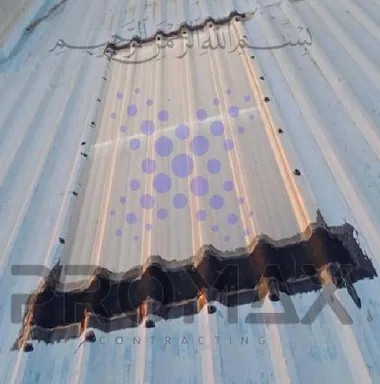
Technical fit means the contractor has done the same type of failure correction under similar site conditions. If your facility has a metal roof with repeated leakage at laps and screw points, you need a team that understands metal roof waterproofing systems, screw treatment, sheet condition, insulation exposure, and thermal movement. If the issue is rooftop ponding and concrete cracking, the contractor should be able to recommend substrate repair, slope correction where required, and a waterproofing system that matches the roof use and exposure.
Experience should be specific. "Industrial projects completed" is not enough. Ask what kind of industrial assets they repaired, what failure patterns they addressed, and what system they installed.
Evaluate how the contractor inspects
A serious contractor does not rush to quote from a few photos and a roof area measurement. They inspect. They trace water paths. They check details, overlaps, discharge points, penetrations, flashing conditions, fastener lines, rust formation, and substrate integrity. They ask what happened before the leak appeared, whether previous repairs were attempted, and how operations are affected.
This matters because industrial defects travel. Water entering at one roof penetration may appear inside several bays away. Corrosion at one panel edge may indicate broader coating breakdown. A cracked floor joint may signal movement, moisture, or chemical exposure rather than surface wear alone.
The inspection process should also lead to a clear scope. Not just "waterproof roof" or "repair gutter," but what will be cleaned, removed, replaced, treated, sealed, coated, fabricated, or reinforced. Vague scopes create variation claims, delays, and weak accountability.
Capability on paper is not the same as execution in the field
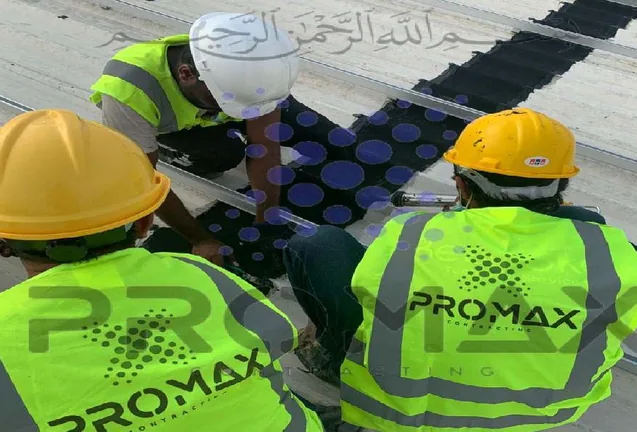
Industrial buyers often receive polished profiles, but field delivery is where projects succeed or fail. During contractor selection, ask how work is supervised on site, how materials are handled, whether fabrication is in-house or outsourced, and how the team manages access, safety barriers, weather exposure, and phased execution.
This is where many low-cost vendors fall short. They may know the product name, but not the installation discipline. They may promise minimal disruption, then block operations with poor sequencing. They may begin rust treatment without proper surface preparation or apply waterproofing on contaminated substrates. Those are not minor errors. They directly affect adhesion, service life, and warranty value.
A reliable maintenance contractor should be able to explain the method in practical terms. How will they prepare the surface? How will they treat joints and penetrations? What happens if hidden corrosion is found? How will drainage be protected during the work? How will they keep the site operational and safe?
Industrial maintenance contractor selection and response speed
In maintenance environments, response time is part of technical capability. A contractor that takes days to mobilize for active leaks, sheet damage, drainage overflow, or safety-related deterioration may expose the facility to unnecessary loss. Fast response does not mean careless work. It means the contractor has enough internal control over labor, materials, inspection, and supervision to act when the building needs attention.
This is one reason many industrial clients prefer specialized contractors with inspection, engineering input, fabrication support, and maintenance execution under one structure. It shortens the gap between diagnosis and action. When temporary control measures, permanent repair details, metal replacement, and waterproofing installation are coordinated by one team, decision-making improves.
Promax Contracting operates in that execution model because industrial clients usually need more than a patch. They need inspection, repair design, material application, and after-sales support aligned from the start.
Look closely at materials, but look even harder at system design
Buyers often ask which membrane, coating, or flooring product will be used. That is a fair question, but product choice alone does not guarantee a durable result. The system design matters more. A good contractor matches the material to the substrate condition, exposure level, movement, drainage pattern, traffic, and expected maintenance cycle.
For example, EPDM-based waterproofing may be highly effective in the right application, especially where flexibility, weather resistance, and detail treatment are important. But even the right material can fail if edges are poorly terminated, penetrations are not detailed properly, or water traps are left unresolved. The same applies to rust treatment, industrial painting, gutter replacement, and epoxy flooring. The repair logic must match the defect.
Ask contractors why they recommend a certain system, not just what they recommend. If they cannot explain the failure mechanism and the repair sequence, the proposal is incomplete.
Cost matters, but cheap scope usually becomes expensive work
Every procurement team has budget pressure. That is normal. Still, industrial maintenance contractor selection should compare cost against scope completeness, expected life, shutdown impact, and rework risk.
A lower bid may exclude substrate repair, detail treatment, corroded fastener replacement, drainage correction, access equipment, or protective preparation. On paper it looks efficient. In practice it often becomes a series of additions, delays, and callbacks. The most expensive maintenance job is the one that interrupts operations twice.
A better way to compare proposals is to examine what each contractor believes is causing the problem, what exactly they will do, what they are excluding, how long the system is expected to perform, and what support is available after handover. A contractor that prices honestly and defines scope clearly is usually easier to manage than one that wins on assumptions.
Signs you are choosing the right contractor
The right contractor asks technical questions early. They visit the site before finalizing scope. They provide practical recommendations instead of generic language. Their team understands live-site constraints, permit-to-work requirements, and access planning. They can handle specialized details such as skylight waterproofing, pipe penetration sealing, purlin replacement, gutter line correction, and metal roof treatment without splitting responsibility across multiple vendors.
Just as important, they do not pretend every issue has the same answer. Some roofs need rehabilitation, not coating. Some gutters need replacement, not sealing. Some concrete roofs need crack treatment and waterproofing together. Some floor failures are operational issues, not material defects. A good contractor will tell you when a partial repair is reasonable and when it is false economy.
That level of honesty is useful because maintenance decisions are rarely made in ideal conditions. You may need a temporary control now and a planned permanent repair later. You may need phased work to avoid downtime. You may need selective replacement because access or budget is limited. The right contractor can work within those realities without losing technical discipline.
When you are evaluating vendors, choose the one that makes the building problem clearer, not the one that makes the proposal look simpler. In industrial maintenance, clarity is usually the first sign of competence, and competence is what protects your facility when the next failure starts to show.
Talk to Promax
Need this on your roof? Call +971 56 727 4205 or request a free inspection. Promax provides EPDM metal-roof, concrete and industrial waterproofing across Dubai and the UAE with up to a 15-year warranty.