A warehouse roof can look acceptable from ground level while concealed failures are already affecting insulation, purlins, gutters, fasteners, and internal operations. Industrial roof refurbishment Dubai is not simply a matter of applying a new coating over an old surface. It is a planned repair process that identifies why water is entering, where corrosion has reduced performance, and which system will protect the building through extreme heat, dust, wind, and occasional heavy rainfall.
For facility managers and asset owners, the priority is clear: stop recurring leakage before it becomes a structural, operational, or inventory problem. The right scope depends on the roof condition, building use, drainage layout, existing materials, and the amount of work that can be completed without interrupting production or storage activities.
Why Industrial Roofs Fail Earlier Than Expected
Dubai's industrial buildings operate under conditions that place continuous stress on metal and concrete roof systems. High surface temperatures cause expansion and contraction across sheets, laps, flashings, and penetrations. Over time, this movement can loosen fasteners, crack sealants, open joints, and damage membrane terminations.
Dust accumulation creates a second problem. When dust collects in gutters and valleys, water cannot discharge as designed. During rainfall, ponding forms at low points and overflow can enter through side laps, roof junctions, skylight edges, or deteriorated gutter connections. A small drainage issue can quickly become a widespread leak path.
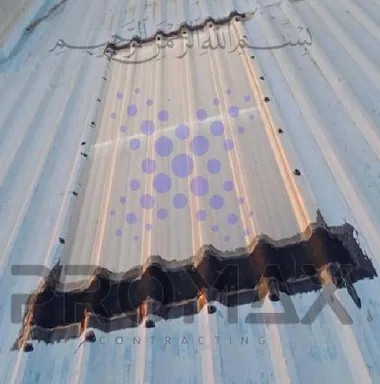
Corrosion is equally significant. Roof sheets may oxidize around screws, overlaps, cut edges, and areas where protective coatings have worn away. If corrosion reaches supporting members or purlins, the refurbishment scope must go beyond waterproofing. Damaged steel requires proper treatment, replacement, fabrication, or reinforcement based on a site assessment.
Repeated patch repairs often hide these underlying conditions. They may provide short-term relief, but they do not correct failed drainage falls, weakened fastener lines, degraded sheet laps, or incompatible repairs installed over the years.
Industrial Roof Refurbishment Dubai Starts With Inspection
A reliable refurbishment program begins on the roof, not with a standard quotation. Inspection should examine the full building envelope area, including roof sheets or slabs, expansion joints, gutters, downpipes, parapet flashings, skylights, exhaust penetrations, pipe penetrations, and access points.
The inspection team should identify active leak locations, but active leaks are only one part of the picture. Water may travel along roof sheets, insulation, structural members, or internal channels before it appears inside the building. The visible stain on a ceiling is not always the actual entry point.
For metal roofs, an assessment should check fastener condition, sheet thickness, corrosion spread, seam integrity, loose laps, failed sealant, damaged ridge caps, and the condition of supporting steel. For concrete roofs, the focus shifts toward cracks, ponding, old membrane failure, upstand details, joint movement, and termination quality.
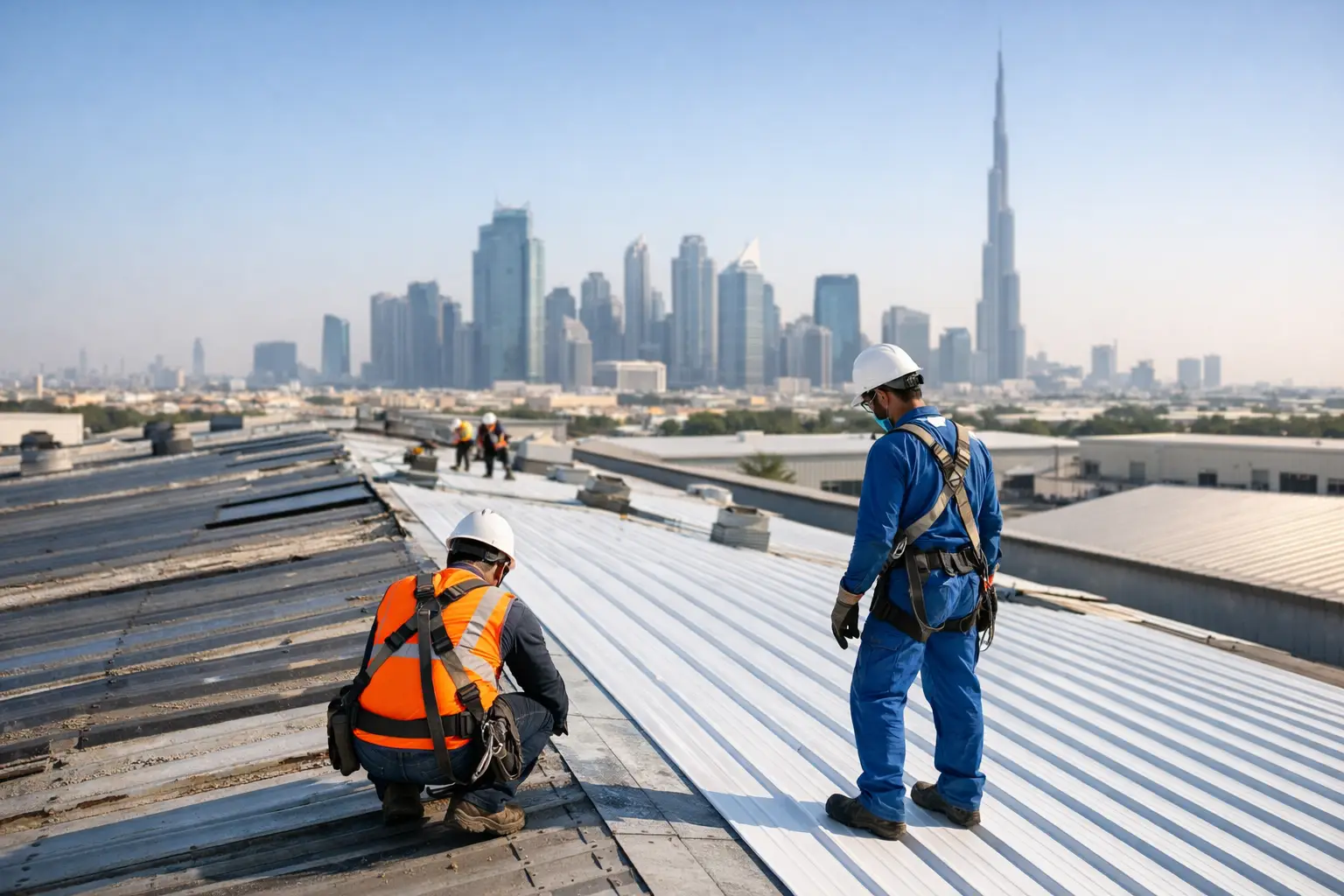
This stage also defines the practical delivery plan. A busy logistics facility may require work by zone, scheduled access routes, debris control, and protection for stock below. A factory with sensitive equipment may need temporary weather protection and controlled work permits. The best technical system will still fail as a project if site access and operational constraints are ignored.
Choosing the Right Refurbishment Scope
Not every deteriorated roof requires complete replacement. In many cases, a targeted refurbishment can extend service life at a lower cost and with less disruption. The decision depends on whether the existing substrate is stable enough to receive a new waterproofing system.
Targeted repairs for localized defects
Targeted repair is appropriate where the roof is generally sound and failures are limited to defined areas. This may include screw treatment, sealing of overlaps, replacement of isolated damaged sheets, flashing repairs, skylight waterproofing, gutter repairs, and sealing around service penetrations.
This approach is cost-effective when inspection confirms that corrosion is superficial and drainage remains functional. It is not the right answer when leaks are recurring across multiple areas or when the base material has reached the end of its serviceable condition.
Full membrane coverage for widespread leakage
Where the roof has multiple leak paths, failed coatings, or extensive joint deterioration, full membrane coverage can provide a more controlled solution. EPDM-based waterproofing systems are often selected for their flexibility, weather resistance, and ability to accommodate thermal movement when correctly detailed and installed.
The quality of the system depends heavily on preparation and detailing. Substrates must be cleaned, repaired, and primed where required. Edges, penetrations, laps, valleys, and vertical transitions require compatible components and careful finishing. A membrane is only as dependable as the details around it.
Replacement and structural repair for advanced deterioration
If metal sheets have significant corrosion, supporting purlins are compromised, or water damage has affected structural elements, replacement may be more responsible than continued patching. This can involve removal of failed sections, fabrication of replacement components, installation of new sheets or gutters, rust treatment, and waterproofing of all junctions.
This option has a higher immediate cost, but it may reduce repeated callouts, inventory exposure, and emergency repair expenses. The trade-off is planning. Replacement work needs accurate measurements, material coordination, safe access, and a clear sequence to keep the facility protected during the works.
Details That Decide Roof Performance
Large roof areas receive attention, but most failures occur at transitions and openings. Fasteners, overlaps, ridge caps, gutters, pipe penetrations, skylights, wall flashings, and expansion joints deserve the same level of engineering as the main roof surface.
Gutters are particularly important in industrial properties. A new waterproofed roof will still experience leakage if undersized, corroded, poorly sloped, or blocked gutters force water back toward the building. Gutter replacement, fabrication, resealing, and downpipe corrections should be evaluated as part of the same refurbishment scope.
Skylights require a separate review because their frames expand differently from adjacent roof sheets. Cracked panels, deteriorated perimeter sealant, and weak flashing details can lead to persistent leakage. A proper repair addresses both the skylight condition and its connection to the surrounding roof.
Safety access is another practical consideration. If maintenance teams cannot safely reach gutters, skylights, and service penetrations, routine checks are delayed until a failure occurs. Walkways, access ladders, guardrails, and designated maintenance routes can make future inspection safer and faster.
Controlling Risk During Live-Site Works
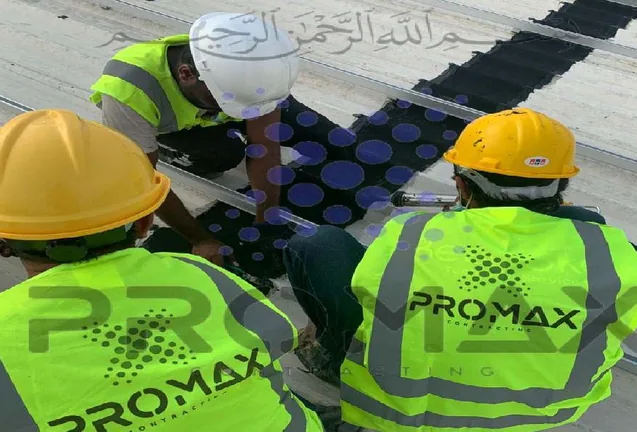
Industrial roof refurbishment is frequently performed above active warehouses, storage areas, and production zones. That makes project control as important as material selection. The contractor should coordinate access, isolate work areas where needed, secure tools and loose materials, manage debris, and monitor changing weather conditions.
Temporary waterproofing should be available when repairs expose vulnerable areas. Materials should be staged to avoid unnecessary roof loading, and hot works or cutting activities must follow site safety procedures. Where roof sheets are being replaced, the sequence should prevent large sections from remaining open overnight.
A responsive after-sales process also matters. Even well-executed refurbishment works may require follow-up after the first significant rainfall or after adjacent trades complete their work. Promax Contracting approaches roof rehabilitation as an inspection, repair, fabrication, and maintenance requirement rather than a one-time coating application.
How to Plan the Project Budget
The lowest quotation can become expensive if it excludes preparation, corrosion treatment, drainage repairs, access equipment, edge detailing, or warranty-related follow-up. Compare scopes line by line, not just total prices. A useful proposal should define the existing condition, repair methodology, materials, coverage areas, exclusions, and expected sequence of work.
Budget planning should also account for the cost of doing nothing. Water ingress can damage stored goods, interrupt operations, stain internal finishes, accelerate steel corrosion, and create safety concerns. Emergency repair work is usually more disruptive than planned refurbishment, particularly during a period of rainfall.
Where budgets are limited, prioritize active leaks, structural concerns, drainage failures, and high-risk penetrations first. A phased program can be sensible, provided each phase connects to an overall roof strategy rather than becoming another series of isolated patches.
A roof does not need to fail completely before action is justified. When fasteners are rusting, gutters are overflowing, sealants are cracking, or small leaks return after every repair, inspection is the practical next step. Early intervention gives the owner more choices, better scheduling control, and a stronger chance of preserving the building without a major emergency.
Talk to Promax
Need this on your roof? Call +971 56 727 4205 or request a free inspection. Promax provides EPDM metal-roof, concrete and industrial waterproofing across Dubai and the UAE with up to a 15-year warranty.