A metal roof rarely fails all at once. It starts with a stained insulation line over a warehouse bay, a drip near a skylight curb, rust around fasteners, or ponding at a gutter connection that keeps coming back after every patch. For industrial and commercial buildings, those early signs are not minor. They usually point to wider waterproofing failure, thermal movement stress, corrosion, or drainage defects that need proper site diagnosis - not another temporary sealant job.
That is where professional metal roof leak repair services make the difference. On large-span sheds, factories, workshops, and storage facilities, leakage is usually a system problem. The visible entry point is only one part of the failure. Unless the roof is inspected as a whole, repairs tend to shift the problem rather than solve it.
What metal roof leak repair services should actually cover
A proper repair scope starts with inspection, not product application. On operational buildings, contractors need to identify whether leakage is coming from end laps, side laps, fastener penetrations, pipe penetrations, roof curbs, skylights, valley gutters, box gutters, ridge caps, expansion points, or corrosion-opened panels. In many cases, two or three defects are active at the same time.
Good metal roof leak repair services also account for building use. A warehouse storing dry goods has different risk exposure than a production facility with heat, vapor, and process equipment below the roof line. If repair planning ignores internal humidity, rooftop traffic, vibration, or access limitations, even a technically correct repair can underperform.
For that reason, the right service provider typically combines leak tracing, corrosion assessment, substrate condition review, drainage checks, and repair method selection in one inspection process. The repair itself may involve fastener replacement, seam treatment, rust removal, panel sealing, flashing reconstruction, EPDM-based waterproofing, gutter rehabilitation, or localized sheet replacement. It depends on what has failed and how far that failure has spread.
Why metal roofs leak in commercial and industrial buildings
Most building teams already know that age is a factor, but age alone is rarely the whole story. Metal roofs leak because they move, expand, contract, vibrate, and weather under constant exposure. In hot climates, thermal cycling puts repeated stress on joints, fixings, and sealant lines. Over time, that movement opens up pathways for water ingress.
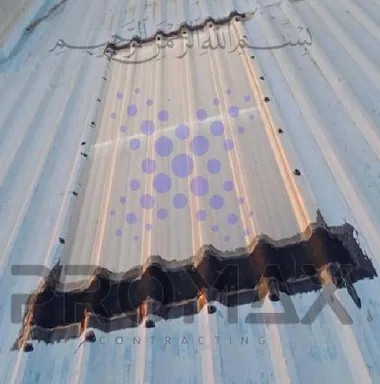
Fasteners are one of the most common failure points. Washers harden, screws back out, and fixing holes enlarge. Once that happens, water bypasses the fixing line and reaches the substrate or purlin zone. If the leak is left untreated, corrosion develops around the fastener field and repair costs rise quickly.
Seams and laps are another frequent issue. On long roof runs, even a small installation error or aging seal line can allow capillary action to pull water inward. The leak may then show up several feet away from the actual opening, which is why visual guesswork often leads to the wrong repair location.
Drainage defects also matter more than many owners expect. Blocked gutters, undersized downpipes, poor slope, and debris loading all increase standing water. Metal roofing systems are not forgiving when water is allowed to sit at laps, penetrations, or gutter junctions. Repeated wetting accelerates coating breakdown and rust formation.
Then there is corrosion. Once protective coatings fail, exposed steel begins to deteriorate. In early stages, corrosion can be treated and sealed. In advanced stages, the panel may lose thickness and structural reliability, making localized replacement the safer option.
Repair first or replace sections? It depends on failure depth
Not every leaking roof needs replacement, but not every roof is a candidate for surface treatment alone either. The right decision depends on the condition of the sheet profile, the extent of rusting, the integrity of laps and fixings, and whether supporting members have been affected.
If the leak source is localized and the metal panels remain structurally sound, targeted repair is usually the most cost-effective approach. That might include replacing failed fasteners, treating rusted zones, sealing penetrations, reworking flashings, or applying an engineered waterproofing system over problem areas. For many warehouses and industrial sheds, this route restores service life without major disruption to operations.
If corrosion is widespread, if panels are perforated, or if purlins and supports show deterioration, the scope may need to move beyond leak sealing. At that stage, sectional sheet replacement, purlin replacement, or broader roof rehabilitation becomes more practical than repeated patchwork. A serious contractor should be clear about that. Overpromising on a failing roof only delays a larger problem.
What a reliable repair process looks like on site
The best repair outcomes come from methodical field execution. First comes inspection and leak mapping. This includes reviewing roof geometry, access points, drainage paths, fixing patterns, penetrations, and visible corrosion. Moisture tracing inside the building helps connect internal leak marks with external roof conditions.
Next comes defect classification. Some issues are active leak points. Others are near-failure conditions that should be repaired in the same mobilization to avoid repeat callouts. This is especially important on large facilities where access equipment, permits, and production coordination all affect downtime and cost.
Surface preparation is where many repairs succeed or fail. Loose rust, failed sealant, contaminants, and unstable coatings have to be removed before treatment begins. Skipping this step may make the roof look repaired for a short period, but adhesion and waterproofing performance will suffer.
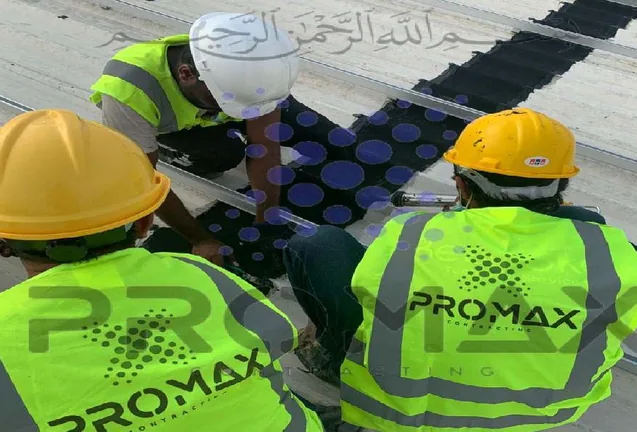
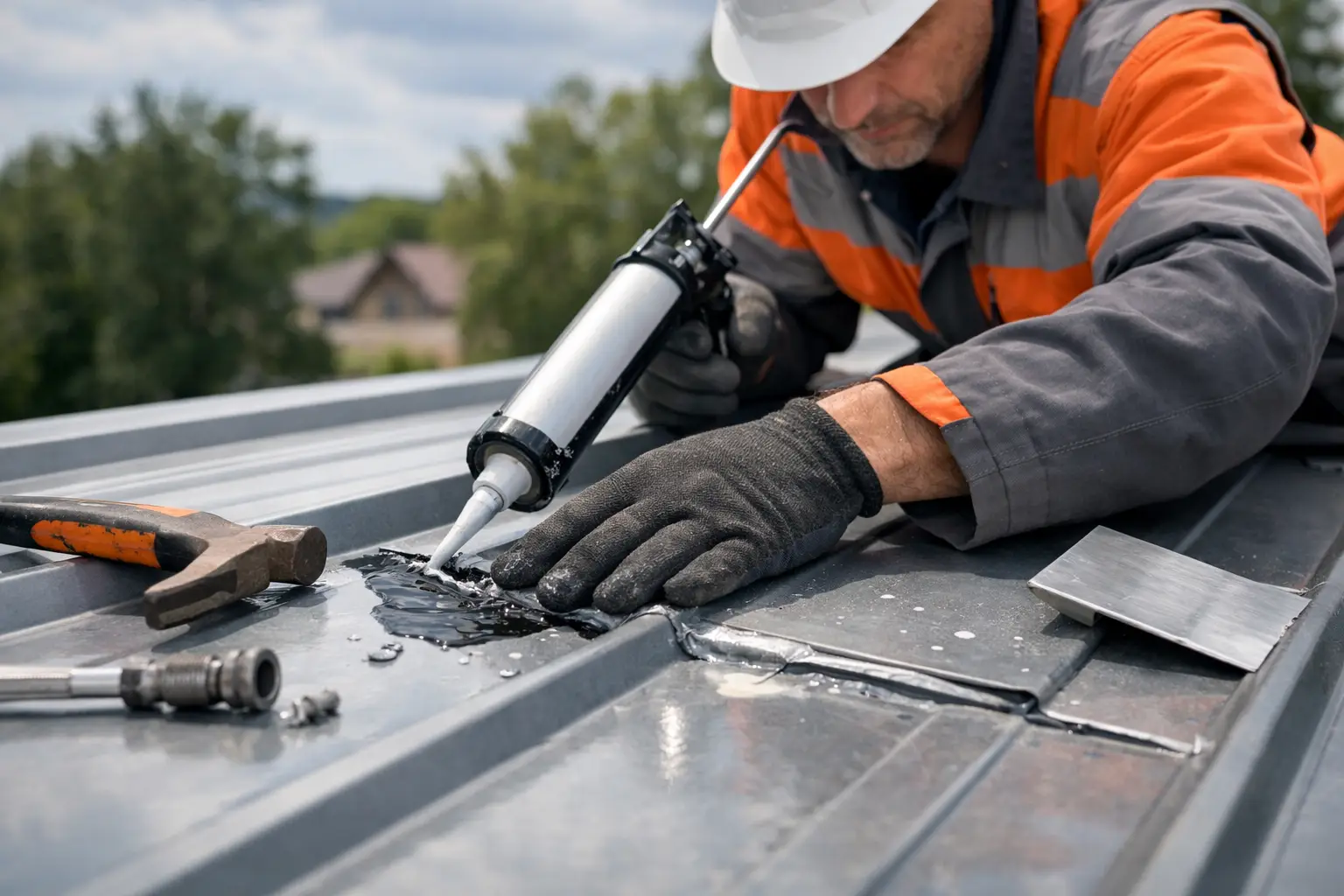
The repair stage itself varies by defect. Fastener lines may need replacement and sealing. Penetrations may need reshaping and flashing correction. Open joints may require reinforced waterproofing treatment. Corroded zones may need mechanical preparation, anti-rust treatment, and protective overcoating. Gutters may need regrading, patching, or full replacement if standing water has become part of the leak cycle.
Final inspection should verify coverage, adhesion, detail completion, and drainage performance. On active commercial sites, after-sales response also matters. If a roof has a history of leakage, building teams need a contractor who can return quickly if hidden secondary defects appear after the first rain event.
Where cheap leak repairs usually fail
The market is full of short-term fixes dressed up as complete solutions. A bead of sealant over a moving joint, a coating applied over untreated rust, or random patching around a visible drip point may slow water for a few weeks. It will not address thermal movement, failed fixings, drainage overload, or substrate deterioration.
That is why procurement should look beyond price per square foot. The real comparison is between one engineered repair cycle and multiple reactive callouts, damaged stock, ceiling repairs, electrical risk, and lost maintenance hours. Cheap repairs often become expensive because they ignore the failure mechanism.
For industrial assets, the contractor's capability matters as much as the material system. Leak repair on a live facility may require fabrication of custom flashings, safe roof access planning, coordination around operations, and the ability to address connected issues such as gutters, skylights, pipe penetrations, and corroded steel members in one scope.
Choosing a contractor for metal roof leak repair services
For facility managers and project teams, the right contractor should be able to explain the leak path clearly, define whether the issue is local or systemic, and specify the repair method without vague language. You want a team that understands metal roof movement, waterproofing compatibility, corrosion control, and industrial site execution.
Look for field inspection discipline, practical repair detailing, fabrication support, and willingness to document the scope before work begins. If the contractor can only offer generic coating language without discussing seams, screws, gutters, penetrations, and drainage, the diagnosis is probably incomplete.
This is where service depth becomes valuable. A provider such as Promax Contracting can support inspection, waterproofing, metal surface restoration, gutter work, penetration sealing, and related rehabilitation under one execution model. That reduces handoff gaps and helps ensure the repair scope fits the actual roof condition.
When a metal roof starts leaking, the goal is not to hide the symptom before the next rain. The goal is to restore a weather-tight system that can handle heat, movement, water flow, and operating demands without turning every season into another emergency call.
Talk to Promax
Need this on your roof? Call +971 56 727 4205 or request a free inspection. Promax provides EPDM metal-roof, concrete and industrial waterproofing across Dubai and the UAE with up to a 15-year warranty.