A leaking metal roof over an active warehouse is not just a roofing issue. It can shut down storage lanes, damage stock, interrupt production, and create safety exposure fast. That is why metal roof repair vs replacement is not a cosmetic decision. It is an operational and financial decision that should be based on inspection data, failure pattern, roof age, and the actual condition of the full roof system.
For commercial and industrial buildings, the wrong call usually shows up twice - once in repeated repair spending, and again in avoidable interior damage. A localized leak does not always mean the whole roof has failed. At the same time, patching a roof with widespread corrosion, loose fasteners, failed laps, and weakened support members is rarely a cost-saving move for long.
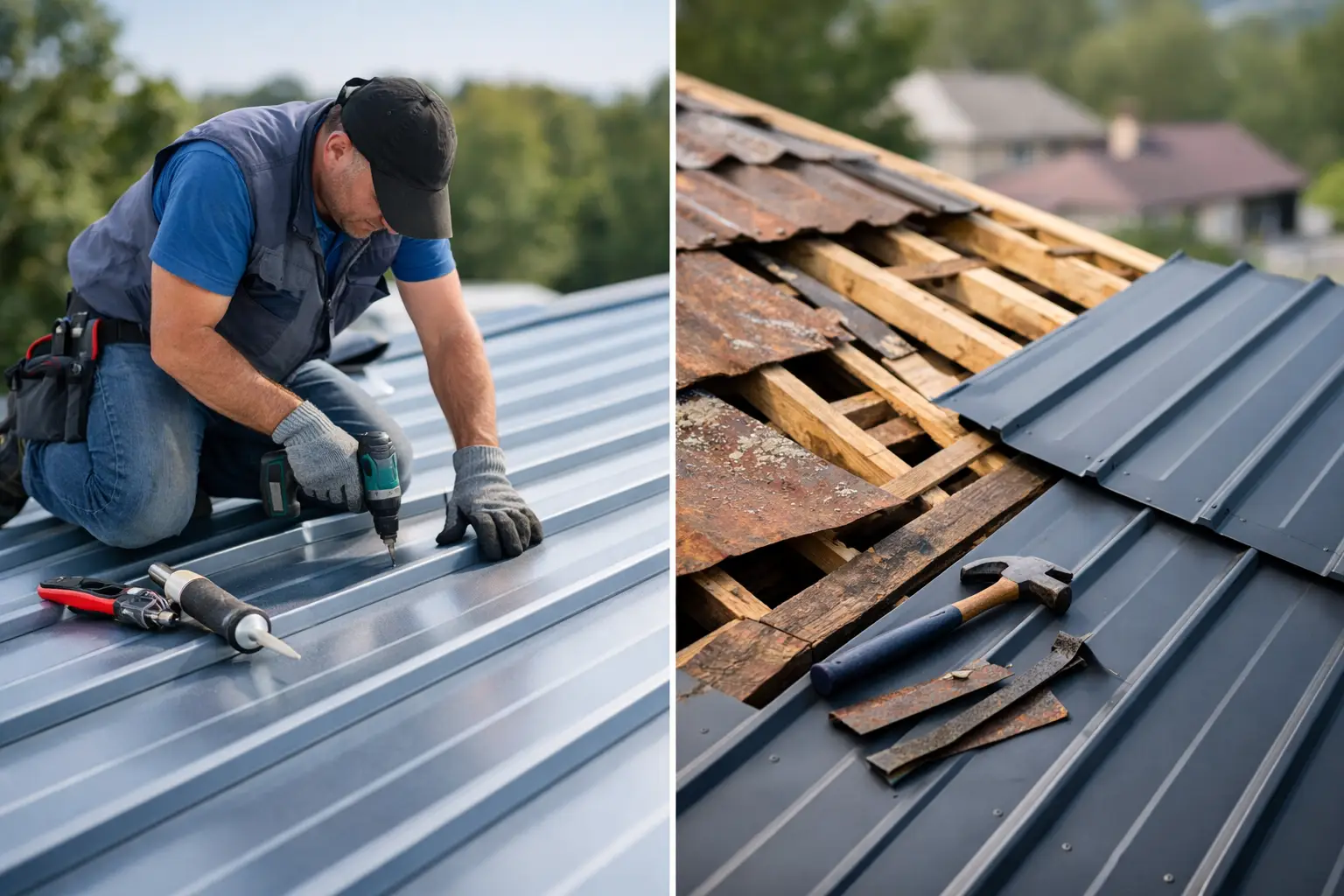
How to assess metal roof repair vs replacement
The first question is not where water is dripping inside. The first question is why the roof is failing. On industrial roofs, leaks often travel. Water may enter at end laps, skylight curbs, pipe penetrations, gutters, or screw lines, then appear several feet away from the actual source. A proper assessment needs site inspection, moisture path tracing, panel condition review, and checks on drainage, insulation condition, and structural support.
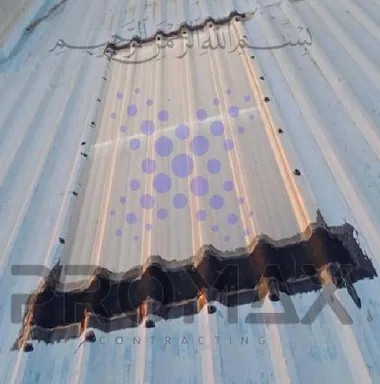
Repair is usually the right direction when the roof has isolated defects and the main assembly is still serviceable. That includes limited fastener back-out, small areas of corrosion, failed sealant at penetrations, minor flashing damage, localized membrane separation, or a few damaged sheets after impact. In these cases, targeted intervention can restore waterproofing performance without the cost and disruption of a full roof change.
Replacement becomes the stronger option when deterioration is broad, repeated leaks are occurring in multiple zones, corrosion has reached panel integrity, purlins are compromised, or previous patchwork has created a roof full of mixed details and weak points. If repair work is being carried out every season with no durable improvement, the roof is already telling you that isolated treatment is no longer enough.
When repair makes technical and financial sense
A repair program works best when the roof still has structural life left in it. Many metal roofs do not fail all at once. They fail at their details first. Fasteners loosen under thermal movement. Washers dry out. Laps open slightly. Sealants become brittle under UV exposure. Gutters block, causing backflow. Small rust areas begin around scratches, cut edges, and water-retaining points.
In those conditions, a well-scoped repair can be very effective. The key is that the work must go beyond surface patching. Proper repairs may include fastener replacement, screw treatment, rust removal and rust conversion, panel sealing, lap treatment, penetration waterproofing, gutter correction, flashing replacement, and protective coating or membrane application over prepared surfaces. If the defects are concentrated and the substrate remains stable, repair can extend service life significantly.
For many facility managers, this is the preferred route because it reduces capital spend, shortens work duration, and limits disruption to operations. That matters in live warehouses, factories, and service buildings where shutdowns are expensive. But repair only delivers value when the scope is based on actual roof condition, not guesswork. Applying sealant over active rust, wet insulation, loose sheets, or moving joints is not repair. It is delay.
Signs replacement is the better long-term decision
Replacement should be considered when the roof system has moved past maintainable defects and into systemic failure. One common sign is leak migration across multiple elevations and bays. Another is advanced corrosion on panels, laps, and fixings, especially where metal thickness has already been reduced. If roof sheets are perforated, if recurring movement has enlarged fastener holes, or if support steel shows rust damage, the issue is no longer just waterproofing.
Age matters, but condition matters more. A twenty-year-old roof that has been maintained properly may still be a good candidate for rehabilitation. A much younger roof with poor installation, trapped moisture, drainage failure, and aggressive corrosion may already need replacement in major sections. This is why a field inspection is more important than a simple age-based rule.
Replacement also becomes practical when repair access is poor or when too many roof components have reached end of life at the same time. If panels, insulation, gutters, curbs, and penetrations all need correction together, piecemeal work can become inefficient. At that point, a replacement or major overlay strategy may offer better waterproofing continuity, cleaner detailing, and lower life-cycle cost.
Cost is not just the initial contract value
Owners often frame metal roof repair vs replacement around immediate budget. That is understandable, but it is not enough. The true cost includes interior damage risk, emergency callouts, stock exposure, production interruption, safety liability, and the administrative cost of repeated maintenance visits.
Repair is cheaper upfront in most cases. Replacement costs more initially, but it can reduce reactive maintenance and provide a longer service interval. The right decision comes from comparing short-term savings against the cost of continued failure. If a building is experiencing active leaks over electrical areas, racking systems, production lines, or tenant spaces, the risk profile changes fast.
A useful way to look at it is this: if repair can stabilize the roof for several more years with a clear scope and predictable performance, it is often the right move. If repairs are buying only a short extension before the next failure, replacement may be the lower-cost option over the next budget cycle.
What a proper inspection should cover
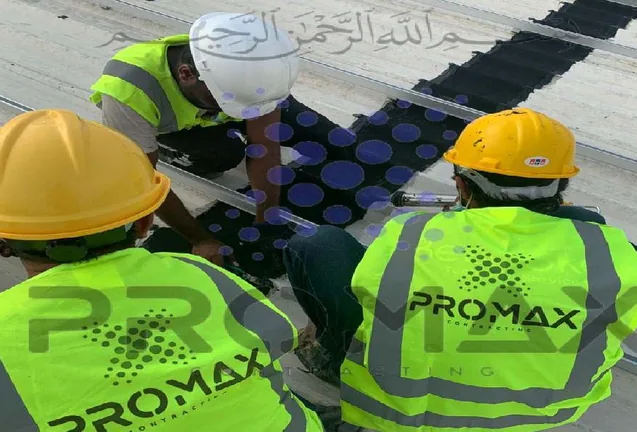
A serious recommendation should not start with a guess from ground level. Commercial metal roofs need close inspection of panel condition, seams, screws, washers, ridge details, side laps, end laps, penetrations, gutters, downpipes, skylights, and roof-mounted equipment interfaces. The contractor should also review ponding patterns, surface contamination, under-sheet condensation risks, previous repair materials, and signs of movement around support lines.
Where needed, the inspection should extend below the sheet line. Wet insulation, rusted purlins, failed anchor points, and internal staining all help determine whether the problem is local or systemic. This is where experienced field teams add value. They do not just point to the leak location. They identify the failure mechanism and the most durable correction.
For industrial facilities, fabrication capability also matters. Custom flashings, gutter sections, curb details, and support metal often need to be made to suit existing roof geometry. Standard off-the-shelf patchwork rarely solves a complicated roof with years of modifications and service penetrations.
The middle path: restoration and rehabilitation
The decision is not always limited to basic repair or full replacement. In many commercial buildings, restoration sits in the middle and makes strong technical sense. If the roof sheets are largely intact but weathered, a rehabilitation scope can include surface preparation, rust treatment, fastener replacement, lap sealing, waterproofing reinforcement, and a protective roof coating or membrane system.
This approach can recover waterproofing performance and reduce heat load while avoiding a full strip-out. It is especially relevant where the building needs fast turnaround and controlled cost, but the owner still wants a system-level solution rather than scattered repairs. Promax Contracting commonly sees this scenario on warehouses and industrial sheds where the roof is tired, leaking at details, and suffering from corrosion, yet still recoverable with the right treatment sequence.
That said, restoration is not a shortcut for a failing structure. If the substrate is unstable or corrosion is already advanced through key components, rehabilitation will not replace the need for major replacement work.
Making the decision with less risk
The best decisions usually come from three things: a documented inspection, a phased cost view, and a realistic service-life forecast. Ask what defects are isolated, what defects are systemic, how long the proposed solution is expected to last, and what supporting work is required around penetrations, drainage, steel support, and waterproofing details.
A reliable contractor should be able to explain why a repair will hold, or why it will not. They should also be clear about limitations. If a roof can be repaired for now but will likely need replacement in a few years, that should be stated plainly so procurement and facility teams can plan budgets properly.
A metal roof does not have to be new to be dependable. But it does need the right intervention at the right time. If the roof still has a sound base, repair or rehabilitation can protect the building and control cost. If failure is widespread, replacement is often the more responsible move. The smartest next step is not choosing the cheaper option on paper. It is choosing the option that stops water, protects operations, and gives the building a clear path forward.
Talk to Promax
Need this on your roof? Call +971 56 727 4205 or request a free inspection. Promax provides EPDM metal-roof, concrete and industrial waterproofing across Dubai and the UAE with up to a 15-year warranty.