When a warehouse roof starts leaking over stock, or corrosion begins spreading around laps, fasteners, and gutters, the first question is usually not whether repair is needed. It is what drives the price. Metal roof restoration cost factors vary widely from one facility to another because the visible leak is rarely the full scope. What matters is the roof condition below the leak path, the amount of surface failure, the access constraints, and whether restoration can solve the problem without partial replacement.
For commercial and industrial buildings, cost is not just about square footage. A 50,000-square-foot roof with minor fastener issues can be more straightforward than a 15,000-square-foot roof with severe ponding, purlin damage, open laps, failed skylight sealing, and active rust around penetrations. That is why serious pricing starts with inspection, not assumptions.
The main metal roof restoration cost factors
The biggest pricing variable is the condition of the existing roof system. If the metal sheets are still structurally serviceable, restoration is often the most cost-effective path. If corrosion has perforated panels, substrate damage is advanced, or support members need replacement, the scope moves beyond coating and waterproofing into heavier repair work.
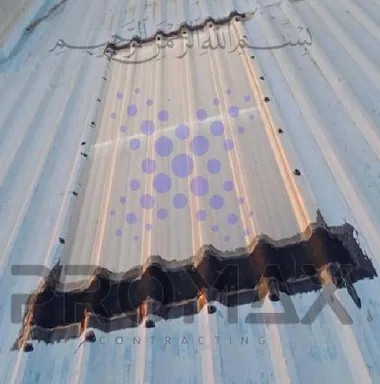
Surface corrosion is one of the first issues that changes cost. Light oxidation can usually be treated through cleaning, rust removal, priming, screw treatment, and protective coating. Deep rust around overlaps, gutters, ridge areas, or fixing points usually means more labor, more material, and sometimes fabricated replacement sections. The more preparation a roof needs, the more the restoration price rises.
Leak source complexity also matters. A roof with one failure point is not priced the same as a roof with repeated leakage around pipe penetrations, end laps, parapet junctions, skylight curbs, and drainage outlets. Water ingress on metal roofs often travels before it drops inside the building, so tracing and treating the actual failure points takes technical inspection time and more detailed execution.
Roof size matters, but not in a simple way
Large roofs usually reduce the rate per square foot because setup, mobilization, and equipment costs are spread across a bigger area. But large industrial roofs can also become more expensive if the geometry is difficult, if the building must remain fully operational, or if restoration has to be phased zone by zone.
A simple, open-span warehouse roof is easier to restore than a facility with multiple levels, service platforms, rooftop equipment, and restricted work windows. On paper, both may have similar area. In practice, labor productivity is very different.
The shape of the roof also affects how much detail work is required. Long straight runs with minimal penetrations are more efficient. Roofs with repeated joints, flashings, valleys, curbs, and gutter transitions demand more handwork, and handwork is where restoration budgets often change.
Access and safety requirements
Access is a major cost driver that many owners underestimate. If teams can move material directly onto the roof with standard lifting equipment and work safely across the surface, the job is more efficient. If access requires cranes, manlifts, edge protection, temporary walkways, permit coordination, or confined work sequencing around active production, cost increases quickly.
Safety systems are not optional on industrial sites. If the roof lacks proper access points, anchor provisions, or safe travel paths, temporary or permanent safety measures may need to be included. That adds value because it improves ongoing maintenance access, but it also changes the project budget.
Surface preparation is often the hidden cost center
The coating or membrane system gets attention, but preparation usually determines both project cost and long-term performance. A metal roof cannot be properly restored over loose rust, failed sealant, contaminated surfaces, or unsecured fasteners.
Preparation may include pressure washing, mechanical cleaning, rust treatment, replacing damaged screws, sealing laps, treating joints, removing failed patchwork, and correcting minor sheet movement. On roofs that have been patched multiple times over the years, old repair materials can slow down production and require partial reworking before new systems can be installed correctly.
This is where low quotations can become risky. If a contractor prices restoration without enough allowance for surface preparation, the final system may look acceptable at handover but fail early around the same weak points. For facility managers, that usually means paying twice - once for the cheap fix and again for the proper repair.
Repair scope versus restoration scope
Not every roof qualifies for the same type of restoration. Some roofs need only waterproofing and coating. Others need localized metal sheet replacement, purlin reinforcement, gutter replacement, skylight waterproofing, or penetration rebuilding before a full restoration system can be applied.
This is a critical distinction in metal roof restoration cost factors. The price changes when the job moves from surface renewal into structural or fabricated repair. For example, replacing a series of rusted box gutters or damaged ridge flashings is not the same as applying a reflective coating over cleaned sheets. Fabrication, fitting, waterproof detailing, and tie-ins all add labor and material cost.
The good news is that targeted repairs can still be far less expensive than full roof replacement, especially when the majority of the roof is recoverable. A contractor with fabrication and waterproofing capability under one scope can usually manage that transition more efficiently than separate vendors working in sequence.
Material system selection changes the budget
Restoration systems are not interchangeable. The right system depends on the roof profile, corrosion level, climate exposure, leak pattern, and service-life target. A basic coating program will cost less than a reinforced waterproofing system with seam treatment and high-build protection, but it may not solve the same level of failure.
In hot, high-UV environments, material performance becomes even more important. If the roof is exposed to thermal movement, standing water, salt-laden air, or repeated maintenance traffic, the specification needs to reflect that. Lower-cost materials may reduce upfront expense but create shorter maintenance cycles and more downtime risk.
Facility owners should look at system compatibility as well. A roof that has already received multiple previous treatments may require specific primers, adhesion testing, or selective removal of incompatible materials. This can affect both pricing and scheduling.
Climate and environmental exposure
Buildings near coastal zones, process plants, or dusty industrial corridors often require more intensive preparation and more durable protection systems. Salt exposure accelerates corrosion. Chemical residue can affect adhesion. Sand, debris, and heat cycling create wear around laps and mechanical fixings.
A roof in a controlled inland environment may need a simpler restoration approach than a roof over an active factory with exhaust discharge, humidity variation, and regular wash-down conditions. Same metal roof category, different cost profile.
Labor, scheduling, and operational constraints
Industrial roofing work is rarely just a roofing job. It has to fit around logistics, production, storage, safety controls, and weather windows. If the work can be completed during normal site hours with clear roof access, labor cost is easier to manage. If work must happen overnight, on weekends, or in short shutdown periods, the rate changes.
Operational sensitivity also affects sequencing. A food storage facility, manufacturing plant, or occupied warehouse may require careful area isolation, debris control, fire-watch procedures, or phased handover. Those controls are necessary, but they add planning time and labor.
Responsiveness matters here. A contractor that can inspect quickly, identify the actual failure mechanism, and coordinate repair without disrupting operations will usually save money beyond the quoted line items. That is part of the value in specialized execution.
Warranties, after-sales support, and what the price really buys
Not all restoration proposals include the same level of accountability. One price may cover surface coating only. Another may include detailed joint treatment, fastener encapsulation, drainage correction, leak sealing, manufacturer-aligned application steps, and an after-sales response commitment.
This is why comparing quotes line by line is more useful than comparing totals. Ask what is included in inspection, testing, substrate repair, material thickness, detail treatment, and warranty coverage. A lower number can still be the more expensive option if it excludes the exact items that typically fail first.
For many industrial clients, the better question is not How much does restoration cost per square foot? It is What scope is required to stop leakage, control corrosion, and extend service life with the least disruption? That answer comes from a proper roof survey, not a generic rate.
Promax Contracting typically approaches this through site inspection, technical assessment, and scope alignment before pricing, because restoration only works when the system matches the building condition.
If you are budgeting for roof work, treat price as a result of condition, access, repair depth, and system selection - not as a one-size number. The most useful estimate is the one that shows exactly what your roof needs, what can be saved, and what should be fixed now before the next leak turns into inventory loss or structural repair.
Talk to Promax
Need this on your roof? Call +971 56 727 4205 or request a free inspection. Promax provides EPDM metal-roof, concrete and industrial waterproofing across Dubai and the UAE with up to a 15-year warranty.