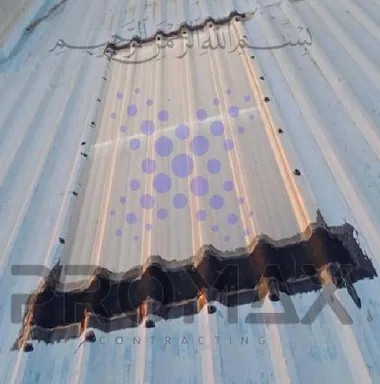
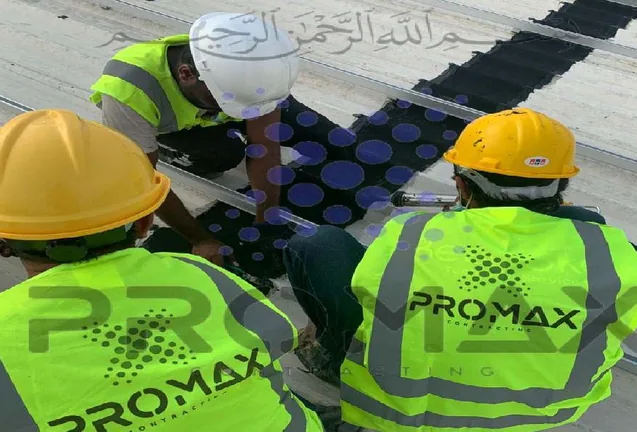
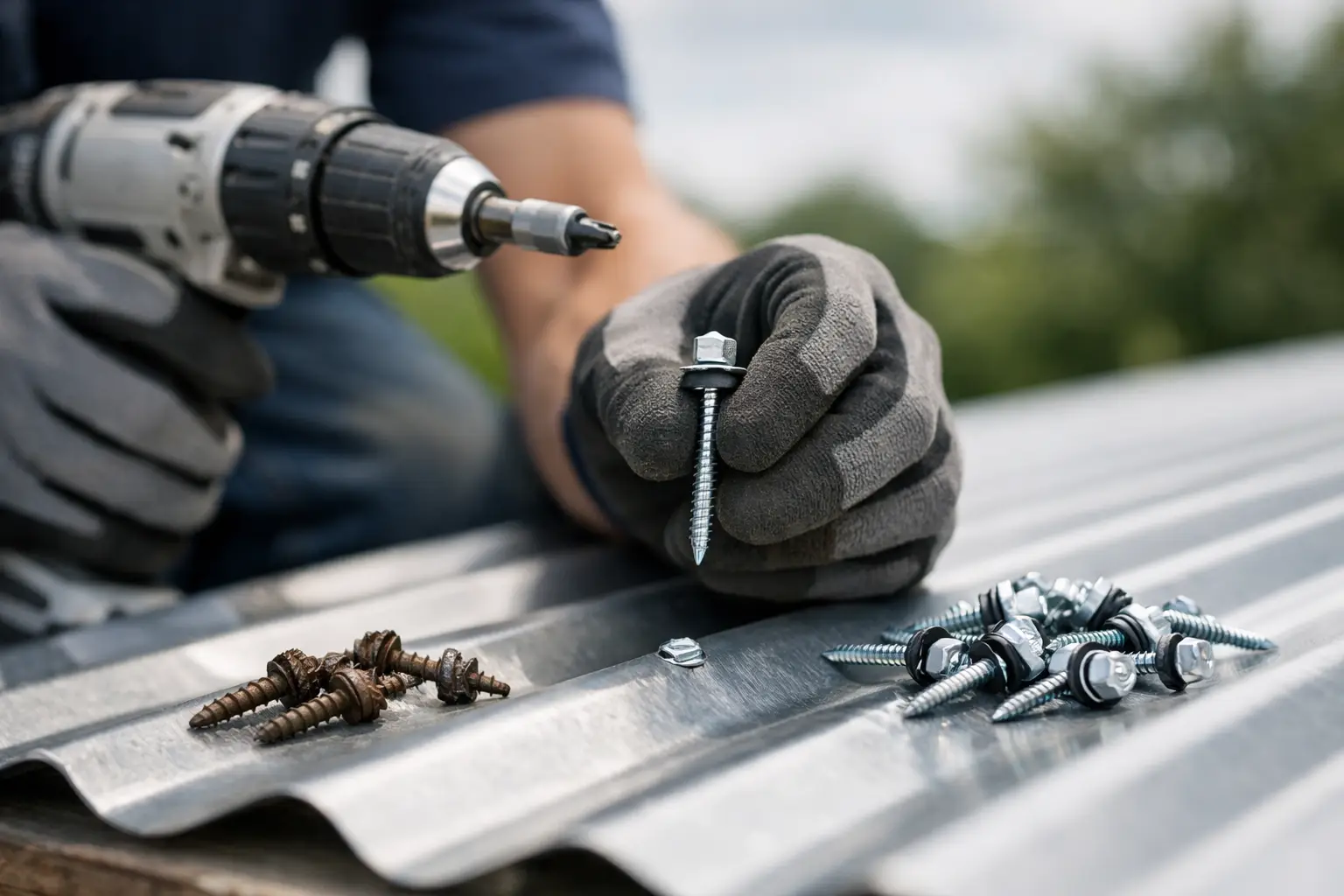
A leaking metal roof often gets blamed on panels, laps, or sealant failure. In many industrial buildings, the real issue is simpler and more widespread: metal roof screw replacement has been delayed until the fasteners have already backed out, corroded, or lost compression at the washer. On warehouses, factories, storage buildings, and service yards, that small failure point can turn into recurring leaks, insulation damage, rust spread, and disruption below.
Why metal roof screws fail before the roof does
Metal roof systems depend on thousands of fastening points working together. When those screws are exposed to heat cycling, UV, standing water, wind uplift, and corrosive dust or marine air, the fastener assembly takes continuous stress. The screw may remain in place, but the neoprene or EPDM washer hardens, cracks, or flattens. Once compression is lost, water starts entering around the penetration.
In older roofs, another common problem is back-out. Expansion and contraction of metal panels creates movement at every fastening point. Over time, screws can lift slightly out of the purlin or substrate. Even a small lift is enough to break the seal under the washer. This is why a roof can look intact from a distance and still leak repeatedly during driven rain.
Corrosion adds another layer of failure. If the screw coating has deteriorated, rust develops around the head and at the roof sheet interface. In aggressive environments, especially coastal or industrial areas, the roof sheet itself may begin to enlarge around the fastener hole. At that stage, replacing like for like is not always enough. The condition of the panel, purlin, and surrounding metal must be checked before specifying the correct replacement screw.
When metal roof screw replacement is the right fix
Not every leaking roof needs full replacement, but not every screw problem can be solved with surface sealant either. The right decision depends on the failure pattern.
If the roof has isolated loose fasteners, washers that have aged out, and panels that are still structurally sound, targeted metal roof screw replacement can be a cost-effective corrective measure. This is especially true where leaks are linked to exposed fastener lines, ridge caps, side laps, or perimeter zones with higher wind loading.
If a large roof area shows widespread fastener aging, inconsistent previous repairs, rust bleed at hundreds of screw points, or repeated leak complaints after rain, the job should be approached as a system issue. In those cases, replacement is not just about swapping hardware. It usually requires inspection mapping, fastener count verification, pull-out assessment, treatment of rusted areas, and in some cases secondary waterproofing over the roof.
Where purlins are deteriorated, sheets are badly elongated, or structural movement is excessive, screw replacement alone will not hold. A contractor should identify whether the substrate can still accept a new fastener with proper grip and compression. If not, additional rehabilitation measures are needed.
What a proper roof fastener inspection should check
A serious inspection does more than note visible leaks. It should review fastener type, diameter, length, washer condition, spacing, corrosion level, panel hole condition, and substrate engagement. On industrial roofs, this matters because one wrong replacement choice can create a new cycle of leaks.
For example, upsizing a screw may improve grip in a weakened hole, but if the panel is thin or heavily rusted, overdriving can deform the sheet and worsen water entry. Installing a new fastener into a compromised purlin may feel tight on the day of repair but fail early under thermal movement. If mixed fastener types have been used over the years, galvanic compatibility also needs attention.
A good inspection should also check related failure points around the screws. Pipe penetrations, skylight curbs, gutters, ridge details, and end laps often fail at the same time because the roof has aged as a whole. This is where an experienced contractor adds value - not by replacing screws in isolation, but by identifying the broader leakage path.
Choosing the right replacement screw matters
There is no single universal fastener for every metal roof. The correct specification depends on roof sheet profile, panel thickness, support type, environmental exposure, and whether the original hole has remained stable.
In practical terms, the replacement screw must achieve secure pull-out resistance, correct washer seating, and long-term corrosion performance. The washer material matters as much as the screw itself. Inferior washers tend to fail early under heat and UV exposure, especially on roofs with high surface temperatures. For demanding commercial roofs, long-life washer performance should not be treated as a minor accessory.
Head style and coating also matter. A fastener suited for a dry inland building may not perform the same way on a coastal warehouse or process facility. If the roof is already undergoing rust treatment, waterproofing upgrades, or panel restoration, the screw specification should align with the full rehabilitation scope.
Common mistakes that shorten the life of repairs
The most common mistake is replacing only the visibly leaking screws. On a large roof, the leak you see inside may be several meters away from the failed fastener. Water tracks along panel ribs, insulation facings, and structural members. Spot replacement without a full condition review usually leads to repeat callouts.
Another frequent issue is overdriving. When the screw is tightened too far, the washer gets crushed and loses its sealing capacity. Underdriving is just as bad because the washer never seats properly. Both problems are avoidable with trained crews and controlled installation methods.
Sealant-only repairs are also overused. Sealant can support a proper repair detail, but it should not be used to compensate for failed grip, a lifted screw, or a perished washer. On exposed metal roofs, temporary patching often breaks down quickly under heat and movement.
Then there is the procurement mistake: buying replacement fasteners based on price rather than compatibility and service life. On a residential shed that may be a minor issue. On a warehouse storing stock, machinery, or electrical systems, the cost of failure is far higher than the savings on cheap screws.
How metal roof screw replacement fits into a larger repair scope
On industrial and commercial buildings, fastener work often sits inside a broader roof maintenance strategy. If water ingress has been active for some time, the repair scope may also include rust removal, treatment of corroded panels, re-sealing of side laps, flashing repairs, gutter correction, and waterproofing over critical zones.
This is why site diagnosis matters. A technically sound contractor will determine whether the roof needs simple screw replacement, sectional rehabilitation, or a combined system such as fastener replacement with EPDM-based waterproofing at vulnerable areas. The goal is not to sell more work than necessary. The goal is to stop leakage at the root and extend service life with the right level of intervention.
For facilities that cannot tolerate downtime, sequencing is equally important. Work may need to be phased around operations, stock movement, safety access, and weather windows. That is especially relevant for factories, logistics buildings, schools, and large storage sites where roof access and internal protection have to be planned properly.
When to act before the next rainy season
If you are already seeing drip points, stained insulation, rust marks under screw lines, or recurring patch repairs on the same roof slope, waiting usually increases the repair area. Fastener problems rarely stay local for long. Once water starts entering at multiple points, the roof assembly and supporting components begin to degrade together.
A proactive inspection is usually the lowest-cost point of intervention. It allows the building team to identify whether fasteners are failing due to age, movement, corrosion, poor previous workmanship, or underlying substrate weakness. That diagnosis determines whether the right answer is selective replacement, full fastener line replacement, or a larger restoration package.
For owners and facility managers responsible for aging metal roofs, the practical question is not whether some screws have failed. It is how many have failed without being visible from the floor below. That is why experienced contractors approach these roofs with inspection, testing, and execution discipline rather than maintenance guesswork.
Promax Contracting handles this type of work the way industrial buildings require it - with site inspection, technical assessment, proper material selection, and repair scopes built for long-term service instead of short-term patching.
If your roof is telling you the fasteners are at the end of their life, replacing them early is usually far cheaper than repairing everything water reaches afterward.
Talk to Promax
Need this on your roof? Call +971 56 727 4205 or request a free inspection. Promax provides EPDM metal-roof, concrete and industrial waterproofing across Dubai and the UAE with up to a 15-year warranty.