A failed lap joint on a metal roof rarely stays a small problem for long. What starts as a minor drip around a fastener line or roof penetration can quickly turn into insulation damage, corrosion, stained interiors, and production disruption. That is why a proper metal roof sealant review matters. For facility managers and project teams, the real question is not which product sounds best on a label. It is which sealant system will survive movement, UV exposure, ponding risk, heat, and aging metal without creating another callout in six months.
What a metal roof sealant review should actually assess
Most sealant comparisons in the market are too generic. They focus on packaging claims instead of field performance. On a commercial or industrial metal roof, the sealant has to perform against several failure points at once. It needs adhesion to coated or weathered metal, flexibility under thermal expansion and contraction, resistance to standing water where drainage is poor, and compatibility with screws, lap joints, curbs, flashings, skylight perimeters, and pipe penetrations.
That means a useful review is not just about product chemistry. It is about application context. A sealant that performs well on a new metal panel installation may fail on an older roof with oxidation, loose fasteners, or movement at sheet overlaps. Likewise, a product that handles UV well may still underperform if the substrate preparation is poor or if the joint geometry is wrong.
In practice, the best sealant is often the one that fits a complete repair method, not a one-step patch.
The main sealant types used on metal roofs
Silicone sealants
Silicone is often selected where UV resistance and weather exposure are major concerns. It remains flexible for a long time and generally performs well in high-heat environments. On roofs exposed to intense sun, this matters. Silicone can also tolerate some moisture exposure better than many alternatives, which is one reason it appears in many emergency repair specifications.
The trade-off is that not all silicone products bond equally well to every metal surface, especially if coatings are aged, chalking, or contaminated. Recoating over silicone can also become complicated depending on the system. For isolated flashing repairs, roof penetrations, and certain exposed joints, silicone can be very effective. For large-area restoration work, it needs to be evaluated as part of the full roof system, not as a standalone answer.
Polyurethane sealants
Polyurethane is valued for strong adhesion and toughness. It is often a good option where joints see mechanical stress or where a firm, paintable sealant is needed. On metal roofs, polyurethane can perform well at seams, curbs, and edge details when substrate preparation is controlled.
Its limitation is long-term UV exposure. Some polyurethane sealants can degrade faster than silicone in harsh sun if left unprotected. In real projects, that means polyurethane may be a solid technical choice in protected areas or as part of a reinforced repair assembly, but less attractive for fully exposed, high-temperature roof zones unless the system is specifically designed for it.
Butyl sealants
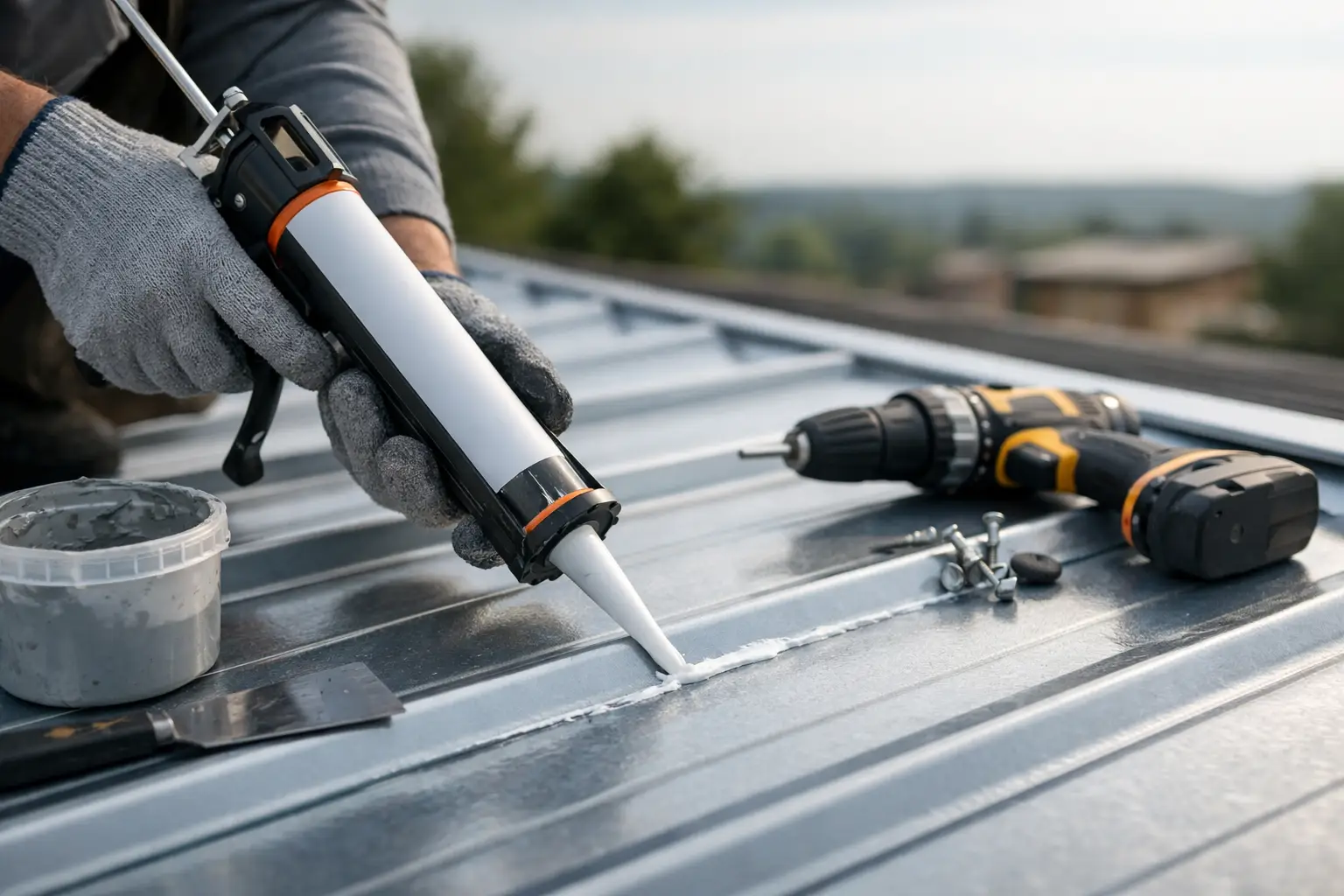
Butyl remains common in metal roofing because it offers good adhesion, water resistance, and practical performance at panel laps and compression joints. Butyl tapes and gun-grade butyl products are frequently used under metal overlaps, around fasteners, and within assembled details where compression improves sealing.
Where butyl becomes less convincing is in exposed, surface-applied repairs that rely on long-term UV durability. It works best when detailed correctly and protected within the joint, rather than smeared over a failing seam as a visible top repair. For panel lap construction and concealed sealing, butyl still earns its place.
EPDM-based liquid and tape systems
For more demanding leak rectification, especially on aging commercial roofs, EPDM-based sealants and reinforced waterproofing systems often provide a stronger long-term route than basic caulking products. These systems are especially useful where movement, weathering, and repeated leakage suggest that the failure is not a single gap but a broader weakness in the assembly.
An EPDM-based approach can bridge joints more reliably, handle thermal movement, and integrate well with patching strategies around penetrations, gutters, valleys, and transitions. The key distinction is that these are often system repairs rather than spot repairs. They usually require better preparation, more disciplined detailing, and skilled application, but the service life can justify that effort.
Where each type performs best
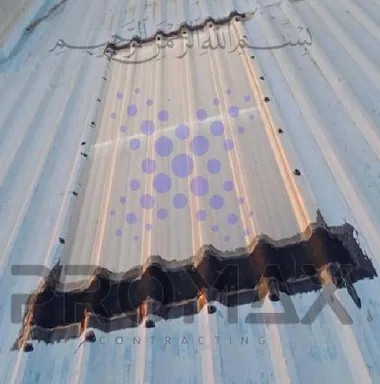
A metal roof sealant review only becomes useful when tied to actual failure zones. Fastener heads with washer deterioration often need more than a dab of sealant. If screws are backing out, the fastening issue should be corrected first, then sealed with a compatible product. Lap joints with capillary action may need cleaning, reinforcement, and resealing along the full seam rather than isolated patching.
For roof penetrations such as vent pipes, cable entries, and support brackets, flexibility matters because these locations move differently from the panels around them. Silicone or EPDM-based systems often have an advantage here, depending on the detail. At gutters and box channels, where ponding or slow drainage is common, water resistance under prolonged exposure becomes more important than simple initial adhesion.
On heavily aged roofs with rust, no sealant should be expected to solve active corrosion by itself. Oxidized metal needs treatment, and in some cases local sheet or purlin replacement may be necessary before waterproofing work begins. Applying premium sealant over unstable substrate is not a durable repair strategy.
What separates a temporary patch from a durable repair
The difference is usually preparation and scope. Many sealant failures are not product failures. They are application failures. Dust, oil, oxidation, loose coatings, trapped moisture, poor bead profile, and rushed surface treatment all shorten service life.
A durable repair typically includes inspection of panel condition, seam movement, fastener integrity, drainage, and nearby corrosion. The substrate is cleaned properly. Unstable material is removed. The sealant is chosen to suit the joint type and exposure level. Where needed, reinforcement tape or membrane is added so the repair can move with the roof instead of tearing away from it.
This is especially true on warehouses, factories, and storage facilities where roof temperatures fluctuate sharply and maintenance teams cannot afford repeat leakage during operations. In those environments, a narrow product-only review is less useful than a field-based repair assessment.
Common buying mistakes
The first mistake is choosing by brand familiarity alone. A respected sealant line can still be the wrong fit for standing water, aged coating surfaces, or high-movement joints. The second mistake is treating all leaks as point failures. Water entry often appears far from the actual breach, especially on sloped metal roofs with insulation and secondary framing below.
Another common issue is overusing general-purpose sealants. These may look fine after application but fail early under roof conditions. Commercial roofs require products formulated for exterior movement, heat, UV, and moisture exposure. Finally, many teams underestimate the importance of compatibility. Metal type, factory finish, existing coating, and prior repair material all affect adhesion.
Our practical verdict on metal roof sealant options
If the requirement is exposed UV stability on small flashing details and penetrations, silicone is often a strong contender. If the need is firm adhesion in detailed joints with some protection from direct exposure, polyurethane can work well. If the application is within compressed panel laps or concealed joints, butyl remains highly relevant. If the roof has recurring leaks, aging seams, movement, and multiple vulnerable details, EPDM-based reinforced repair systems generally offer a more dependable long-term solution than relying on surface caulking alone.
That said, the best answer depends on roof condition. A relatively new metal roof with isolated leakage can often be repaired locally with the right sealant and detail treatment. An older roof with widespread seam fatigue, screw issues, gutter failure, and corrosion usually needs a broader waterproofing strategy. That is where experienced inspection and execution make the difference.
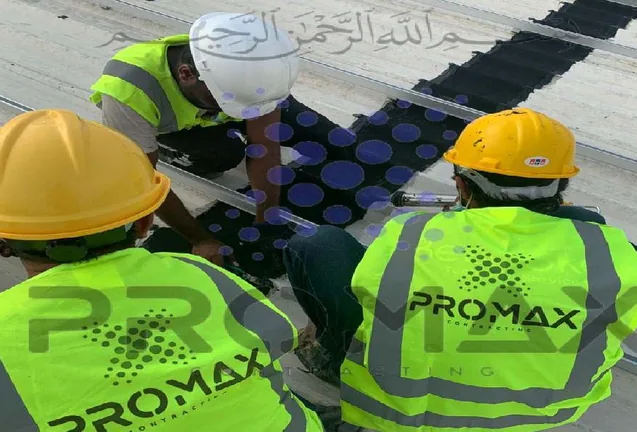
Promax Contracting approaches these cases as repair systems rather than product guesses. For commercial and industrial roofs, that means inspecting the leakage path, substrate condition, movement points, drainage pattern, and metal deterioration before recommending a sealant type or reinforcement method.
When sealant is not enough
Some roofs are past the stage where another bead of sealant is responsible asset protection. If there is severe rusting at laps, recurring ponding due to poor falls, widespread fastener failure, deteriorated gutters, or damaged roof penetrations, the correct remedy may involve sectional replacement, fabricated flashing upgrades, drainage correction, and a full waterproofing treatment over selected zones.
That costs more upfront, but it usually costs less than repeated shutdowns, damaged stock, ceiling repairs, and emergency callouts. For facility teams responsible for uptime, that calculation matters more than unit price per tube.
A good sealant can solve the right problem very effectively. A bad diagnosis turns even the best sealant into a short-term patch. If your roof is leaking, start with the condition of the assembly, not the label on the cartridge.
Talk to Promax
Need this on your roof? Call +971 56 727 4205 or request a free inspection. Promax provides EPDM metal-roof, concrete and industrial waterproofing across Dubai and the UAE with up to a 15-year warranty.