
A roof leak around a pipe rarely stays a small problem for long. In industrial and commercial buildings, failed pipe penetration roof sealing can lead to wet insulation, corrosion at metal sheets, stained ceilings, damaged stock, and repeated shutdowns for patchwork repairs. The issue is not the pipe alone. It is the joint between moving services, roof sheets or slabs, fasteners, flashings, sealants, and waterproofing layers that has to perform under heat, rain, dust, and constant expansion and contraction.
Why pipe penetrations fail faster than the main roof
Most roof areas are broad and predictable. Pipe penetrations are not. They interrupt the roof system, create edges and terminations, and introduce a round profile into a flat or profiled surface. That means more cutting, more detailing, and more chances for water to track under the system if workmanship is weak.
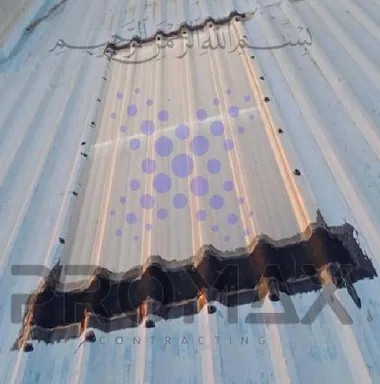
On metal roofs, the problem gets worse because the sheet profile creates voids around the pipe base. If those voids are filled with low-grade sealant or covered with a generic patch, water can sit in the laps and eventually migrate into the roof build-up. On concrete roofs, the pipe may pass through a sleeve, screed, or raised curb, and every interface needs compatible waterproofing treatment. A good-looking finish is not enough. The detail has to resist movement and remain watertight.
The Gulf climate also puts extra stress on these areas. UV exposure hardens low-quality sealants. Daily temperature swings cause expansion at different rates between steel, concrete, PVC pipes, and waterproofing materials. If the original detail did not account for that movement, cracks and separation are only a matter of time.
Pipe penetration roof sealing is a detailing job, not a sealant job
One of the most common mistakes on commercial roofs is treating pipe penetration roof sealing like a simple caulking task. It is not. A durable repair or new installation depends on the full assembly - substrate condition, flashing geometry, membrane compatibility, surface preparation, fastening method, and termination detail.
If a contractor only adds more sealant over an already failed joint, the result is usually temporary. Water may already be traveling beneath the visible crack. In many cases, the old flashing is loose, rusted, punctured, or incorrectly shaped to begin with. The right approach starts with inspection and removal of defective materials, not cosmetic covering.
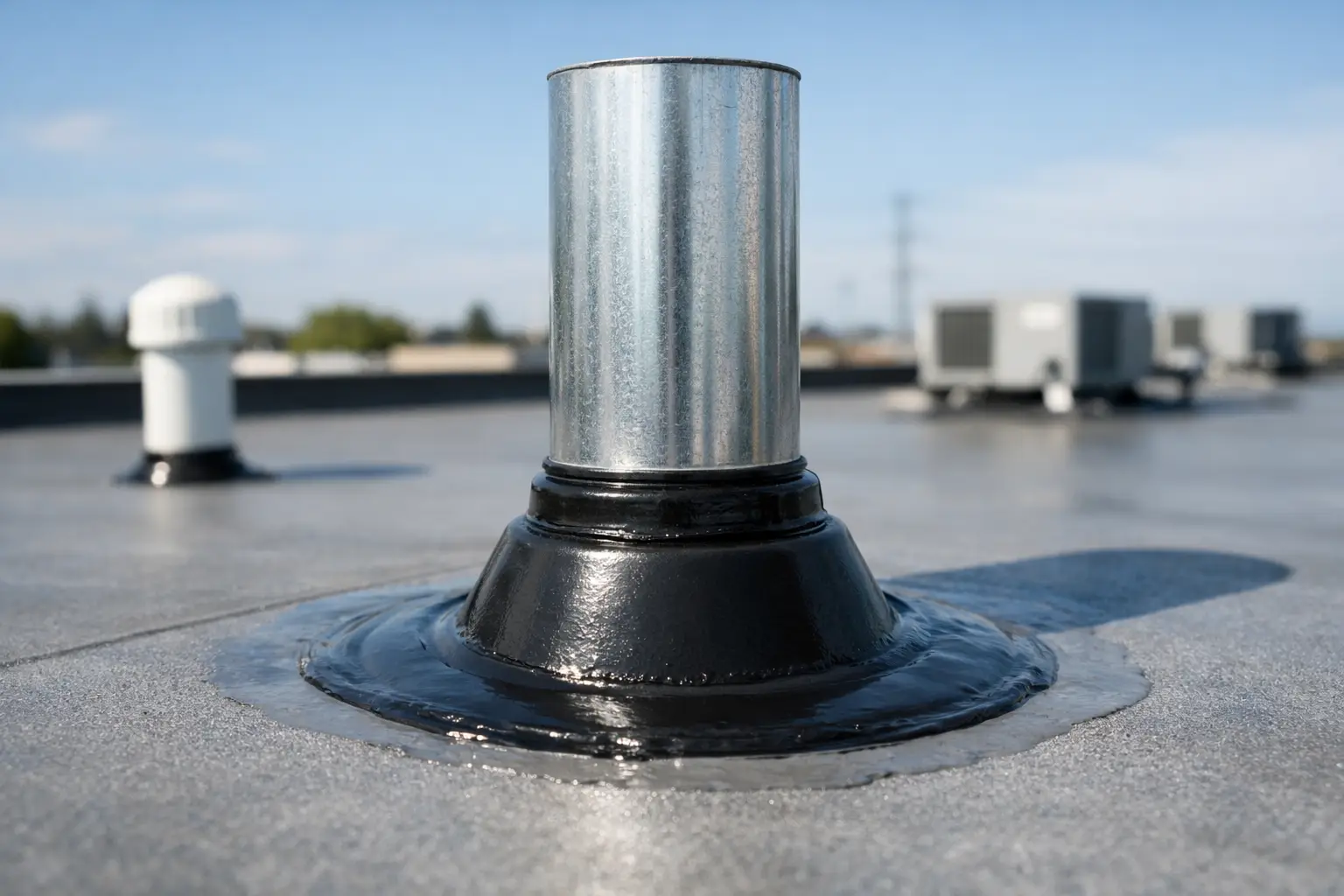
For service penetrations carrying HVAC lines, vents, process pipes, conduits, or drain outlets, the detail also needs to consider maintenance access. If the pipe is regularly serviced, the roof seal must hold while allowing practical access around the penetration. That is where fabrication and proper flashing selection matter.
What a proper inspection should identify
Before any repair system is selected, the penetration detail should be inspected as part of the surrounding roof condition. Focusing only on the visible leak point can miss the actual water path.
A proper site inspection should check pipe size, material, spacing, and movement; roof type and profile; existing membrane or coating condition; signs of rust, open laps, blistering, cracked sealants, and failed fasteners. It should also review whether water is ponding near the penetration and whether nearby gutters or downpipes are causing backup.
This stage matters because not every leaking penetration needs the same fix. A single vent pipe on a concrete roof can often be rebuilt with a membrane-compatible collar and reinforced flashing. A cluster of service pipes on a corroded metal roof may need local sheet replacement, rust treatment, new fabricated saddles or curbs, and a full waterproofing tie-in. The best repair is the one that addresses the actual failure mechanism, not just the symptom.
The systems that work best depend on the roof type
Metal roof penetrations
Metal roofs need details that can bridge profile ribs, bond securely to coated or weathered steel, and tolerate movement. In many industrial applications, EPDM-based flashing systems perform well because they remain flexible and can be formed around pipe penetrations with reliable waterproofing performance. But the membrane alone is not the whole solution.
The sheet around the pipe must be sound. If corrosion has already eaten into the panel, sealing over it is a short-term fix. Rust treatment, screw replacement, panel repair, and reinforcement at the base may all be required before the flashing is installed. Termination at the pipe should also be mechanically secure, not dependent on exposed sealant as the primary defense.
Concrete roof penetrations
Concrete roofs usually call for a membrane or liquid-applied waterproofing detail that ties into the main roof system. Surface preparation is critical. Dusty, weak, or damp substrates reduce adhesion and shorten service life. If cracks are present near the pipe sleeve or curb, those need treatment before the flashing layer goes in.
For concrete roofs, the detail often performs better when the penetration is raised properly above the finished roof level. A low entry point may still leak even with decent sealing because water remains concentrated around it during heavy rain or drainage backup.
Mixed-service penetrations and retrofit conditions
Retrofit work is where many failures happen. New MEP services are often installed after the roof is complete, and the waterproofing detail becomes an afterthought. In these cases, the repair may need custom fabrication, especially when pipes are tightly grouped or installed near laps, ridges, skylights, or expansion joints.
This is where execution quality separates a durable job from another callout next season. Standard off-the-shelf boots are useful, but they are not suitable for every roof layout or service cluster.
Materials matter, but compatibility matters more
Many roof leaks around penetrations come from mixing materials that were never designed to work together. The wrong primer, the wrong sealant, or an incompatible membrane can fail even if the installer followed the product instructions.
For that reason, pipe penetration roof sealing should be selected as part of a system. EPDM flashings, reinforced membranes, metal counterflashings, clamps, sealants, and surface treatments all need to suit the substrate and the expected movement. On aggressive industrial sites, resistance to heat, UV, moisture, and chemical exposure may also be a factor.
Cheap sealants usually fail first. They shrink, harden, or lose adhesion. But even premium materials will not save a poorly prepared substrate or weak termination detail. The assembly is only as strong as its weakest point.
Common repair shortcuts that create repeat leaks
Facility teams often inherit roofs that have been patched several times by different vendors. The leak history usually tells the story. If the same penetration has been repaired more than once, there is a detailing problem, not just a maintenance problem.
Typical shortcuts include applying sealant over dirt or rust, patching over wet surfaces, using rigid materials on moving joints, skipping reinforcement at corners and profiles, and failing to extend the repair into the surrounding roof area. Another common issue is ignoring adjacent defects. A penetration may appear to be the source, but water can enter from an open side lap or failed fastener uphill and show up at the pipe location.
That is why technical inspection and methodical execution are more valuable than a fast cosmetic fix. Immediate response matters, but so does getting the diagnosis right.
What building owners and facility managers should expect from the contractor
For commercial and industrial sites, the contractor should be able to do more than apply a patch. You should expect a clear inspection, a defined scope, compatible materials, and a repair method suited to the roof type and service condition. If fabrication is required, that should be handled as part of the solution, not left to field improvisation.
It also helps when the contractor can assess related issues during the same visit - rusted sheets, failed gutters, weak curbs, loose fasteners, insulation damage, or heat-related membrane breakdown. Roof penetrations rarely fail in isolation on aging industrial buildings.
Companies such as Promax Contracting are typically brought in when the leakage has moved beyond a basic maintenance issue and requires proper waterproofing, fabrication support, and coordinated roof rehabilitation. That is often the point where spending slightly more on the right system saves far more in recurring repairs, stock loss, and disruption.
When replacement is smarter than repeated sealing
Not every penetration should be repaired. If the surrounding roof section is extensively corroded, if the pipe detail was poorly located from the start, or if multiple services have turned one area into a patchwork of old flashings, replacement of the local roof section may be the better option.
This is especially true on older warehouse and factory roofs where coating over deteriorated metal has limited value. In those cases, replacing sheets, rebuilding the penetration detail, and tying it into a broader waterproofing program gives a more stable result. The upfront scope is larger, but the risk profile is lower.
A reliable roof does not depend on luck at the most vulnerable point. If a pipe passes through your roof, that detail needs engineered attention, proper materials, and field execution that respects movement, weather exposure, and the real condition of the substrate. Handle it early, and you prevent a small opening from becoming a building-wide maintenance problem.
Talk to Promax
Need this on your roof? Call +971 56 727 4205 or request a free inspection. Promax provides EPDM metal-roof, concrete and industrial waterproofing across Dubai and the UAE with up to a 15-year warranty.