
A roof rarely fails all at once. Most drainage problems start with a small restriction, a low spot holding water, or a drain system that was never sized for actual storm demand. By the time water starts spilling over parapet walls, backing up around rooftop equipment, or leaking into storage and production areas, the damage is already moving beyond the roof surface. That is why roof drain overflow prevention methods matter for any commercial or industrial facility with a flat or low-slope roof.
For warehouses, factories, sheds, and institutional buildings, overflow is not just a housekeeping issue. It can saturate insulation, overload structural areas, damage wall systems, create slip hazards, and interrupt operations. The right approach is not one product or one emergency fix. It is a coordinated drainage strategy based on inspection, hydraulic capacity, roof condition, and maintenance discipline.
Why roof drains overflow in the first place
Overflow usually comes from one of three conditions. The first is blockage. Strainers clog with leaves, dust, packaging debris, bird nests, sealant waste, and rooftop fragments from older repairs. The second is undersized or poorly distributed drainage, where the roof simply cannot move water fast enough during peak rainfall. The third is loss of drainage performance over time because the roof slope has changed, insulation has compressed, structural deflection has increased, or internal piping has partially failed.
In industrial environments, these issues often overlap. A roof may have drains that are technically present but badly located. It may have gutters or downpipes added later without correcting the original flow path. It may also have equipment curbs, pipe supports, cable trays, and service platforms that interrupt water movement and create ponding zones.
That is why a proper drainage review must go beyond checking whether a drain opening exists. The real question is whether water can reach it quickly, whether the drain can discharge at required volume, and whether there is a safe overflow path if the primary system is compromised.
Core roof drain overflow prevention methods
The most effective roof drain overflow prevention methods combine design correction with active maintenance. On large commercial roofs, relying on cleaning alone is risky. If the system layout is wrong, even a clean drain can still overflow under heavy rainfall.
1. Keep primary drains clear and serviceable
This sounds basic, but it is the first control point. Drains need strainers that are intact, properly fixed, and suited to the debris conditions on the roof. Broken strainers allow larger debris into the line. Missing strainers may briefly improve surface flow, but they increase the chance of internal pipe blockage, which is harder and more expensive to clear.
Routine cleaning should include the drain bowl, strainer, sump area, and the immediate roof field around each drain. On industrial roofs, dust and airborne particulates can form sludge when mixed with water. That sludge settles in low points and slows entry into the drain long before a full blockage occurs.
2. Verify hydraulic capacity, not just drain count
A common mistake is assuming that several drains automatically mean adequate drainage. Capacity depends on rainfall intensity, roof area, drain size, pipe diameter, vertical drop, and system layout. If one section of roof carries more water than intended, local overflow can happen even when other drains remain underused.
This is where engineering review matters. For facilities with repeated ponding or overflow history, drain spacing and pipe sizing should be checked against actual roof geometry and storm conditions. In some cases, adding a new drain point or increasing outlet size is more effective than repeated patch repair around existing drains.
3. Install dedicated overflow drainage
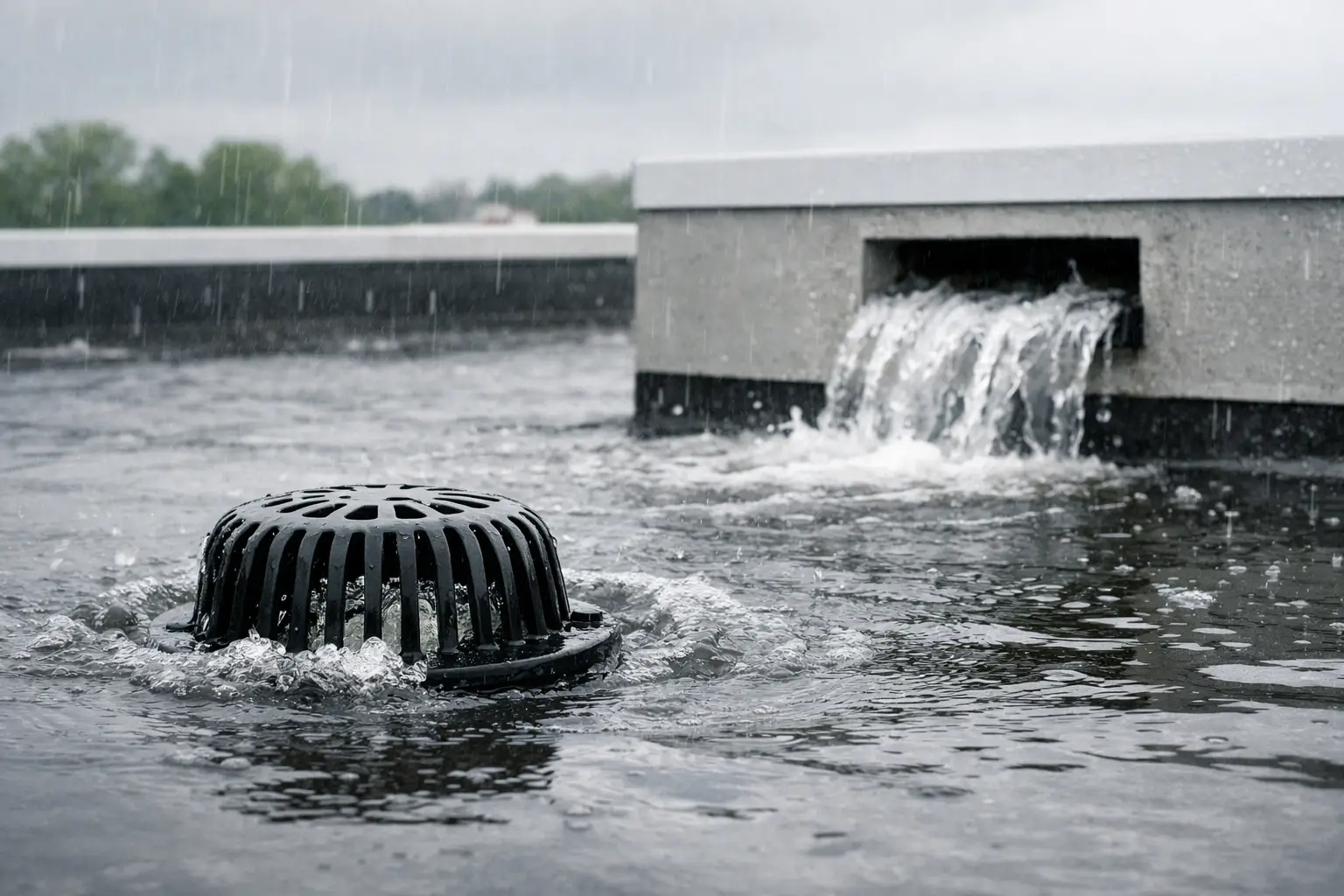
Primary drains should not be the only protection. A separate overflow system provides a controlled secondary path when the main drains are blocked or overwhelmed. This can take the form of overflow scuppers through parapet walls, secondary roof drains set slightly above the primary drain elevation, or engineered emergency discharge points.
The key is elevation control. Overflow components must activate before water rises to a level that threatens roof loading, equipment bases, door thresholds, or waterproofing terminations. If overflow outlets are set too high, they exist on paper but fail when needed. If they are too low, they may discharge too early and mask primary drainage problems.
4. Correct ponding areas and low spots
Water does not need to cover the entire roof to create risk. Localized ponding around one drain sump or one deflected bay can be enough to start overflow in a storm event. When water has to travel across depressed areas, up ridges, or around rooftop obstructions, flow slows down and debris settles faster.
Corrective work may involve tapering, localized screed adjustment, insulation build-up, drain sump reconstruction, or membrane reworking around drainage points. On older roofs, structural movement may also need to be assessed. There is no benefit in replacing a drain if the surrounding roof profile still traps water.
Drain details matter more than many owners expect
A roof drain is only as reliable as the waterproofing and metalwork around it. Failed clamping rings, loose fasteners, corroded drain bodies, split sealant joints, and poor membrane termination all reduce performance. Some drains leak before they overflow, which creates a false impression that the issue is waterproofing only. In reality, both drainage failure and sealing failure may be happening together.
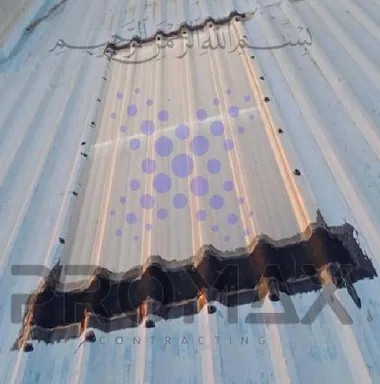
On metal roofs and mixed roof systems, transitions are especially vulnerable. Water may overshoot gutters, enter through lap joints, or migrate below sheets before it ever reaches a designed outlet. In those cases, overflow prevention includes more than drain maintenance. It may require gutter replacement, fabrication correction, edge detail modification, or targeted waterproofing at penetrations and termination zones.
How maintenance should be scheduled
For commercial facilities, annual cleaning is usually not enough. Roof drains should be checked before the rainy season, after major storms, and after any rooftop work by other trades. Mechanical service teams, telecom installers, and general maintenance crews often leave behind wire cuttings, wrapping, sealant cartridges, and fastener debris that later migrate into drains.
A practical inspection program should document ponding locations, drain condition, outlet flow, membrane integrity around drains, and any signs of rust or separation in connected metal components. If a building has a history of overflow, the inspection should also verify whether water marks on parapets or equipment curbs indicate previous high-water levels.
The trade-off is simple. Frequent inspections cost less than replacing wet insulation, repairing damaged stock, or shutting down an occupied area due to water ingress. For large facilities, scheduled preventive maintenance is usually the cheapest part of the drainage system lifecycle.
When repairs are enough and when upgrades are necessary
Not every roof needs a full drainage redesign. If overflow is caused by isolated blockage, damaged strainers, or a failed drain assembly, targeted repair may solve the issue. If the same building experiences repeated standing water across multiple seasons, however, it is usually a system problem rather than a one-off defect.
That is where many owners lose time. They keep treating symptoms at one drain while the roof still lacks proper slope, adequate overflow points, or sufficient discharge capacity. A contractor with waterproofing and fabrication capability can usually identify whether the best fix is localized restoration or a broader upgrade package involving drains, gutters, scuppers, membrane works, and supporting metal modifications.
For facilities in high-heat and dust-heavy environments such as the Gulf region, preventive planning becomes even more important. Fine debris accumulation, thermal movement, UV exposure, and aging sealants all speed up drainage failure. In these conditions, roof drainage should be treated as an operational protection system, not just a building accessory.
Roof drain overflow prevention methods for existing buildings
Existing roofs require a realistic approach. You are working around operating equipment, fixed structural geometry, tenant requirements, and budget controls. The best roof drain overflow prevention methods for existing buildings usually start with a site inspection and water-path assessment rather than a standard product recommendation.
A good field review looks at roof levels, ponding patterns, drain locations, parapet height, gutter condition, internal pipe performance, and overflow options. It should also consider how repairs will be executed without disrupting operations. On active warehouse and factory sites, response time matters, but so does sequencing. Fast work that ignores drainage logic only pushes the problem to the next storm.
This is where an execution-focused contractor adds value. Promax Contracting typically approaches these conditions by combining inspection, technical recommendations, fabrication support, waterproofing correction, and maintenance follow-up rather than isolating the issue to one trade package.
What decision-makers should ask before approving work
Before approving any drainage repair, ask whether the contractor has identified the actual cause of overflow, whether backup drainage is included, and whether roof levels were checked instead of just the drain fitting. Ask how the repair will perform in peak rain, what related waterproofing details will be corrected, and what maintenance interval is recommended after completion.
If the answer is only to clean the drain and apply sealant, that may be appropriate for a minor defect, but it is not a complete strategy for a building with recurring overflow risk. Commercial roofs need drainage systems that are serviceable, correctly detailed, and engineered for real operating conditions.
Water always tests the weakest point first. The right response is to find that point before the next storm does.
Talk to Promax
Need this on your roof? Call +971 56 727 4205 or request a free inspection. Promax provides EPDM metal-roof, concrete and industrial waterproofing across Dubai and the UAE with up to a 15-year warranty.