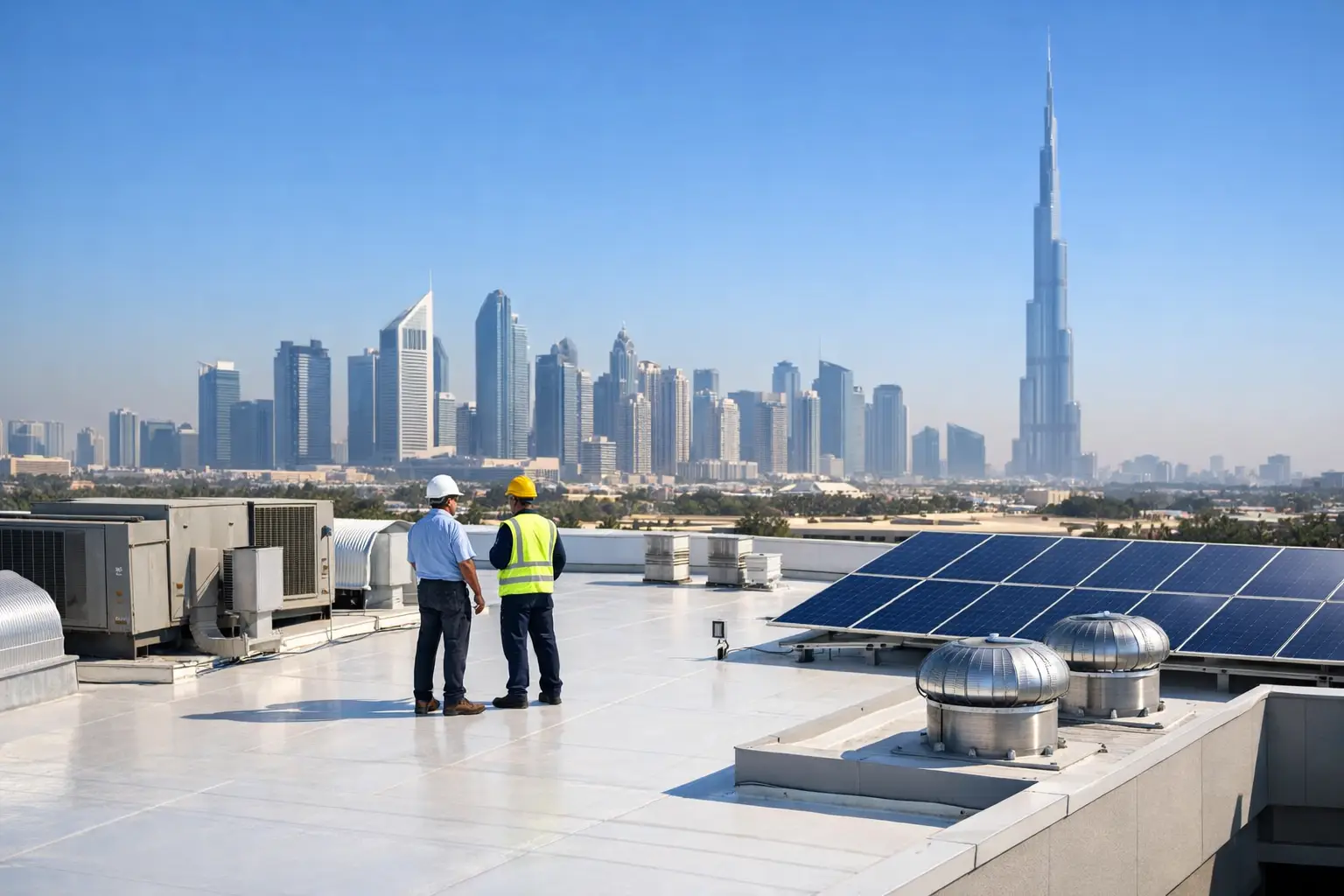
A warehouse roof in Dubai rarely fails all at once. It starts with small movement at laps, loose fasteners, blocked gutters, cracked sealant around penetrations, or corrosion spreading under panels where nobody sees it during routine operations. By the time water reaches stock, equipment, insulation, or electrical routes, the repair is no longer minor. That is why roofing Dubai projects need more than patchwork. They need inspection-led decisions, correct system selection, and site execution that matches the building's actual exposure.
For commercial and industrial properties, the roof is not a cosmetic item. It is part of the operating envelope. When it underperforms, the damage reaches production areas, storage zones, internal finishes, and maintenance budgets very quickly. In Gulf conditions, the main issue is not just rainfall. It is the combination of heat load, UV exposure, thermal expansion, standing water, aging fixings, dust accumulation, and corrosion at details.
Why roofing Dubai conditions are different
Roofs in Dubai are exposed to a harsher service environment than many owners account for during initial construction. On paper, a roof may look adequate. On site, movement, poor drainage, weak detailing, and incompatible repair materials can shorten its life well before the expected term.
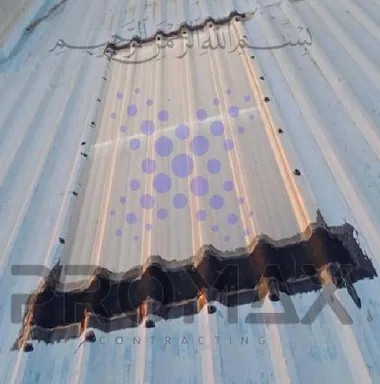
Metal roofs expand and contract daily. If fasteners loosen, washers fail, or overlaps open slightly, water finds a path. Concrete roofs bring a different set of problems. Hairline cracking, failed screeds, membrane aging, parapet weakness, and poor termination details often allow slow water ingress that goes unnoticed until interior damage appears. The roof type changes the repair method, but the principle stays the same - the failure usually begins at details, not at the largest visible surface.
That matters for facility managers because the wrong repair can make a roof harder to maintain later. A low-cost coating applied over untreated rust, active leaks, or wet substrate can delay the problem for a short period, then fail under heat and movement. A proper system starts with diagnosis.
What a commercial roof inspection should actually cover
A serious roofing assessment goes beyond identifying the leak point reported by tenants or operations staff. Water often enters at one location and appears at another. For that reason, inspection should map the full roof condition, not just the symptom.
On metal roofing, the inspection should review panel condition, end laps, side laps, screw lines, failed washers, rust level, purlin integrity where accessible, ridge and flashing details, skylight curbs, gutter performance, and all penetrations. If there is repeated leakage, the drainage route and roof slope also need verification.
On concrete roofing, attention should go to membrane condition, cracks, ponding areas, movement joints, upturns, parapet wall junctions, pipe penetrations, AC plinths, drainage outlets, and previous repair interfaces. Many roof failures come from transitions where one trade stopped and another trade started.
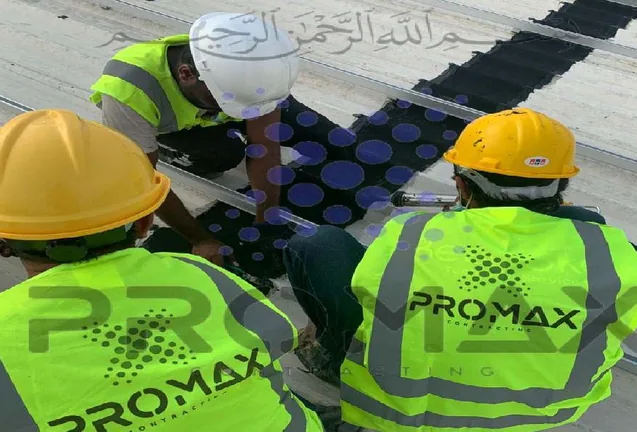
For industrial sites, inspection also needs a practical lens. Can the work be executed safely without stopping operations? Is access available for materials, fabrication, and drainage correction? Will the repair survive maintenance traffic? These are not secondary questions. They affect what system is realistic.
Choosing the right roofing Dubai solution
There is no single best roof repair system for every building. The right choice depends on substrate condition, age, accessibility, operational sensitivity, and budget horizon. Owners usually run into trouble when they ask for a product before defining the failure mechanism.
If the roof is structurally sound and the issue is localized leakage at laps, penetrations, or gutters, a targeted repair scope may be enough. That can include screw replacement, lap treatment, rust removal, sealing of penetrations, gutter rehabilitation, and detail waterproofing. This is often the most cost-effective route when deterioration has not spread across the full roof area.
If heat, movement, and repeated leaks are affecting a wider section, a full waterproofing treatment is often more reliable than ongoing patch repairs. EPDM-based systems, membrane reinforcement, and correctly detailed flashing treatments are commonly selected where long-term weather protection is required. The key is compatibility with the existing surface and proper preparation before installation.
Where corrosion is advanced, especially on older warehouses and sheds, the roof cannot be treated as a waterproofing-only issue. Rusted sheets, weakened purlins, damaged gutters, and deteriorated fastener zones may require replacement and fabrication support along with coating or membrane work. Waterproofing over unstable metal is not a durable fix.
Common failure points on industrial roofs
In practice, most leaks come from a relatively small group of roof details. Penetrations are one of the biggest offenders. Pipes, ducts, cable routes, exhaust points, and equipment supports interrupt the waterproofing plane. If these locations are not sealed with the correct detail treatment, they become repeat leak sources.
Gutters are another frequent issue. A roof system is only as good as its drainage path. Corroded channels, loose joints, poor outlet sizing, and debris buildup allow water to back up into laps and edge conditions. During short but heavy rain events, that weakness becomes obvious.
Skylights also create problems when curb details fail or surrounding sheets move. On concrete roofs, parapet junctions and drain outlets are common weak spots. On metal roofs, screw lines and overlap zones deserve close attention, especially where previous patching has been done without treating the full detail.
This is why roofing Dubai work on commercial assets should be detail-driven rather than product-driven. Most failures are not solved by covering large areas alone. They are solved by rebuilding the weak points correctly.
Speed matters, but repair quality matters more
Commercial clients often need urgent response because leakage affects stock, machinery, finished goods, and tenant operations. Fast mobilization is important. But urgency should not lead to poor scope definition.
A temporary arrest may be necessary to stop immediate water ingress, especially during active leakage. After that, the permanent scope should be based on condition, not assumptions. In many cases, owners have already paid several times for emergency patching before approving the repair they needed at the start.
A contractor with inspection capability, fabrication support, waterproofing experience, and after-sales response can reduce that cycle. The advantage is not only convenience. It improves accountability. One team can assess the roof, identify whether the issue is membrane failure, metal deterioration, drainage defects, or structural support loss, then carry the work through installation and follow-up.
What property teams should expect from a roofing contractor
For industrial and commercial sites, contractor selection should come down to execution depth. The roof system matters, but so do access planning, safety controls, substrate preparation, material handling, and post-repair support.
A reliable roofing contractor should be able to explain why the leak is happening, what repair options are available, and where a short-term treatment is acceptable versus where replacement is the only responsible answer. They should also identify adjacent risks that affect roof performance, such as rusted gutters, failed purlins, damaged downpipes, or poor water discharge.
Documentation also matters. Site photos, inspection findings, area measurements, detail marking, and a clear method statement help property teams compare proposals properly. Without that, two quotations may look similar on price while covering very different scopes.
This is especially relevant for buyers managing multiple facilities. Standardizing roof inspection and repair reporting across assets makes budgeting easier and helps prioritize work by condition rather than by the loudest complaint.
A better way to think about roof life cycle cost
Many owners focus on the immediate repair number. That is understandable. But roof spending should be measured against disruption cost, asset damage, energy loss, and how often the same area needs to be revisited.
A cheaper repair that fails after one season can cost more than a properly engineered treatment that remains serviceable for years. The trade-off depends on the building's future. If a facility is nearing redevelopment, a controlled short-term repair may be reasonable. If it supports critical operations, inventory, or tenant commitments, the better question is how to stabilize the envelope with minimal repeat intervention.
That is where a specialist contractor adds value. The job is not just to stop today's leak. It is to recommend the repair level that fits the building's remaining life, operating demands, and maintenance risk. Companies such as Promax Contracting are often brought in for exactly this type of work - when the roof problem is no longer isolated and the client needs technical execution, fabrication support, waterproofing expertise, and fast response under one scope.
A commercial roof does not need promises. It needs correct diagnosis, durable detailing, and crews that understand how Gulf weather attacks real buildings. If your roof is already showing signs of leakage, rust, ponding, or failed drainage, the smart move is to inspect the full system before minor damage becomes operational downtime.
Talk to Promax
Need this on your roof? Call +971 56 727 4205 or request a free inspection. Promax provides EPDM metal-roof, concrete and industrial waterproofing across Dubai and the UAE with up to a 15-year warranty.