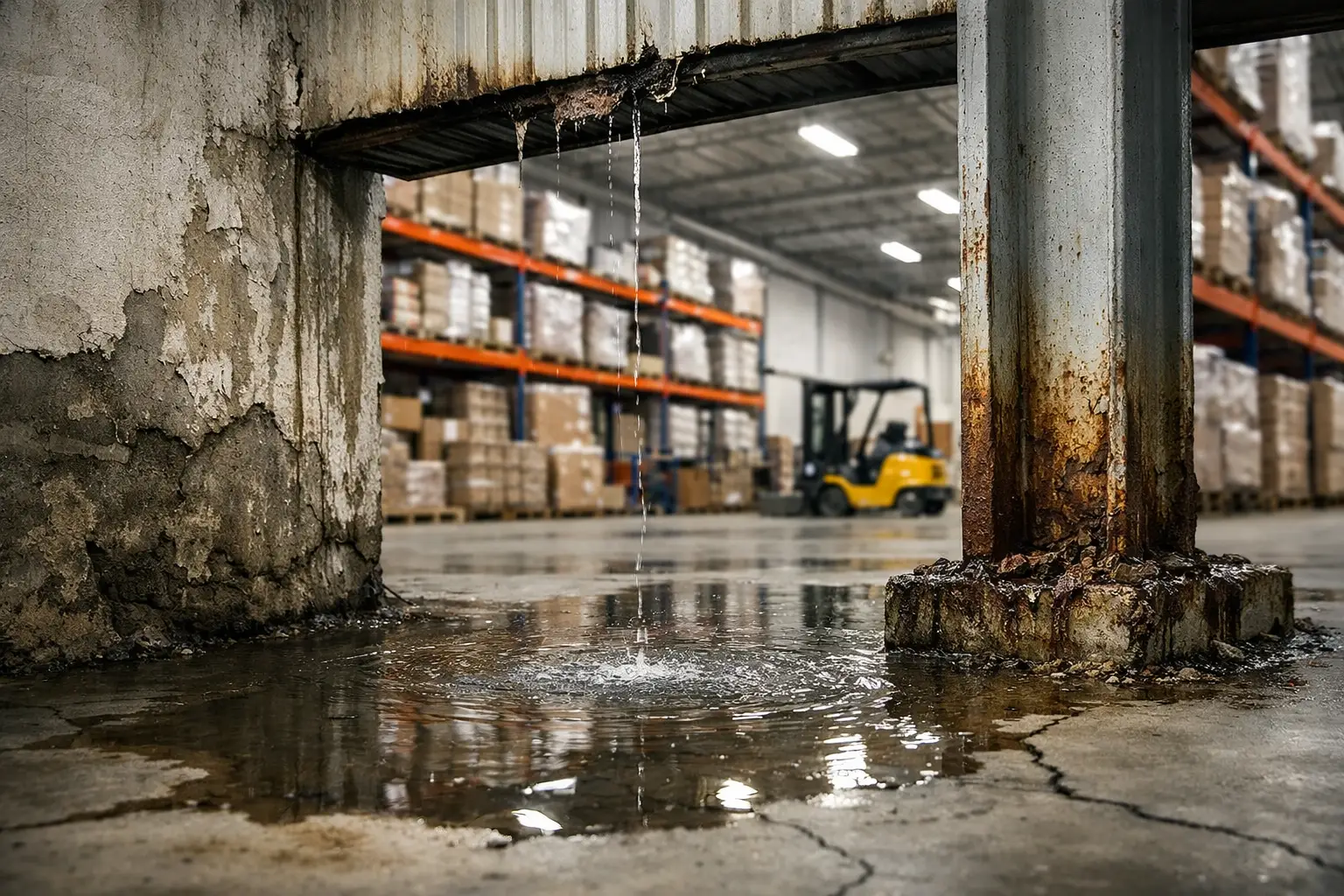
A warehouse leak rarely begins as a visible ceiling drip. It often starts at one loose fastener, an opening around a service pipe, or a blocked outlet that holds water after a storm. The top warehouse waterproofing failure points are usually concentrated at these details, where different materials meet and movement, heat, and weather place constant stress on the building envelope.
For facility teams, the cost is not limited to the repair area. Water ingress can interrupt storage activity, damage stock, accelerate corrosion, affect electrical systems, and create safety concerns. Finding the exact failure point before applying a repair system is what separates a durable result from a short-term patch.
Why Warehouse Waterproofing Fails at Details
Large warehouse roofs and metal-clad buildings have broad exposed surfaces, but the main membrane field is not always the first place to fail. Most leakage develops at transitions, joints, and penetrations. These are areas where water can track beneath laps or around fixings, often traveling away from the point where it becomes visible inside.
Heat exposure adds another layer of risk. In hot climates, metal sheets expand and contract daily. Sealants can harden, crack, or lose adhesion. Fasteners can work loose. Standing water after rainfall can expose weak laps that remained unnoticed during dry periods. A repair method must account for the roof material, slope, drainage path, existing coatings, and condition of surrounding components.
Top Warehouse Waterproofing Failure Points to Inspect
1. Roof sheet laps and membrane seams
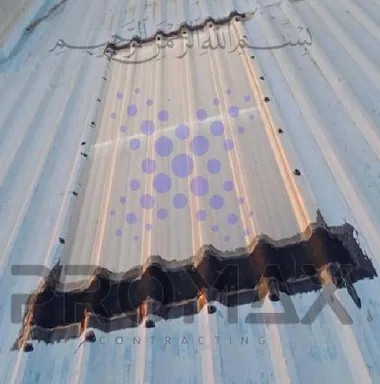
Overlapping metal sheets, membrane laps, and previous repair joints are frequent leakage locations. Capillary action can pull water into a poorly sealed lap, particularly where the roof slope is shallow or wind drives rain sideways. A seam may look intact from a distance while its sealant has separated underneath.
Inspection should focus on lifted edges, exposed lap sealant, open joints, trapped debris, and signs of staining below the overlap. Simply applying more sealant over a contaminated or moving joint may not last. The surface must be cleaned, prepared, and treated with a compatible waterproofing system that can accommodate movement.
2. Pipe penetrations and service openings
Every pipe, duct, cable tray support, vent, and conduit passing through the roof creates a waterproofing detail. These points are especially vulnerable because the roof surface and the penetrating element often move at different rates. Old mastic around a pipe can split after repeated heat cycles, allowing water to enter beneath the flashing.
The right repair depends on the penetration shape, material, and accessibility. A reliable detail usually requires proper surface preparation, reinforced flashing treatment, and a flexible waterproofing layer returned up the penetration. It also requires checking whether water is being directed toward the penetration by a failed nearby lap or drainage issue.
3. Gutters, outlets, and drainage channels
Waterproofing systems are not designed to perform indefinitely under standing water. When gutters fill with dust, leaves, packaging debris, or corrosion scale, rainwater backs up at roof edges and around outlets. This can flood sheet laps, overflow into wall connections, and place unnecessary load on aged gutters.
Gutter failure is often a combined problem. The channel may have corrosion holes, loose brackets, incorrect falls, failed outlet connections, or inadequate capacity for the roof area. Cleaning alone will not correct damaged metal or poor drainage geometry. A site inspection should identify the cause of ponding before gutter replacement, lining, sealing, or fabrication work is specified.
4. Fasteners, screws, and washers
On metal roofs, thousands of screw locations can become potential water entry points. The washer beneath a fastener head can degrade under ultraviolet exposure and heat. Screws may loosen from vibration or thermal movement, while corrosion can enlarge the opening around the fixing.
Randomly coating screw heads is not a complete repair strategy. Failed fasteners should be assessed for grip, corrosion, washer condition, and the integrity of the supporting metal. Depending on the condition, treatment may involve replacing fixings, sealing the screw line, reinforcing affected zones, and addressing corrosion before it spreads into the sheet or purlin area.
5. Parapet walls, edge flashings, and wall connections
At the roof perimeter, water can enter behind loose flashings or through cracks where roof material meets a parapet wall. These points are exposed to wind uplift and are often disturbed during maintenance access, signage installation, or temporary repair work. A narrow opening at an edge flashing can allow a significant volume of water into the building during wind-driven rain.
The repair should not stop at the visible crack. Contractors need to inspect the flashing termination, wall surface condition, counterflashing, sealant joints, and the route water takes from the roof edge. Where metal components are corroded or undersized, replacement or custom fabrication may be more cost-effective than repeatedly sealing deteriorated material.
6. Skylights and roof access openings
Skylights, roof hatches, and access curbs create multiple waterproofing interfaces. Their frames can crack, fixing points can loosen, and perimeter seals can fail under sunlight and movement. Condensation may also be mistaken for a leak, which is why diagnosis matters before repair work begins.
Inspect the full perimeter, not only the visible wet area. Check the glazing frame, curb flashing, surrounding sheet laps, fixing points, and internal drainage routes. If the skylight itself is brittle or damaged, perimeter sealing may only delay a larger replacement decision.
7. Corroded metal and neglected previous repairs
Corrosion changes the condition of the substrate beneath a waterproofing layer. A coating applied over rust, weak metal, or trapped moisture can lose adhesion quickly. The same applies to old patchwork repairs where incompatible sealants, tapes, and coatings have been layered over one another without removing failed material.
Corrosion treatment must be part of the waterproofing scope when deterioration is present. This can include mechanical preparation, rust treatment, replacement of severely damaged sections, and protective coating or membrane coverage suited to the roof assembly. The goal is to restore a sound surface before relying on it as a waterproofing base.
Why Repeated Patch Repairs Become Expensive
A small emergency patch has a place when active water ingress threatens operations. However, repeated spot repairs can create an uneven roof condition with many different materials and unknown adhesion levels. Each new patch may redirect water beneath an older repair, making future fault finding slower and more costly.
The better approach is to separate immediate containment from permanent rectification. First, stop active water entry where required. Then inspect the wider area to determine whether the issue is isolated or part of a pattern involving seams, fasteners, drainage, or corrosion. This is particularly relevant for older warehouses where several failure points may have the same underlying cause.
A Practical Inspection Sequence
An effective warehouse roof inspection follows the path of water rather than only looking at the stain inside. Start at the highest nearby roof section and trace toward drainage points, checking seams, penetrations, fixings, and flashings along the route. Internal observations remain useful, but water can travel along structural members before dripping below.
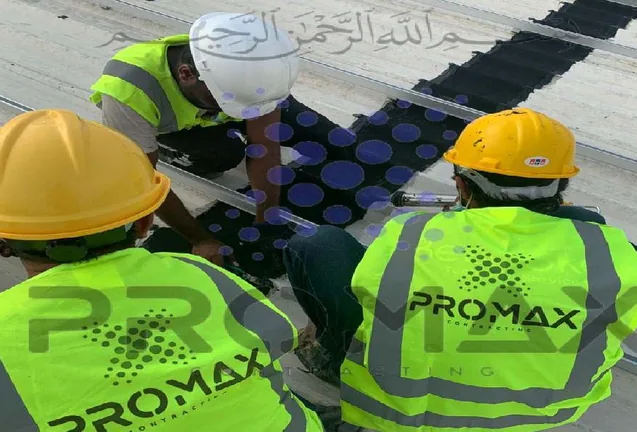
A professional inspection should document the roof type, visible defects, moisture paths, condition of gutters, corrosion areas, and previous repair materials. It should also identify access and safety requirements before work starts. For operating warehouses, repair planning must consider work zones, weather windows, protection of stored goods, and whether sections can be completed without disrupting daily activity.
Promax Contracting approaches these issues through site inspection, technical repair recommendations, surface preparation, waterproofing installation, and after-sales support. For roofs with multiple defects, an integrated scope is usually more dependable than treating each leak as an unrelated event.
The most useful maintenance decision is made before the next storm. Inspect the details that receive the most movement and water exposure, correct drainage before water ponds, and repair failing materials while the damage is still localized. That is how a warehouse roof remains an asset that protects operations rather than an ongoing source of emergency work.
Talk to Promax
Need this on your roof? Call +971 56 727 4205 or request a free inspection. Promax provides EPDM metal-roof, concrete and industrial waterproofing across Dubai and the UAE with up to a 15-year warranty.