A warehouse roof rarely fails all at once. Most of the time, the warning signs show up earlier - standing water after rain, overflow at gutter lines, rust around drains, damp insulation, stained purlins, and repeated leak calls from the same zones. That is why warehouse roof drainage improvement steps should start before the next major storm, not after inventory gets damaged or operations are interrupted.
For facility managers and industrial property owners, drainage is not a minor roofing detail. It affects waterproofing performance, structural loading, corrosion rates, internal humidity, and maintenance cost over time. On large-span warehouses, even a small drainage defect can become a recurring failure point because water concentrates quickly and exposes laps, fasteners, penetrations, and sheet joints to constant stress.
Why drainage failures keep returning
In many warehouses, the drainage problem is not just one blocked outlet. It is a system issue. The roof slope may be too shallow in key areas, downpipes may be undersized, internal drains may sit above the low point instead of at it, and gutters may have already lost line due to corrosion or poor support spacing.
Repairs also fail when the diagnosis is too narrow. A team may seal a leak around a drain bowl, but if ponding water remains on the panel for days, the waterproofing is still working under the wrong conditions. The result is familiar: repeat patching, growing rust, insulation damage, and higher service frequency.
That is why the correct approach is structured. Good drainage improvement combines inspection, hydraulic assessment, surface repair, waterproofing integration, and planned maintenance.
Warehouse roof drainage improvement steps that actually solve the problem
1. Start with a full roof and drainage inspection
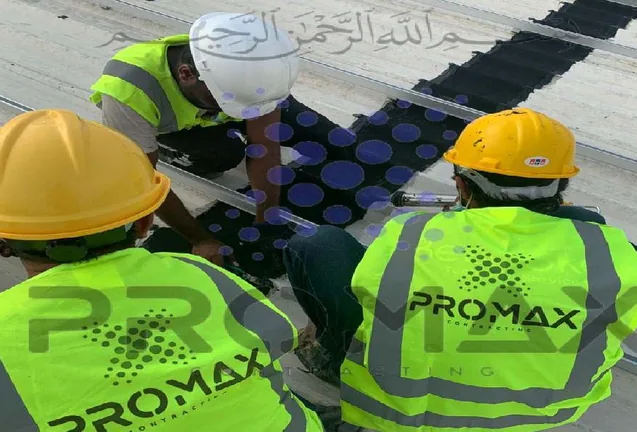
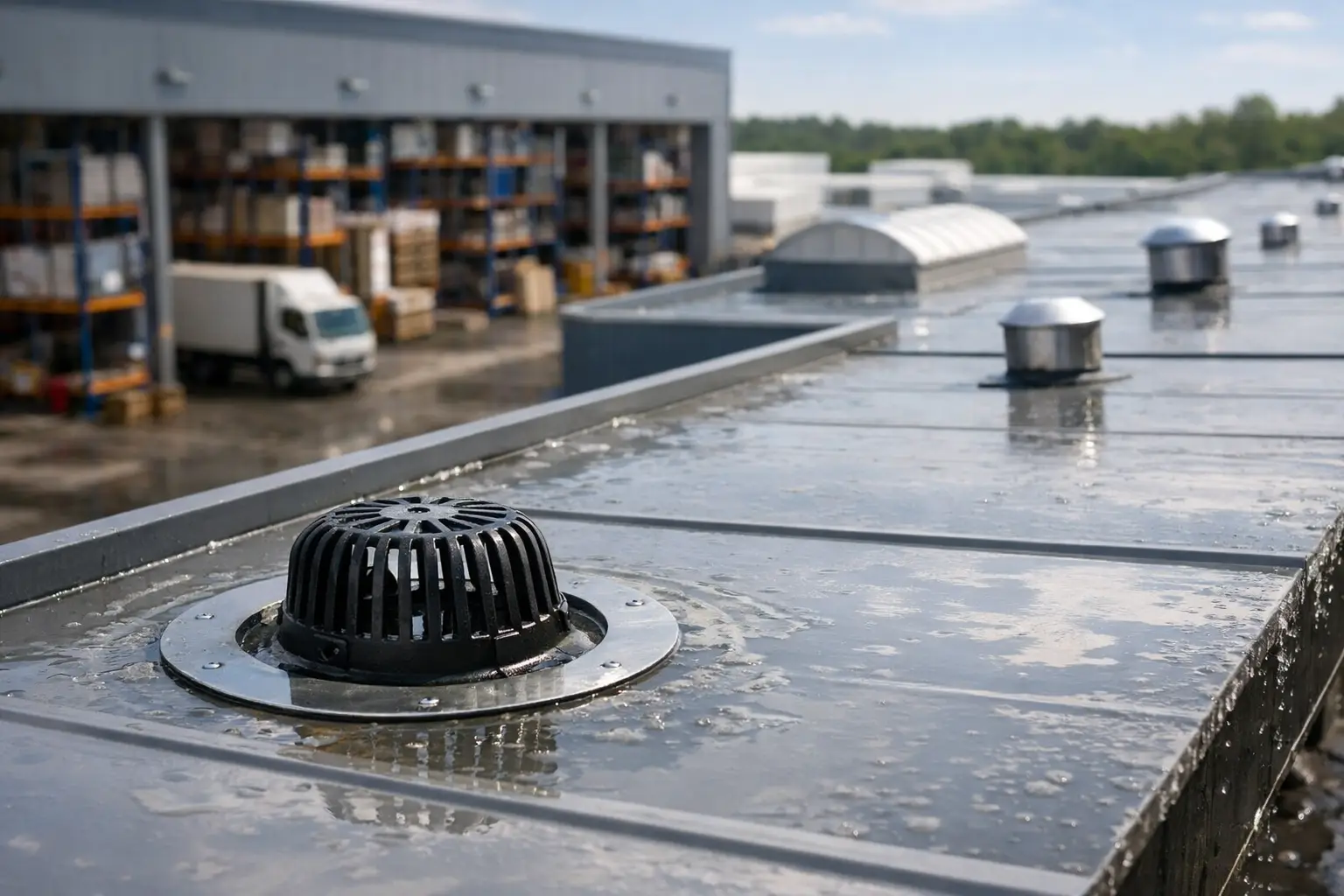
The first step is to inspect the complete water path, not only the leak location. On a warehouse roof, that means checking roof sheets or slabs, valleys, gutters, internal drains, scuppers, downpipes, expansion joints, skylight perimeters, parapet conditions, and all penetrations.
A proper site inspection should identify where water is entering, where it is being trapped, and why it is not discharging fast enough. This often includes measuring ponding depth, locating low spots, checking existing slope, reviewing corrosion around fasteners and drain edges, and confirming whether outlets are blocked by debris, membrane build-up, or poor installation alignment.
Without this first step, drainage upgrades often become guesswork. With it, the scope becomes practical and cost-controlled.
2. Clear blockages and verify outlet capacity
Blocked drains are the most obvious issue, but they are not always the only issue. Leaves, dust, packaging debris, bird nesting material, and roof scale can all reduce water flow. In industrial areas, sediment build-up is especially common around gutters and outlet bowls.
Cleaning should be followed by capacity verification. A drain that is clean but too small for the roof area will still overflow during heavy rainfall. The same applies to downpipes with tight bends, crushed sections, or poor discharge routing at ground level.
This is where many warehouse owners lose time. They restore flow temporarily, but they do not check whether the drainage design matches the roof catchment area. If capacity is wrong, cleaning helps, but it does not solve the root cause.
3. Correct low spots and ponding zones
Persistent ponding is one of the clearest signs that drainage improvement is incomplete. Water should move toward the outlet efficiently. If it sits for long periods, the roof surface is being overloaded and the waterproofing system is aging faster than it should.
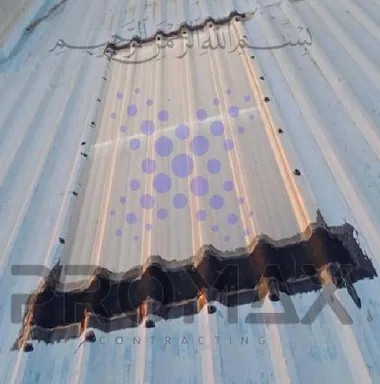
Correcting ponding depends on the roof type. On metal roofs, deformed sheets, failed supports, or misaligned framing can create local depressions. On concrete roofs, settlement, screed failure, or poor original slope formation may be the issue. In either case, the solution may involve local re-leveling, support correction, tapered build-up, or replacing damaged roof sections.
This is not an area for cosmetic patching. If low spots are left untreated, any new coating or membrane installed above them will continue to face standing water exposure.
Drainage upgrades must work with the waterproofing system
4. Repair drains, gutters, and edge details as one assembly
Drainage components fail at the connection points. The outlet itself may be sound, but the surrounding metal can be rusted. A gutter may look serviceable, but the joints may already be open. A parapet scupper may discharge water, but poor flashing detail can still allow water back into the wall line.
Warehouse roof drainage improvement steps should include repairing or replacing deteriorated gutters, outlet bowls, sleeves, brackets, and edge flashings together where needed. On large industrial roofs, fabricated metal components often need to be custom-made to fit actual site dimensions rather than nominal drawings.
This is where execution quality matters. A badly aligned replacement gutter or a drain detail with poor sealing at laps will create the same problem under the next rainfall cycle.
5. Integrate waterproofing around every drainage point
Drainage cannot be separated from waterproofing. Every drain, scupper, gutter junction, and penetration is a transition zone, and transition zones are where many warehouses leak first.
The repair system should be selected based on substrate condition, roof type, movement, and exposure. On metal roof applications, corrosion treatment, fastener treatment, joint sealing, and membrane detailing may all be required before the drainage point is considered secure. On concrete roofs, crack treatment and surface preparation are just as important as the waterproof layer itself.
EPDM-based systems are often a strong option in drainage-related repairs because they handle movement well and can be detailed effectively around outlets and penetrations when installed correctly. Still, material choice depends on the roof condition. The best system is the one that matches the surface, the drainage geometry, and the service environment.
6. Review overflow protection and emergency discharge
Some warehouses do not fail under normal rain. They fail during short, intense weather events when primary drainage is overwhelmed or partially blocked. If there is no emergency overflow route, water depth can rise quickly and create both leakage and structural risk.
Overflow scuppers, secondary outlets, and safe discharge planning should be reviewed as part of any serious upgrade. This is particularly important on low-slope roofs with large uninterrupted catchment areas. The cost of adding emergency drainage is usually far lower than the cost of one major water ingress event.
It also helps from an operations standpoint. Facility teams need drainage that performs under real conditions, not only on paper.
The maintenance piece that decides whether repairs last
7. Put the roof on a scheduled inspection and cleaning cycle
A drainage upgrade is only as durable as the maintenance behind it. Warehouses collect dust, airborne debris, and residue from adjacent operations. That means gutters and drains can return to restricted flow faster than many teams expect.
A scheduled inspection program should include cleaning, visual leak tracing, corrosion checks, joint review, membrane inspection, and confirmation that discharge points remain open. The right frequency depends on roof size, nearby dust load, surrounding trees, and operating environment. In many industrial properties, pre-season and post-storm inspections are the minimum standard, not an extra.
This is also where after-sales response matters. If a contractor installs a drainage correction but disappears when the first issue appears, the owner is left managing risk alone. Promax Contracting typically sees better long-term results when drainage upgrades are paired with routine follow-up and fast corrective attendance where needed.
When repair is enough and when redesign is smarter
Not every warehouse needs a full drainage redesign. If the issue is isolated corrosion, local blockage, or a small number of failing outlets, targeted repair can be the right decision. It keeps cost lower and disruption limited.
But there are cases where repair-only thinking becomes expensive. If the roof has repeated ponding across multiple bays, chronic gutter overflow, undersized downpipes, or structural deflection affecting water flow, then a broader redesign usually makes more sense. That may include changing gutter profiles, increasing outlet counts, reworking slopes, or replacing sections that no longer drain correctly.
The trade-off is straightforward. A limited repair is faster and cheaper upfront. A system correction costs more initially but often reduces repeat leak calls, emergency response spending, and interior damage over the next few years. The right choice depends on the age of the roof, the value of the protected assets, and how often drainage-related failures are already occurring.
A warehouse roof should move water off the building quickly, predictably, and without forcing the waterproofing system to do all the work. If your site still has standing water, recurring leaks, or overflowing gutters after previous repairs, the issue is usually not finished - it is only patched. The better next step is a proper inspection, a technically sound drainage scope, and execution that treats the roof as one connected system.
Talk to Promax
Need this on your roof? Call +971 56 727 4205 or request a free inspection. Promax provides EPDM metal-roof, concrete and industrial waterproofing across Dubai and the UAE with up to a 15-year warranty.