
A warehouse roof leak repair example is rarely just about patching one wet spot. In active facilities, the visible drip inside the building is usually the last sign of a larger failure path across roof sheets, gutters, laps, fasteners, penetrations, or insulation. If the repair scope is based only on where water appears on the floor, the leak often returns after the next storm.
That is why experienced warehouse roofing teams start with diagnosis, not guesswork. In large-span industrial buildings, water can travel along purlins, insulation facings, and metal laps before it shows up inside. The right repair method depends on roof profile, age, drainage condition, corrosion level, and whether previous temporary sealing has already trapped moisture in the system.
A real warehouse roof leak repair example
Consider a mid-sized logistics warehouse with a metal roof over storage racking and loading activity. The facility team reported repeated leaks above one aisle and near a shutter opening after moderate rainfall. Internal maintenance had already applied sealant from inside at the visible drip points, but the water ingress continued.
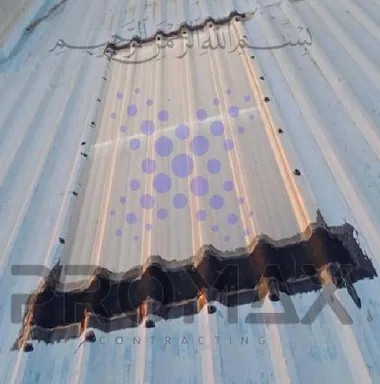
On inspection, the issue was not one defect. The roof had several failure points acting together. Rust was active around old fasteners, some roof laps had started to open under thermal movement, and a valley gutter section was holding standing water because of poor discharge. There was also leakage at one pipe penetration where the old flashing had hardened and cracked.
This kind of case is common in warehouses exposed to heat, dust, and long service cycles. The roof may look acceptable from ground level, but the waterproofing line is already compromised in multiple areas. A proper repair scope has to deal with the leak path as a system, not as a single hole.
What the inspection found
The first step was controlled access and a full top-side inspection, including roof sheet condition, screw lines, end laps, side laps, flashing junctions, gutter performance, and penetration detailing. Water testing was used only after the visual and physical survey because random flooding can spread water into unrelated areas and create false readings.
The inspection confirmed four primary defects. First, several fasteners had backed out slightly, and their washers had degraded under UV exposure. Second, corrosion had started around screw points and lap joints, especially in sections where dirt and moisture remained trapped. Third, the valley gutter had localized blockage and low spots, which caused ponding and overflow during rainfall. Fourth, the pipe penetration seal had failed due to age and movement.
There was also a secondary issue inside the roof build-up. Moisture had migrated into insulation below one leak zone. That matters because even when the external opening is sealed, trapped wet insulation can continue affecting internal humidity, staining, and thermal performance. In some projects, that means replacement of selected internal materials is part of the real repair cost.
Why temporary patching failed
This warehouse roof leak repair example shows why temporary patching often underperforms in industrial buildings. Generic sealant was applied over dusty surfaces, across moving joints, and without corrosion treatment. It covered symptoms but did not restore the roof assembly.
Metal roofs expand and contract daily. If a sealant is placed over an active lap or around a loose fastener without substrate preparation and mechanical correction, the bond is likely to break. The same applies to gutters. If water is not draining correctly, no amount of local sealing will solve repeated overflow.
There is also the issue of compatibility. Not all sealants bond well to aged metal coatings, previous mastics, or contaminated roof surfaces. Good repair work depends on surface preparation, detailing, and choosing a system that matches the roof condition and movement behavior.
The repair strategy used on site
The repair was divided into targeted actions instead of a full roof replacement. That decision made sense because the roof sheets were still structurally serviceable across most of the building. The failure was concentrated in critical waterproofing details and drainage zones.
1. Fastener and screw line treatment
Defective fasteners were removed and replaced where needed. Corroded points were cleaned and treated before new sealing work. This matters because sealing over active rust usually shortens the life of the repair. Once the screw lines were stabilized, they were incorporated into the waterproofing treatment rather than left as isolated points.
2. Lap joint sealing and reinforcement
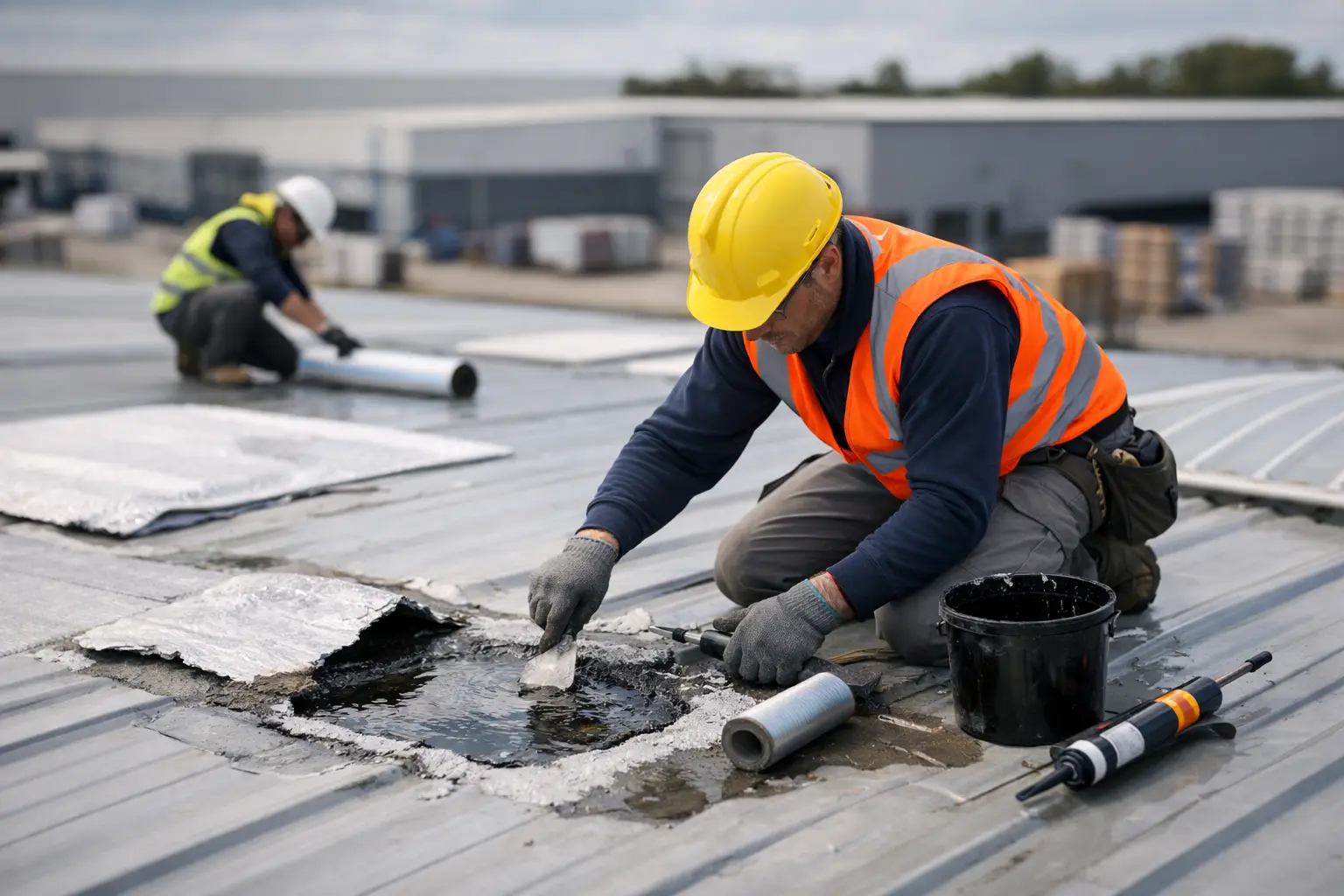
Open laps were cleaned, dried, corrected, and sealed using a roofing-grade waterproofing system suitable for metal roof movement. In higher-risk sections, reinforcement was added over the lap treatment to improve continuity. This is often the difference between a cosmetic repair and a durable one.
3. Gutter correction and discharge improvement
The valley gutter was cleaned, the low-performance section was repaired, and discharge flow was restored. In some warehouses, gutter leakage is misread as roof-sheet leakage because water backs up and enters at adjacent joints. Correcting drainage was as important as sealing the roof itself.
4. Penetration waterproofing
The failed pipe penetration was stripped back and re-detailed with a proper flashing arrangement and waterproof sealing system. Penetrations are high-risk zones because they combine movement, mechanical stress, and difficult geometry. They should never be treated as a simple caulking job.
5. Internal follow-up works
Wet internal materials in the affected zone were checked and replaced where deterioration had already started. This is not always a large scope, but ignoring it can leave a building with hidden moisture problems even after the roof leak is technically closed.
Where EPDM and membrane systems fit in
In many industrial leak cases, localized membrane treatment is a stronger option than repeated spot sealing. For this warehouse roof leak repair example, membrane-based detailing was used in the most vulnerable sections because it provides better continuity across joints, fastener lines, and irregular details.
EPDM-based systems are especially useful where flexibility, weather resistance, and long-term movement tolerance are required. That said, not every roof needs blanket membrane coverage. On some projects, targeted treatment at penetrations, gutters, and recurring leak lines is more cost-effective than coating the entire roof. The right answer depends on the spread of defects and the remaining life of the substrate.
This is where contractor judgment matters. If the roof has widespread corrosion, structural sheet weakness, or chronic ponding across large areas, repair may only delay a bigger intervention. If the roof is generally sound and the failures are detail-related, a well-designed rehabilitation scope can restore performance without full replacement.
What decision-makers should take from this example
The main lesson is simple. Water ingress in warehouses is usually a system failure, not an isolated event. If your team sees leaks at one internal location, the origin may be several meters away, especially on metal roofs with laps, insulation, and structural channels.
A proper contractor will inspect the full path of failure, not just the symptom. That includes roof sheets, flashings, gutters, penetrations, fasteners, discharge points, and internal wet zones. It also means being honest about repair limits. Some leaks are repairable with targeted work. Others are signs that the roof has reached the point where phased rehabilitation is the smarter commercial decision.
For facility managers and warehouse operators, speed matters, but accuracy matters more. Fast response is valuable only if the repair scope is technically sound and durable under heat, rainfall, and building movement. Promax Contracting approaches these jobs with that mindset - inspect thoroughly, isolate failure points, apply the right waterproofing system, and restore serviceability with minimum disruption.
How to recognize when a warehouse roof needs more than a patch
If leaks reappear after previous sealing, if gutters are overflowing, if rust is visible around screw lines, or if water staining keeps spreading along internal members, the building likely needs a broader inspection. The same applies when leaks appear only during wind-driven rain. That often points to laps, flashings, or edge conditions rather than simple punctures.
It also helps to look beyond the leak itself. Rising indoor humidity, stained insulation, damaged inventory packaging, and repeated ceiling maintenance calls are all signs that the roof issue is affecting operations. By that stage, the cheapest repair is rarely the one with the lowest initial price.
The best time to fix a warehouse roof is before product damage, shutdowns, or structural deterioration force the decision. A careful inspection and a technically correct repair plan can extend roof life significantly and reduce repeat maintenance. When the repair is based on how the roof actually fails, not on where the drip lands, the result is far more dependable.
If you are dealing with recurring leakage, treat the first interior stain as an early warning, not a minor nuisance. The longer water is allowed to travel through a warehouse roof system, the more expensive the repair becomes.
Talk to Promax
Need this on your roof? Call +971 56 727 4205 or request a free inspection. Promax provides EPDM metal-roof, concrete and industrial waterproofing across Dubai and the UAE with up to a 15-year warranty.