A leaking water tank is rarely just a surface problem. In commercial buildings, warehouses, labor accommodations, plants, and institutional facilities, failed water tank waterproofing repair can lead to concrete deterioration, contamination concerns, damaged surrounding areas, higher water consumption, and interrupted operations. A patch applied over a wet, contaminated, or moving crack may stop visible leakage briefly, but it does not correct the cause.
Effective repair starts with identifying where water is traveling, what has damaged the tank lining or structure, and whether the tank remains suitable for the intended water use. The repair system must be selected around the tank material, exposure conditions, water pressure, and access requirements - not simply around the visible leak.
Start With a Proper Tank Inspection
Water can enter or escape through cracks, construction joints, pipe penetrations, overflow areas, wall-to-slab junctions, failed internal coatings, or defective external waterproofing. The point where moisture appears is not always the source. Water often tracks behind coatings or through concrete before becoming visible on the opposite side.
A site inspection should assess the tank internally and externally where access permits. The team should document active seepage, damp patches, concrete honeycombing, exposed reinforcement, coating blisters, loose render, failed sealant, and corrosion around connected metal components. Pipe sleeves, valves, access hatches, and overflow lines deserve close attention because these details are common failure points.
The inspection should also establish whether the issue is internal water loss, external groundwater ingress, rainwater entry around a roof-level tank, or leakage from connected pipework. These conditions require different repair approaches. Treating an external groundwater issue only from inside the tank, for example, may leave the concrete under continued pressure.
Check Structural Condition Before Coating
Waterproofing is not a substitute for structural repair. If the tank has wide cracks, significant movement, spalled concrete, corroded reinforcement, or damaged supports, those issues must be evaluated and repaired before a membrane or coating is applied.
Small static cracks may be routed and sealed with an appropriate repair material. Active cracks or joints with movement need a flexible joint treatment that can accommodate expansion and contraction. Where concrete has deteriorated, loose material must be removed back to sound substrate, reinforcement treated where required, and the area reinstated with a compatible repair mortar.
This sequence matters. A new waterproof layer installed over unstable concrete can crack, detach, or allow water to migrate behind it.
What Causes Water Tank Waterproofing Failure?
Most tank leaks develop from a combination of age, inadequate original detailing, poor substrate preparation, and movement at joints or penetrations. In hot climates, roof-mounted tanks and exposed service areas also face thermal cycling that stresses rigid coatings and sealants over time.
Concrete itself is porous. If the internal protective system has worn away or was never properly installed, water can penetrate the surface and gradually affect the structure. Chlorides, poor-quality water, and prolonged dampness can accelerate reinforcement corrosion. Once steel expands from corrosion, it can crack the surrounding concrete and create more direct water paths.
Another common issue is incorrect material selection. A system suitable for an exterior retaining wall may not be suitable for a potable-water tank. Likewise, a coating that performs well on a dry, stable surface can fail when installed on damp concrete or at a joint that experiences movement.
Poor drainage around external tanks can also create unnecessary hydrostatic pressure. Before repair work begins, the contractor should review nearby drainage, overflow discharge, plumbing leaks, and surface water routes. Correcting these contributing conditions reduces the chance of repeat failure.
Water Tank Waterproofing Repair Systems
There is no single material that fits every tank. The right system depends on whether the tank is concrete, steel, or another material; whether waterproofing is required internally or externally; and whether it will hold potable water, process water, fire water, or non-potable utility water.
For concrete tanks, cementitious waterproofing systems are often used where they are compatible with the substrate and intended water service. These systems can bond directly to prepared concrete and are practical for many internal applications. Flexible cementitious systems can offer better crack-bridging performance where minor movement is expected.
Liquid-applied membranes may be used for selected external surfaces, service areas, and details where a continuous flexible layer is required. Their performance depends heavily on surface preparation, primer compatibility, dry film thickness, and proper treatment of corners, penetrations, and terminations.
For larger or more demanding applications, sheet membrane systems can provide controlled thickness and reliable coverage when correctly detailed. EPDM-based systems may be considered in appropriate external waterproofing conditions where flexibility, weather resistance, and long-term membrane performance are required. The final selection should always account for water contact requirements and the complete tank build-up.
Internal and External Repairs Serve Different Purposes
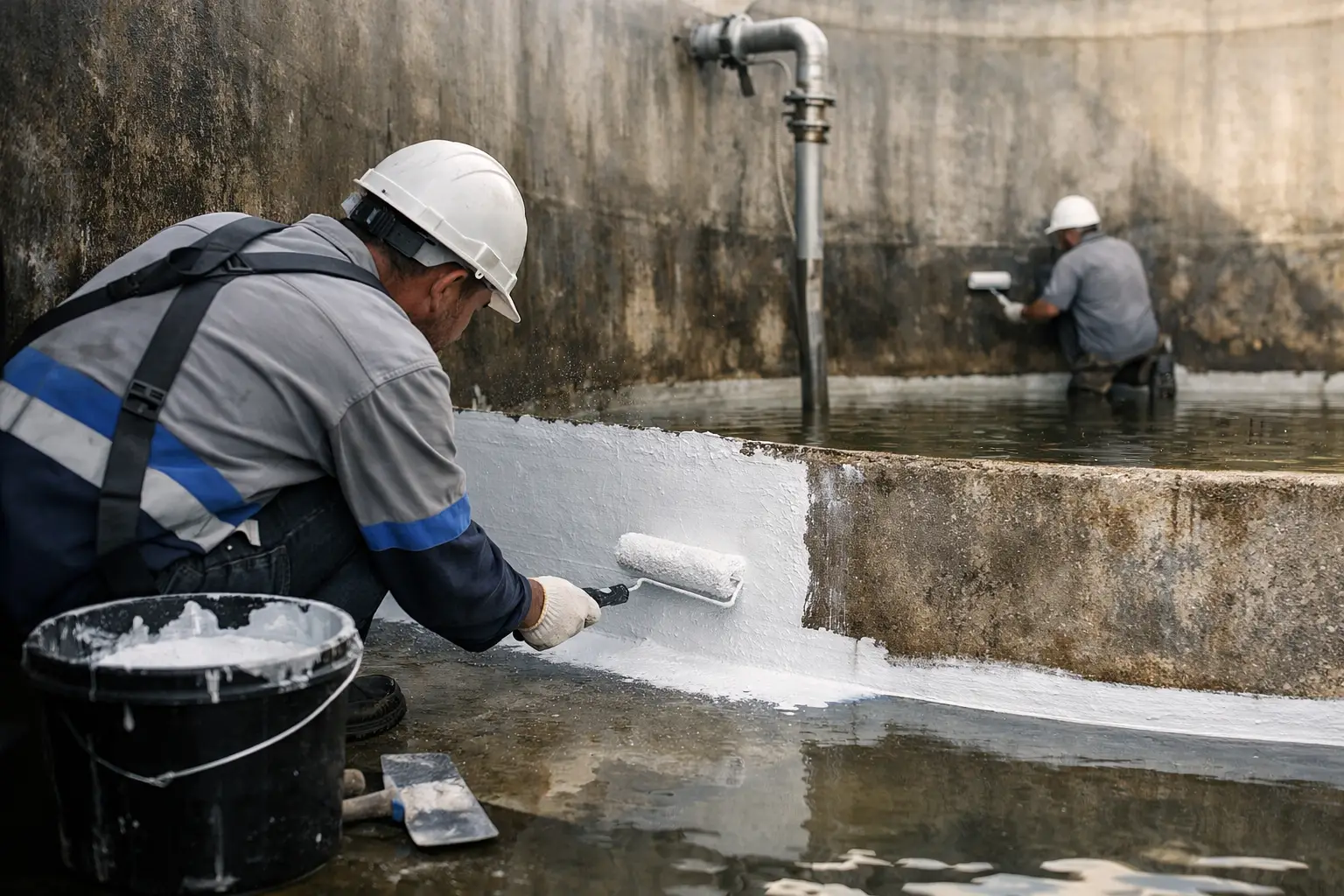
Internal waterproofing protects the water-holding face of the tank. It is often the most direct way to stop water loss and protect the concrete from continuous water exposure. However, the tank must be safely isolated, drained, cleaned, and prepared before work can begin.
External waterproofing protects the outside of the tank from groundwater, rainwater, or moisture entering from surrounding construction. It may require excavation, removal of existing protection layers, drainage correction, and careful reinstatement. It can be more disruptive, but it is sometimes essential when water pressure is acting from outside toward the tank interior.
In some cases, both sides need attention. This is especially true where internal coating failure has allowed water to affect the concrete while external moisture is also present. A professional recommendation should explain which side is being treated, why, and what limitations remain.
Surface Preparation Determines Repair Life
The waterproofing material receives most of the attention, but surface preparation determines whether it bonds and performs. Tank surfaces must be cleaned of slime, scale, loose coating, laitance, salts, oil, and weak concrete. Mechanical preparation may be needed to create a sound, open-textured surface for the selected system.
Corners and wall-to-slab junctions should not be left as sharp 90-degree transitions if the system requires a fillet or reinforcing treatment. Pipe penetrations need compatible sealing materials and detail work that accounts for movement and vibration. Construction joints require flexible treatment rather than a rigid coating alone.
Moisture condition is equally important. Some cementitious systems can be installed on damp substrates, while many resin or liquid membrane products require controlled dryness. Applying the wrong product to a damp surface may trap moisture and cause blistering, debonding, or early failure.
For potable-water tanks, cleaning, material certification, curing, and final flushing requirements should be planned before work starts. The tank should not return to service until the system has cured according to the manufacturer’s requirements and the required quality checks are complete.
Managing Repairs Without Disrupting Operations
Tank repairs can affect water supply, fire protection planning, tenant services, and production activities. Facility managers should establish a shutdown plan before the work begins. This may include temporary water storage, isolation of connected lines, safe access arrangements, confined-space controls, cleaning procedures, and a realistic curing period.
Rushing the return-to-service stage is a frequent mistake. A coating may look dry but still require additional time before immersion. Filling a tank too early can damage the new system and turn a planned repair into another shutdown.
Promax Contracting approaches tank waterproofing work through inspection, substrate repair, system selection, detailed application, and post-repair support. This execution-led approach is particularly valuable where tanks are part of a wider building maintenance issue involving roof drainage, pipe penetrations, corroded metalwork, or water ingress around service structures.
When Is Repair Not Enough?
Repair is usually cost-effective when the tank structure is sound and failures are localized or related to an aged coating, joints, or penetrations. Full rehabilitation may be the better option when multiple leaks are present, coatings are broadly delaminating, concrete damage is widespread, or the tank has reached the point where repeated patching costs more than a planned renewal.
Replacement may be necessary if structural integrity cannot be restored safely or if the tank no longer meets operational capacity and hygiene requirements. The decision should be based on inspection findings, expected service life, access constraints, and the cost of downtime - not only the immediate repair price.
A water tank should be inspected before a small leak becomes a maintenance emergency. The right repair is the one that addresses the water path, restores the substrate, and gives the facility a practical plan for keeping the tank in service.
Talk to Promax
Need this on your roof? Call +971 56 727 4205 or request a free inspection. Promax provides EPDM metal-roof, concrete and industrial waterproofing across Dubai and the UAE with up to a 15-year warranty.