A leaking warehouse roof in Abu Dhabi rarely stays a roof problem for long. It turns into damaged stock, electrical risk, insulation failure, rusted steel, and maintenance calls that keep coming back. That is why waterproofing abudhabi is not a cosmetic scope for industrial and commercial buildings. It is a protection system that affects operations, asset life, and repair cost over time.
For facility managers and project teams, the real issue is not just water entry. It is the combination of heat, UV exposure, sand, ponding water, failed joints, corroded fasteners, damaged gutters, and movement around penetrations. In this environment, a patch-first approach often creates repeat failures. A proper waterproofing scope starts with diagnosis, then moves to system selection, substrate preparation, detailing, and after-service support.
Why waterproofing Abudhabi buildings is a technical job
Abu Dhabi buildings work under conditions that are hard on every exposed surface. Roof sheets expand and contract. Concrete cracks under movement and thermal stress. Sealants fail around skylights, parapets, drains, and pipe penetrations. Once moisture enters, corrosion and material breakdown accelerate, especially on older warehouses, factories, sheds, and service buildings.
This is where many projects go wrong. The market is full of generic coating applications sold as complete waterproofing solutions. In reality, not every leak is solved by applying a topcoat. If the roof slope is poor, the screws are rusted, the overlap joints are open, or the gutter line is undersized, surface treatment alone will not hold for long.
A serious contractor looks at the whole water path. That includes roof sheets, concrete slabs, upstands, curbs, expansion joints, drainage points, flashing details, and transition areas between dissimilar materials. In industrial sites, that review also needs to consider live operations, access limitations, safety controls, and whether work can be staged without affecting production.
Where failures usually start
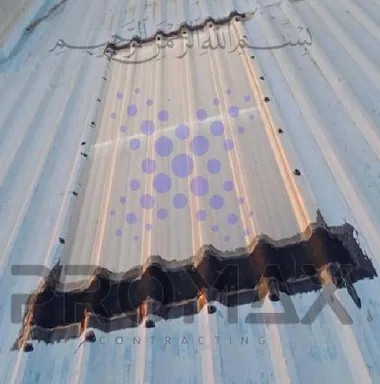
Most industrial roof leaks do not come from one large visible hole. They begin at small weak points that have been exposed for years. Fastener locations are common failure zones because washers degrade and screws corrode. Lapped sheet joints can open under movement. Pipe penetrations and cable entries often fail because of poor detailing. Skylight perimeters are another regular source of water ingress, especially where previous repairs used incompatible sealants.
Concrete roofs have their own pattern of failure. Cracks near parapet walls, membrane detachment, damaged screed, and blocked drainage all contribute to water retention and seepage. On podiums and service areas, repeated maintenance traffic can damage the waterproofing layer without anyone noticing until internal leakage appears.
Gutters should not be treated as a separate issue. In many warehouses, leak complaints are actually drainage failures. If gutters are corroded, undersized, poorly sloped, or disconnected at joints, water backs up and enters through roof edges, end laps, and wall junctions. Repairing the roof without correcting the gutter system only delays the next complaint.
Choosing the right system for waterproofing Abudhabi facilities
System selection depends on the substrate, the failure mechanism, and the expected service life. There is no single material that fits every roof type.
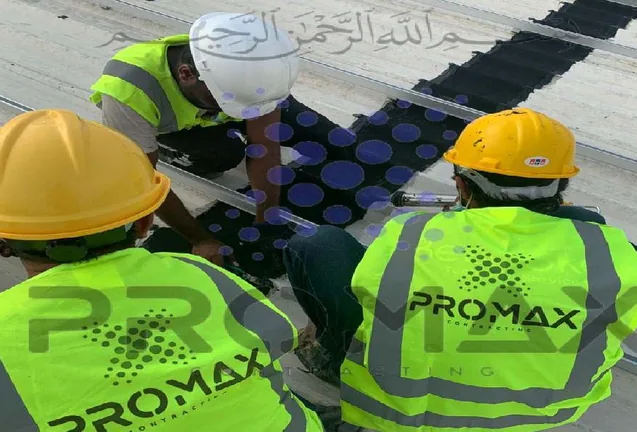
For metal roofs, EPDM-based systems are often a strong choice where the objective is to address joints, fasteners, penetrations, and vulnerable transitions with a flexible, durable membrane approach. They perform well when the roof is properly prepared and the detailing is done by experienced teams. On aging industrial roofs, screw treatment, rust removal, sheet replacement, purlin repair, and flashing fabrication may need to happen before membrane application starts.
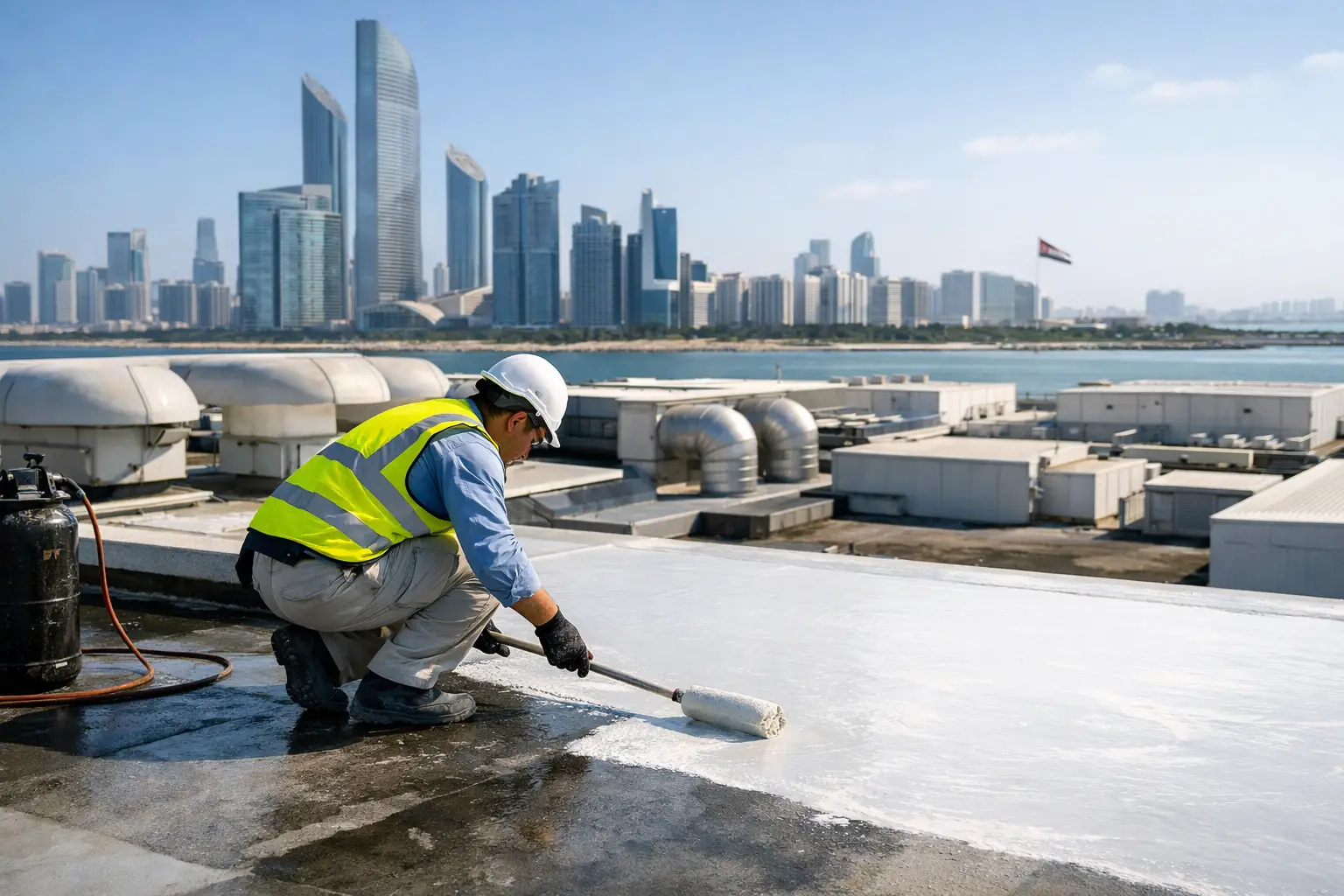
For concrete roofs, the specification may require liquid-applied waterproofing, membrane systems, injection work for cracks, protective screed, or a combination of these. The decision depends on whether the slab is exposed, tiled, buried under finishes, or carrying equipment. If thermal insulation, surface falls, or expansion movement are part of the problem, they need to be addressed in the same scope.
The trade-off is straightforward. A low-cost coating can reduce immediate leakage on a limited budget, but it may not solve underlying defects. A full rehabilitation scope costs more upfront, yet it usually gives better durability, lower disruption, and fewer repeat callouts. For industrial clients, the right answer often depends on downtime risk, warranty expectations, and how critical the building is to operations.
Inspection comes before repair
No reliable waterproofing project starts with a price per square foot and a product name. It starts with inspection. That means checking the roof condition, tracing water entry points, reviewing previous repairs, measuring affected areas, and identifying substrate weakness before any recommendation is issued.
A useful inspection does more than confirm there is a leak. It separates symptoms from causes. Water can travel a long distance before it appears inside the building. A stain over one bay may actually be linked to a failed joint several meters away, or to overflowing drainage at the perimeter. Without that mapping, repair crews end up chasing the wrong area.
For industrial buildings, the inspection should also assess access systems, edge safety, equipment locations, and any fabrication requirements. If replacement flashings, gutters, covers, or support steel are needed, that should be captured early so the repair can move in one coordinated sequence instead of stopping midway.
Execution quality is what decides service life
Materials matter, but field execution decides whether the system performs. Surface preparation, rust treatment, cleaning, priming, adhesion control, overlap detailing, fastening, and weather timing all affect the final result. Shortcuts at any stage usually show up later as blisters, loss of bond, reopened joints, or repeated leakage around details.
This is especially true on industrial roofs where the surface may be dirty, corroded, uneven, or heavily repaired already. A contractor needs crews who understand how to work around existing damage without simply covering it up. In some cases, sections of roof sheet, insulation, purlins, or gutter line must be replaced before waterproofing can be considered complete.
After-sales response matters too. Buildings move. New penetrations get added. Drainage gets blocked. A contractor that can inspect, repair, fabricate, and maintain under one service structure gives the client better continuity than a one-time installer with no follow-up capability. That is one reason many facility teams prefer a specialized contractor like Promax Contracting for technically demanding roof and waterproofing works.
What commercial clients should expect from a proper scope
A professional waterproofing package should be clear about the treatment area, substrate repairs, detailing method, drainage corrections, material system, and execution sequence. It should also define what is excluded, because many failures happen when one trade assumes another trade has addressed a critical point.
For example, if roof leaks are connected to structural movement, severe corrosion, failed skylight framing, or internal condensation, those conditions need to be addressed as part of the planning discussion. Waterproofing is highly effective when it is matched to the actual defect. It performs poorly when it is expected to compensate for unresolved structural or mechanical issues.
Clients should also expect realistic advice on lifespan. Not every roof needs full replacement, but not every roof is a candidate for surface restoration either. A contractor who says every problem can be solved with one coating system is usually selling simplicity, not durability.
The cost of waiting is usually higher
Many owners delay waterproofing work because the leak appears minor or seasonal. In practice, delay increases scope. Water intrusion damages insulation, weakens finishes, spreads rust, and creates hidden deterioration inside cavities and connection points. The later the intervention, the more likely the project shifts from repair to rehabilitation.
For warehouses and factories, the indirect cost is often higher than the repair itself. Stock damage, disrupted production, slip risk, ceiling repairs, electrical exposure, and emergency maintenance all add up. A planned waterproofing program is almost always cheaper than repeated reactive work.
The better approach is to inspect early, repair before monsoon periods, and combine waterproofing with related roof maintenance such as gutter correction, fastener treatment, skylight sealing, and metal restoration. That reduces repeat mobilization and gives the building a more complete protective envelope.
If your facility is already showing signs of leakage, corrosion, or drainage failure, the right next step is not another temporary patch. It is a site-led assessment that identifies exactly where the system is failing and what repair method will hold under Abu Dhabi conditions.
Talk to Promax
Need this on your roof? Call +971 56 727 4205 or request a free inspection. Promax provides EPDM metal-roof, concrete and industrial waterproofing across Dubai and the UAE with up to a 15-year warranty.