A leaking warehouse roof in Abu Dhabi rarely stays a roof problem for long. It becomes damaged stock, unsafe walkways, stained insulation, rusted steel, repeated patchwork, and pressure from operations to fix it without shutting the site down. That is why choosing the right waterproofing company for industrial building in Abudhabi is less about price alone and more about diagnosis, system selection, and field execution.
Industrial buildings fail differently from villas or office towers. Large roof spans move under heat. Fasteners loosen. Gutter lines choke with sand and debris. Pipe penetrations crack at weak points. Skylight perimeters open up. Water travels far from the visible leak, which means the wet spot on the ceiling is often not the real source. A contractor who treats every complaint like a simple coating job usually leaves the actual failure in place.
What an industrial waterproofing company in Abu Dhabi should actually solve
In this market, waterproofing is tied to climate stress and operating risk. Roofs in warehouses, factories, sheds, and storage buildings face constant UV exposure, thermal movement, dust loading, intermittent heavy rain, and aging sheet joints. If the building also carries equipment supports, service penetrations, or old repair layers, the risk becomes more complex.
A capable contractor does not just apply material. The work starts with inspection of drainage behavior, membrane condition, lap failures, screw points, gutter integrity, metal corrosion, concrete cracks, flashing details, and transition areas where different materials meet. These are the places where water ingress usually starts.
For industrial sites, the scope often goes beyond roof surface treatment. If gutter replacement is overdue, if purlins show rust damage, if skylight edges are failing, or if pipe penetrations were never sealed correctly, those items must be addressed together. Waterproofing only the open roof area while ignoring those defects is not a full repair strategy.
Why industrial buildings in Abu Dhabi need a different approach
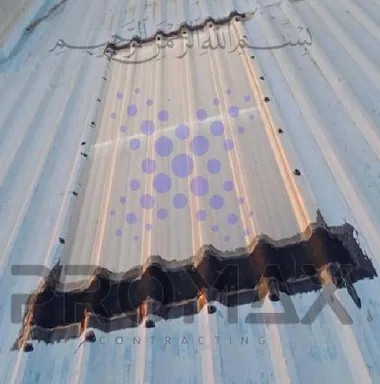
A warehouse in Abu Dhabi may look structurally sound from the ground while its roof assembly is already under stress. Heat expansion and contraction are constant. Sheet overlaps can open slightly over time. Old sealants harden and split. Water then enters during rain events and sits in concealed areas, accelerating corrosion around screws, base plates, and structural members.
Concrete roofs face a different pattern. Hairline cracking, ponding, edge failure, and poor previous repairs are common. Here, the issue is not just stopping water from entering one point. The contractor has to evaluate substrate condition, crack treatment, surface preparation, and membrane compatibility. A cheap top coat over contaminated or unstable concrete rarely lasts.
This is where the difference between a generic maintenance vendor and a specialist becomes clear. Industrial waterproofing requires system thinking. The roof, drainage, penetrations, joints, metal elements, and access points all affect final performance.
How to assess a waterproofing company for industrial building in Abudhabi
The first sign of a serious contractor is how they inspect. If the visit ends with a price before anyone checks drainage flow, roof slope, fastener lines, lap joints, flashings, and water travel paths, the process is too shallow. Industrial leakage needs proper tracing, not guesswork.
The second sign is whether they can handle related repair work in the same scope. Many leaks return because one vendor applies membrane, another handles sheet replacement, and a third deals with gutters later. Coordination gaps create failure points. A contractor with inspection capability, engineering support, fabrication access, and installation teams can close those gaps faster.
The third sign is material discipline. Not every roof needs the same treatment. EPDM-based systems can be highly effective where flexibility, weather resistance, and detail treatment are critical. In other cases, localized sheet replacement, screw treatment, joint sealing, gutter rehabilitation, or concrete crack treatment may need to happen first. Good contractors do not force one product onto every roof. They match the system to the building condition.
After-sales response also matters more than many procurement teams expect. Industrial sites do not always reveal every weakness in one weather event. A contractor that responds quickly after installation, checks repaired zones, and stands behind execution reduces risk long after the invoice is closed.
What a proper waterproofing scope usually includes
For most industrial buildings, the job begins with a site survey and failure mapping. The contractor should identify active and potential ingress points, not only the areas already leaking inside. That usually includes roof sheets or slabs, parapet details, flashing edges, expansion joints, skylights, gutters, downpipes, service penetrations, and connection points between old and new materials.
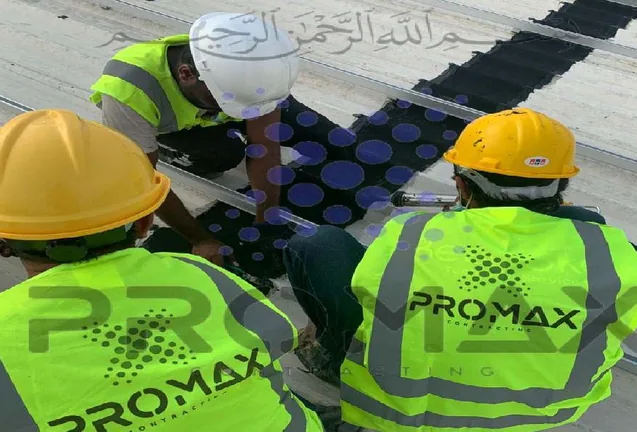
Surface preparation is where many projects are won or lost. Dust, rust, loose coatings, wet substrate, and unstable sealant residue all reduce adhesion and shorten system life. On metal roofs, screw treatment, rust removal, and sheet condition checks are often necessary before membrane work starts. On concrete roofs, crack routing, patch repair, and proper cleaning are essential.
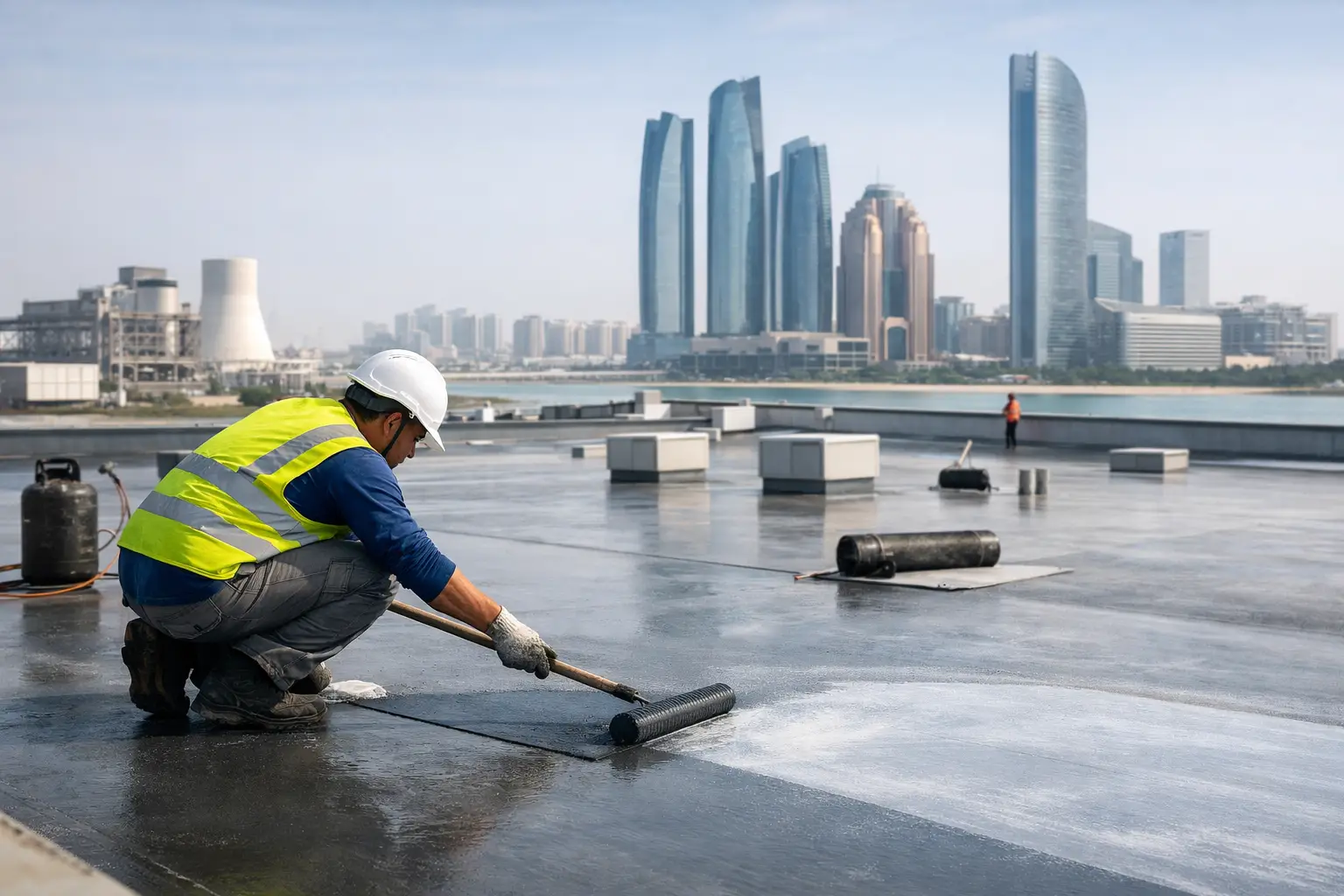
Then comes system installation. Depending on the roof type and condition, this may involve membrane application, EPDM detailing, lap treatment, flashing reinforcement, penetration sealing, or gutter line repair. The best result is not the one with the most material used. It is the one where weak details are corrected and water is directed off the building properly.
Final inspection should confirm coverage continuity, detail completion, drainage performance, and workmanship quality. On active industrial sites, this also needs to happen with minimal disruption to plant movement, storage operations, and access routes.
Common mistakes buyers make
The most expensive mistake is choosing based on lowest quote without comparing scope. One contractor may price only exposed roof coating, while another includes substrate preparation, fastener treatment, gutter correction, flashing repair, and penetration sealing. Those are not equal offers, even if both are called waterproofing.
Another mistake is delaying action until leaks become severe. By then, the repair may no longer be limited to waterproofing. Wet insulation, rusted steel, damaged internal finishes, or compromised electrical areas can expand the scope quickly.
A third mistake is accepting repeated patch repairs on an aging roof that clearly needs a broader rehabilitation plan. Spot fixes have value when the roof is generally sound. They are poor value when defects are spread across joints, screws, drainage lines, and aged details. In those cases, patching often becomes a rolling expense with no stable end point.
Why execution capacity matters as much as technical advice
Many industrial clients have already heard the right diagnosis from previous vendors. The issue was not knowing the problem. The issue was whether the contractor could mobilize, fabricate required components, coordinate access, and complete the work to a consistent standard.
That is why execution capacity matters. Industrial waterproofing often involves more than one trade condition at once - corroded sheet sections, failing gutters, open penetrations, damaged flashing details, and aging membrane zones. A contractor that can inspect, recommend, fabricate supporting metal components, and install the repair system under one operation removes delay and accountability gaps.
This is also where a company like Promax Contracting fits the market well. The value is not just in offering waterproofing. It is in handling roof rehabilitation as a practical field problem with inspection-led decisions, EPDM-based system knowledge, repair integration, and fast response when the building cannot wait.
The better question is not who is cheapest
For industrial owners and facility teams, the better question is this: who can identify the real failure, repair the full chain of defects, and keep the building protected after the job is done? In Abu Dhabi, where heat, rain exposure, and aging roof systems combine to stress large facilities, that question saves more money than any discount on the front end.
If you are reviewing contractors now, ask for a real inspection, a clearly defined scope, and a repair strategy that addresses the roof as a system. A dry building is not just easier to maintain. It protects stock, equipment, structure, and operating continuity, which is what the job was supposed to do in the first place.
Talk to Promax
Need this on your roof? Call +971 56 727 4205 or request a free inspection. Promax provides EPDM metal-roof, concrete and industrial waterproofing across Dubai and the UAE with up to a 15-year warranty.