A leaking roof in Abu Dhabi rarely stays a small issue for long. Once water enters through failed joints, cracked membranes, open screw points, damaged gutters, or unsealed penetrations, the problem spreads into insulation, steel, concrete, stock areas, and electrical zones. That is why working with a waterproofing expert Abu Dhabi facility teams can rely on is not just about stopping water - it is about protecting operations, structure, and maintenance budgets.
In industrial and commercial buildings, waterproofing failures are usually connected to more than one defect. A warehouse may have ponding water from poor drainage, fastener corrosion on metal sheets, weak flashing around skylights, and movement cracks at the slab edge. Treating only the visible leak point may give short-term relief, but it will not solve the system failure. The right contractor starts with inspection, traces the actual water path, checks related components, and recommends a repair scope that matches the roof type, usage pattern, and exposure level.
What a waterproofing expert Abu Dhabi clients need actually does
A proper waterproofing scope is technical field work, not guesswork. Roofs in the Gulf face severe UV exposure, thermal expansion, wind-driven rain, dust buildup, and standing water caused by blocked drains or incorrect slope. These conditions affect metal roofing, concrete decks, expansion joints, parapets, and service penetrations in different ways.
An experienced contractor reads the building envelope as a complete system. That means checking membrane condition, surface preparation requirements, flashing details, gutter capacity, rust development, joint movement, sealant failure, and the condition of supports below the visible surface. In many cases, water ingress is only the symptom. The root cause may be loose fixings, hidden corrosion, failed previous patchwork, or fabrication details that were never properly sealed.
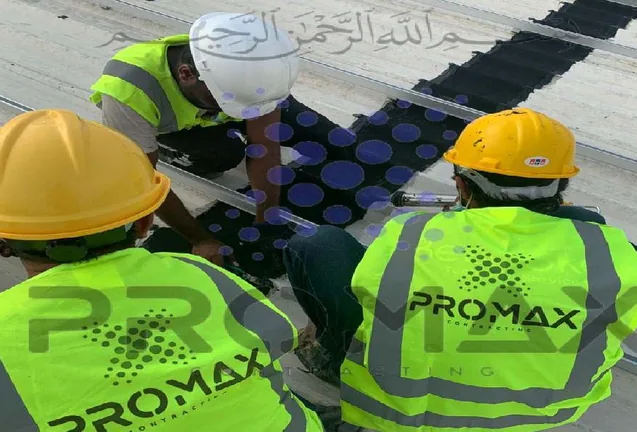
This matters even more on active facilities. Factories, sheds, storage buildings, and logistics units cannot afford repeated shutdowns for trial-and-error repairs. They need inspection-backed decisions, access planning, safe execution, and repair systems that can be installed with minimum disruption.
Why roof waterproofing fails in Abu Dhabi
The climate is hard on every exposed surface. Heat cycles expand and contract metal panels daily. Concrete roofs develop cracks over time. UV breaks down low-grade coatings. Dust blocks drainage points. Older roofs often carry layers of previous repairs that were applied without removing weak substrates.
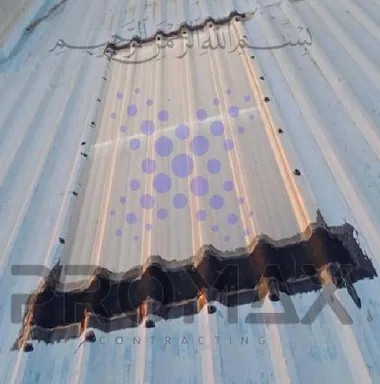
On metal roofs, the common failure points are screw holes, overlaps, ridge details, skylight perimeters, gutters, downpipe connections, and corroded sheet laps. On concrete roofs, the weak areas are usually hairline cracking, membrane debonding, parapet-wall junctions, expansion joints, and service penetrations. In both cases, poor workmanship during earlier maintenance usually makes the next leak harder to diagnose.
There is also the issue of water travel. The point where water appears inside the building may be far from where it entered. A ceiling drip below a beam line can originate at an upstream gutter overflow or an open joint near a roof curb. That is why visual patching alone often fails.
Inspection first, then the right repair system
A reliable waterproofing contractor does not start by selling one material for every problem. The repair method depends on roof construction, age, access conditions, substrate health, and expected service life.
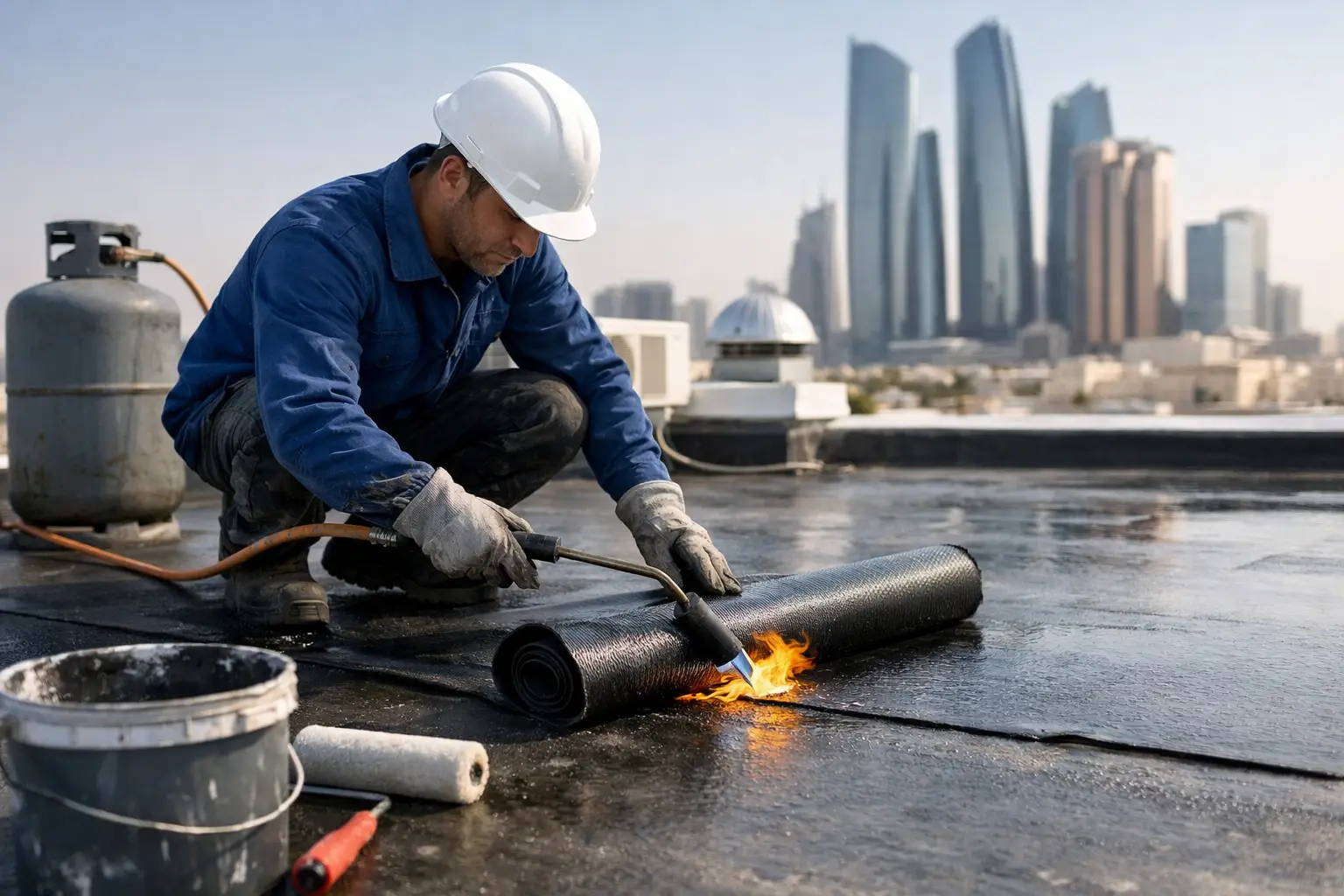
For some roofs, EPDM-based systems are the right choice because they perform well under movement and weather exposure when installed correctly. For others, the job may require localized membrane replacement, crack treatment, gutter relining, screw treatment, sheet replacement, sealant detailing, or metal restoration before any waterproof layer is applied. If corrosion has already affected purlins, clips, or supporting members, waterproofing alone is not enough. Structural and fabrication work must be included in the scope.
This is where technical judgment matters. A low-cost coating over a weak substrate may look acceptable at handover and fail within a short cycle. A more durable system usually begins with proper cleaning, rust treatment, substrate repair, fastening correction, and detail reinforcement. The upfront cost can be higher, but the life-cycle cost is usually lower because the building is not paying for repeated emergency repairs.
Systems should match the building, not the brochure
A warehouse roof with long metal spans needs a different treatment approach than a concrete service deck or a skylight-heavy industrial unit. Facilities with sensitive inventory may need phased work and temporary weather protection. Buildings with live operations below may need work sequencing around loading hours, production lines, or access restrictions.
A contractor with fabrication support and field repair capability can solve these conditions faster because the work is not limited to off-the-shelf patch materials. Custom flashings, gutter sections, cover plates, supports, and edge details can be prepared to suit site conditions instead of forcing the building to fit a generic repair kit.
What facility managers should expect from a waterproofing contractor
Commercial buyers are not just purchasing a membrane. They are purchasing diagnosis, execution, and accountability. A qualified contractor should inspect thoroughly, document defect areas, explain likely failure points, and define the scope in practical terms.
That scope should address the roof as an operating asset. If drainage is poor, the repair should include drainage correction where possible. If sheet corrosion is active, treatment or replacement should be included before waterproofing. If penetrations are poorly sealed, those details should be rebuilt, not simply coated over. If access for future maintenance is unsafe, that should be identified as part of responsible delivery.
Responsiveness also matters. Leaks tend to escalate during weather events, and delays increase damage to insulation, finishes, stock, and electrical infrastructure. A contractor serving industrial clients should be organized for site visits, emergency attendance, material planning, and after-sales follow-up.
Signs you need a waterproofing expert Abu Dhabi teams can trust
Some failure signs are obvious, such as interior drips, wet ceiling panels, mold odor, and ponding water on the roof. Others are easier to miss until damage becomes expensive. Rust around fasteners, staining on wall lines, bubbling coatings, damp insulation, cracked sealants, gutter overflow marks, and repeated leak complaints in the same zone all point to wider waterproofing failure.
For industrial property owners, recurring repair calls are often the clearest warning. If the same area has been patched more than once, the original diagnosis was probably incomplete. That usually means the source was misidentified, the substrate was not repaired correctly, or the chosen material was not suitable for the roof condition.
At that stage, bringing in a waterproofing expert Abu Dhabi operators can depend on is the practical move. The goal is to stop spending on temporary fixes and shift to a repair strategy with measurable service life.
The cost question: repair now or wait?
Waiting can look cheaper on paper, especially if the leak appears minor. In reality, delay usually increases scope. Water damages insulation, accelerates corrosion, weakens internal finishes, and creates safety risks around electrical systems and work areas. It can also interrupt tenancy, stock handling, and production.
Not every roof needs full replacement. In many cases, targeted rehabilitation is enough if the substrate is still serviceable. But that decision should come after inspection, not assumption. The trade-off is straightforward: a properly scoped repair costs more than a patch, and far less than the compounded damage caused by neglect.
Why execution quality matters more than product claims
Many waterproofing products sound similar in a quotation. What separates a durable job from a failed one is preparation, detail treatment, and installation discipline. Surface contamination, moisture trapped below coatings, loose fasteners, untreated rust, poor overlap work, and rushed curing all reduce performance.
This is why experienced site teams matter. They know how to sequence cleaning, treatment, repair, membrane application, reinforcement, and finishing around real roof conditions. They also know when not to apply a system - for example, when underlying metal is too deteriorated, when concrete is unsound, or when drainage defects will keep stressing the repaired zone.
Promax Contracting works in this execution-heavy space where waterproofing is tied to roof rehabilitation, fabrication, corrosion control, and long-term serviceability. For clients managing warehouses, factories, and large-use buildings, that integrated approach is usually more effective than splitting responsibility between multiple vendors.
If your building is showing early signs of leakage, corrosion, or drainage failure, the right next step is not another surface patch. It is a proper site inspection, a clear technical scope, and repair work that treats the roof like an asset that still has years of service to protect.
Talk to Promax
Need this on your roof? Call +971 56 727 4205 or request a free inspection. Promax provides EPDM metal-roof, concrete and industrial waterproofing across Dubai and the UAE with up to a 15-year warranty.