A leaking roof in Abu Dhabi rarely stays a small maintenance issue for long. On warehouses, factories, storage units, and commercial buildings, water entry usually points to a wider failure - damaged laps, open joints, cracked concrete, failed flashing, blocked drainage, loose fasteners, corroded sheets, or badly sealed penetrations. That is why facility teams looking for waterproofing experts Abudhabi should not be looking for a quick patch. They should be looking for a contractor that can inspect the full roof system, identify the real entry points, and execute repairs that hold under heat, dust, movement, and drainage load.
What waterproofing experts Abudhabi should actually do
A capable waterproofing contractor does more than apply a coating and leave. On industrial and commercial buildings, leak repair starts with diagnosis. Water may appear under a skylight but travel from a fastener line twenty feet away. Staining on an internal wall may be caused by parapet cracks, coping failure, or an overflow issue on the roof. If the contractor does not inspect systematically, the repair scope will be wrong from the start.
This is where experienced waterproofing teams separate themselves. They inspect roof sheets, concrete surfaces, valleys, box gutters, downpipes, expansion joints, membrane laps, upstands, wall junctions, HVAC penetrations, pipe sleeves, and previous patchwork. They also look at corrosion, substrate condition, and movement stress because a membrane cannot perform properly over unstable or deteriorated surfaces.
For commercial property managers, this matters because repeat leakage is expensive in ways that do not always appear on the first repair quotation. There is disruption to stored goods, electrical risk, false ceiling damage, insulation failure, corrosion spread, and unplanned shutdown of operations. Paying less for the first visit often means paying more for the second, third, and fourth one.
Why roof waterproofing fails in Abu Dhabi conditions
Abu Dhabi buildings operate under hard exposure. High surface temperatures, thermal movement, UV stress, occasional heavy rain, wind-driven dust, and standing water around poor drainage points all reduce the life of weak repair systems. A product that looks acceptable on day one may fail quickly if the substrate was not prepared properly or the system was not suited to the roof type.
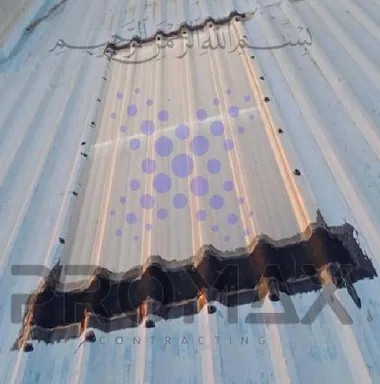
Metal roofs and concrete roofs fail differently, so they should not be treated the same way. Metal roofing often leaks around screw points, end laps, side laps, ridge flashing, gutter interfaces, skylights, and corroded sections. Concrete roofs typically fail through cracks, ponding areas, membrane breakdown, parapet joints, pipe penetrations, or old repair layers that have lost adhesion.
There is also the issue of layering bad work over older bad work. Many roofs have already been treated with mastics, generic sealants, incompatible coatings, or local patching that was never designed as a complete waterproofing system. Those roofs need careful preparation, and sometimes partial removal, before a reliable repair can start.
How experienced contractors approach inspection and scope
The first site visit should produce more than a verbal opinion. A serious contractor will review the roof layout, current condition, access constraints, leakage history, and likely root causes. In some cases, active leak tracing is possible. In others, the contractor must read the failure pattern based on laps, corrosion lines, drainage marks, and surface cracking.
A proper scope usually depends on what the inspection reveals. If the issue is isolated, localized treatment may be enough. If the roof shows widespread fastener failure, membrane fatigue, corroded sheets, damaged gutters, or repeated leakage at several interfaces, partial rehabilitation or a full waterproofing system may be the better decision. This is where engineering judgment matters. Over-specifying wastes budget. Under-specifying guarantees callbacks.
The best waterproofing experts Abudhabi will also explain the trade-off between short-term emergency stopping and long-term correction. Sometimes a facility needs immediate leak arrest before a full shutdown window becomes available. That is reasonable, but the temporary measure should be identified as temporary. Too many buildings remain on emergency patches for years, and the underlying deterioration keeps advancing.
Systems that make sense for industrial and commercial roofs
There is no single waterproofing method that suits every building. The right system depends on substrate type, exposure, movement, existing damage, and required service life. For metal roofs, treatment may include fastener replacement, lap sealing, rust treatment, sheet repair, flashing correction, gutter rehabilitation, and membrane application using systems designed for movement and weathering.
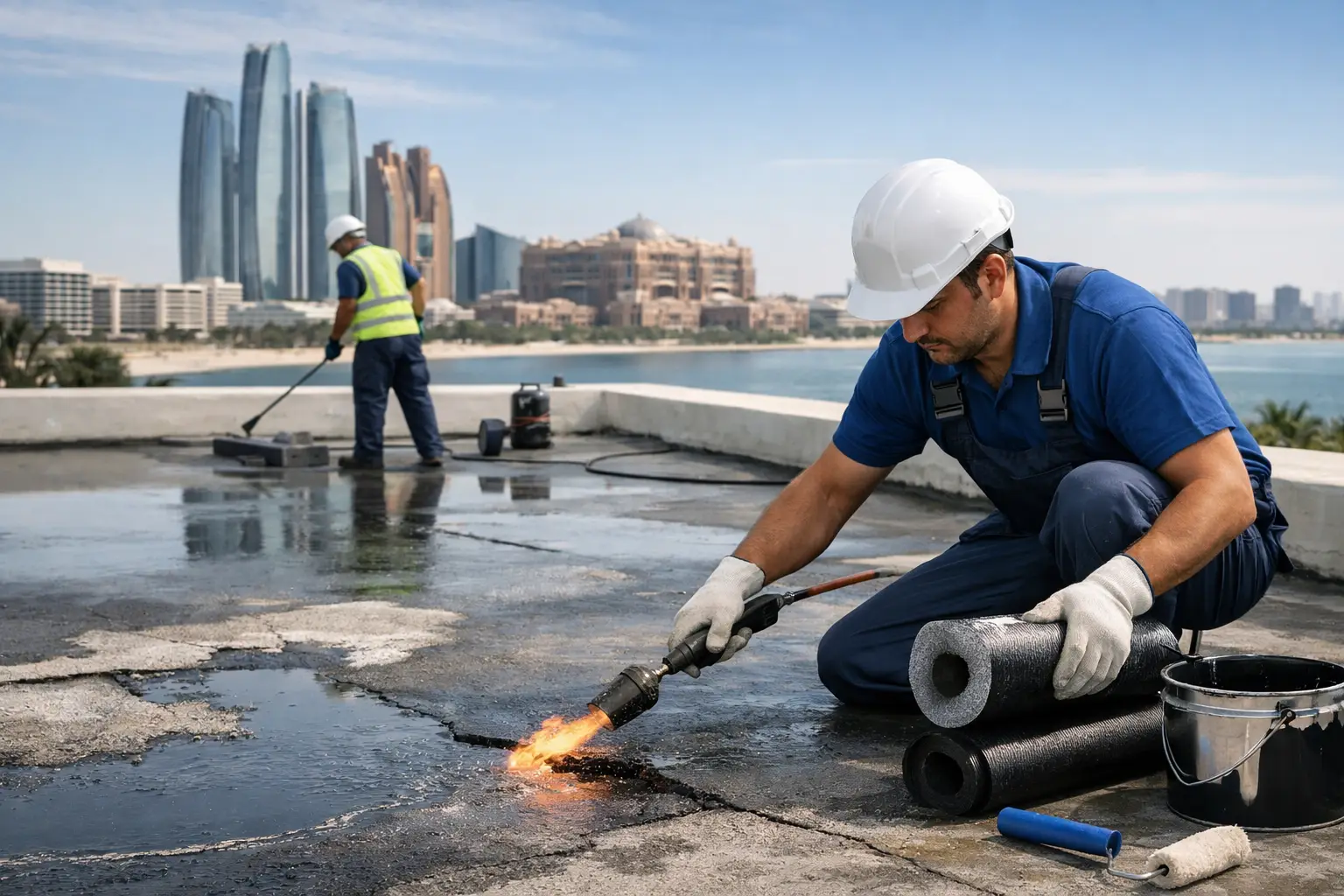
For concrete roofs, the solution may involve crack treatment, surface repair, slope correction in limited zones, membrane installation, upturn detailing, and careful sealing around penetrations and parapet junctions. EPDM-based systems are often selected where flexibility, weather resistance, and long-term joint performance are critical. They are especially useful where detailing quality matters as much as field coverage.
Drainage must be part of the conversation. A well-installed membrane will still struggle if water is allowed to sit around blocked outlets, undersized gutters, back-fall areas, or damaged downpipes. Good contractors address the roof as a working system, not just a surface to coat.
What facility managers should ask before awarding the work
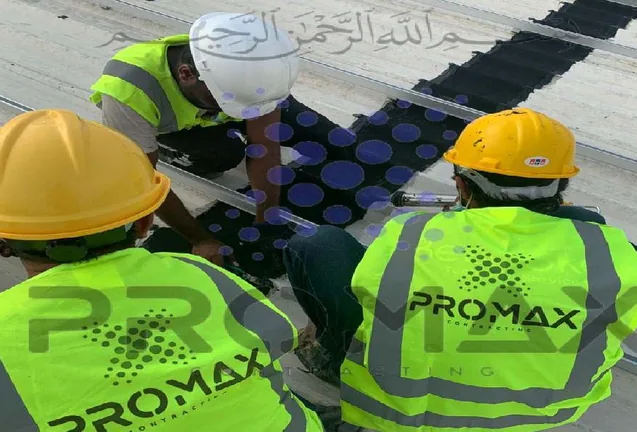
If the building is operational, the contractor should be able to explain access planning, safety controls, work sequencing, and how disruption will be limited. On warehouses and industrial units, roof work often has to be coordinated around active operations, stored inventory, equipment sensitivity, and weather windows.
Ask how the failure will be traced, how the substrate will be prepared, and what happens if hidden deterioration is found after opening the area. Ask whether fabrication support is available for flashings, gutter sections, capping, or sheet replacement. Ask who handles after-sales response if leakage reappears in an adjacent area. These are practical questions, and the answers tell you whether the team is built for execution or just for quoting.
Documentation also matters. Commercial clients usually need clear scope definition, material details, work method awareness, and realistic timelines. If the contractor cannot explain how edge details, penetrations, drainage points, and transitions will be handled, that is a warning sign. Most waterproofing failures happen at details, not on open field areas.
Why one-stop execution matters on complex leak projects
Many leak issues involve more than waterproofing alone. A roof may need localized steel support checks, purlin replacement, sheet changeouts, gutter fabrication, skylight sealing, pipe penetration correction, and rust treatment before the waterproofing system can perform properly. Splitting these activities across multiple vendors often creates delays, scope gaps, and finger-pointing when leaks continue.
A contractor with inspection, repair, fabrication, installation, and maintenance capability under one operation usually delivers better control. The diagnosis is clearer, the detailing is more consistent, and response time is faster when site conditions change. For building owners, that means fewer coordination problems and less operational risk.
This is also why experienced service-led contractors tend to perform better on older buildings. Aging facilities rarely present a clean textbook problem. They have previous repairs, mixed materials, movement damage, drainage defects, and access limitations. The contractor needs field judgment, not just product knowledge.
Choosing waterproofing experts Abudhabi for long-term value
The cheapest waterproofing proposal can be the most expensive option if it ignores root cause, omits preparation, or uses systems that are not designed for the roof condition. Long-term value comes from accurate inspection, correct specification, disciplined surface preparation, proper detailing, and responsive support after handover.
For facility managers and project teams, the real question is not whether a contractor can apply waterproofing material. Many can. The real question is whether they can stabilize the roof system, correct the failure points, and reduce the chance of recurring water ingress under actual site conditions. That takes technical execution, not sales language.
Promax Contracting works in this space because commercial and industrial buildings need practical answers fast - not trial-and-error repairs. The right contractor should be able to inspect, explain, fabricate, install, and stand behind the work with a responsive after-sales approach.
If your building already shows leakage, corrosion, blocked drainage, or repeated patch failures, waiting usually makes the scope larger. A good waterproofing decision starts with a serious inspection and ends with a system that matches the roof, the exposure, and the way the facility actually operates.
Talk to Promax
Need this on your roof? Call +971 56 727 4205 or request a free inspection. Promax provides EPDM metal-roof, concrete and industrial waterproofing across Dubai and the UAE with up to a 15-year warranty.