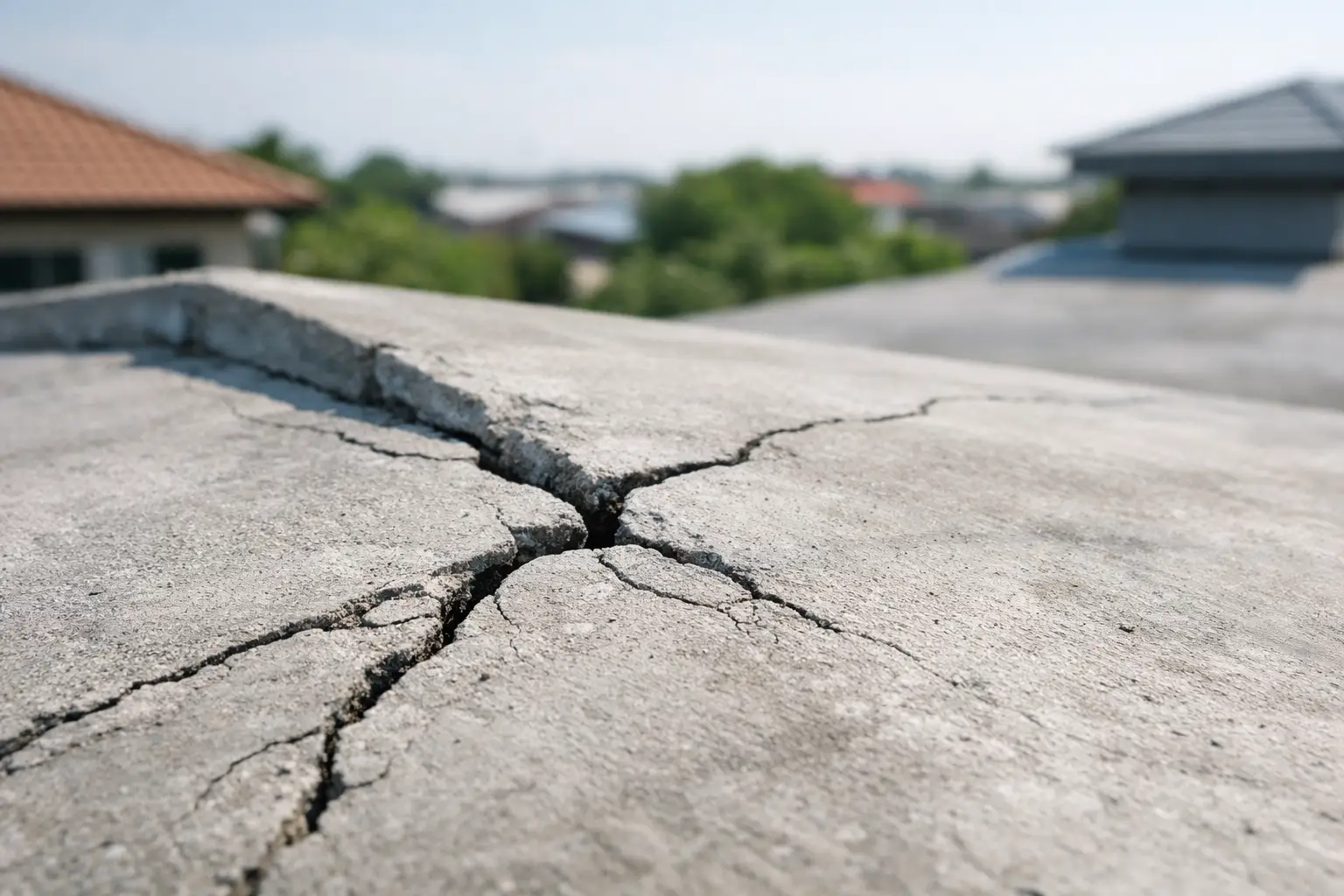
A concrete roof rarely cracks for just one reason. On most commercial and industrial buildings, the visible crack is the final symptom of stress that has been building for months or years through heat movement, shrinkage, water ingress, loading, poor detailing, or missed maintenance. If you are asking what causes concrete roof cracks, the right answer starts with site conditions, crack pattern, and whether the roof is also leaking.
For facility managers and project teams, that distinction matters. A thin surface crack may be cosmetic at first, while a moving crack above a beam line, around a pipe penetration, or near a drainage point can point to a much bigger waterproofing and durability problem. Treating all cracks the same usually leads to repeat leakage, recurring patch repairs, and more disruption later.
What causes concrete roof cracks in real buildings
Concrete is strong in compression, but it still moves, dries, expands, contracts, and reacts to its environment. Roof slabs are exposed more severely than many other structural elements because they take direct sun, rapid temperature change, standing water, service loads, and constant weathering. In hot climates, that exposure is even more aggressive.
One common cause is drying shrinkage. As concrete cures and loses moisture, it naturally contracts. If the slab is restrained by beams, walls, parapets, or embedded elements, that contraction can create tensile stress and cracking. This is especially likely when curing was inadequate, the water-cement ratio was too high, or the pour was not properly controlled.
Thermal movement is another major factor. Concrete roofs expand under daytime heat and contract when temperatures fall. Over time, repeated movement creates stress at weak points such as corners, construction joints, pipe sleeves, equipment bases, skylight upstands, and changes in slab thickness. If movement joints are missing, poorly located, or not properly sealed, cracks often appear where the slab is forced to absorb that movement on its own.
Structural loading also has to be considered. Roofs are frequently asked to carry more than their original design intent. Water tanks, solar systems, mechanical units, cable trays, maintenance traffic, or unauthorized additions can increase load concentration. Even when the slab is not at immediate risk, localized deflection can create cracking that later becomes a water entry path.
Poor waterproofing does not always start the crack, but it often makes it worse
A concrete roof can crack first and leak later, or leak first and deteriorate until cracking becomes more severe. In both cases, waterproofing failure accelerates the damage.
When water enters through hairline cracks, failed membrane laps, open joints, or damaged terminations, it begins to affect the slab from inside. Moisture can reach reinforcement, leading to corrosion. As steel corrodes, it expands, and that expansion creates internal pressure within the concrete. The result is wider cracks, delamination, and eventually spalling.
This is why a crack map alone is not enough. On active buildings, the inspection has to consider membrane condition, slope, ponding areas, drainage performance, sealant failure, and all roof penetrations. The crack may be visible in one location while the moisture source is spreading from another.
Shrinkage, movement, and settlement are not the same thing
It is easy to group every roof crack under general wear and tear, but the repair method depends on the actual mechanism.
Shrinkage cracks are usually finer and more random. They often show up after construction or resurfacing and may remain stable if properly treated and protected.
Movement cracks tend to follow stress lines. You may see them near parapet intersections, re-entrant corners, around openings, or at transitions between old and new construction. These cracks are more likely to reopen after a basic filler repair if the movement itself is still active.
Settlement-related cracks are more serious because they can indicate support movement, differential deflection, or structural distress in the wider building. If one area of the roof slab or supporting frame moves differently from another, the crack pattern is usually more pronounced and less random. In these cases, surface treatment alone is not a dependable solution.
What causes concrete roof cracks around drains, penetrations, and edges
Some roof areas fail earlier because they concentrate stress and moisture. Drains are a good example. If the roof does not fall correctly toward the outlet, water ponds around the drain bowl. Constant wetting, thermal cycling, and local shrinkage can create cracking around that point. Once the crack forms, drainage water uses it repeatedly.
Pipe penetrations create a similar problem. The concrete and the pipe or sleeve do not move at the same rate, especially on roofs exposed to strong solar gain. If the penetration was not detailed with proper sealing and movement allowance, a circular or radial crack pattern often develops nearby.
Roof edges and parapets are also vulnerable. They heat up quickly, cool quickly, and are often the first areas to show failure in old waterproofing systems. If edge terminations are loose or parapet coping details allow water to travel inward, cracks at the slab edge can become part of a larger leakage path.
Construction quality still plays a major role
Many concrete roof cracks can be traced back to original construction practices. Weak mix control, poor compaction, inadequate reinforcement placement, rushed finishing, and improper curing all reduce the slab's long-term performance. Even a technically sound design can underperform if execution on site was inconsistent.
Cold joints are another recurring issue. When concrete is poured in stages without proper joint preparation, the bond line can become a weakness. Under movement and moisture exposure, that line may open into a visible crack.
In rehabilitation projects, new toppings or repair mortars can also crack if they are incompatible with the existing substrate or installed over contaminated, damp, or unstable concrete. Repair materials need to match service conditions, movement expectations, and waterproofing strategy. Otherwise, the roof looks repaired but fails again under the same stresses.
How to tell whether the crack is minor or urgent
The first question is not simply how wide the crack is. It is whether the crack is active, leaking, or connected to deeper deterioration.
Hairline surface cracking without moisture staining may be manageable if the slab is sound and the waterproofing system is upgraded properly. But urgency increases when you see recurring leaks after patch repairs, rust staining, hollow-sounding concrete, spalled areas, damp ceilings below, cracks that widen over time, or repeated failure around joints and penetrations.
Pattern matters too. Random fine cracking across a finish coat is different from a long continuous crack following a structural line. A crack that telegraphs through previous repair layers is another warning sign. That usually means the movement source was never addressed.
What causes concrete roof cracks to return after repair
Repeat cracking usually points to one of three problems: wrong diagnosis, wrong material, or incomplete scope.
If the contractor treats a moving joint as a static crack, the repair may fail quickly. If a rigid patch is applied where thermal movement is high, it will often debond or split. If the roof is repaired locally but ponding water, failed sealants, corroded reinforcement, or membrane breakdown are left in place, the same area can reopen within one season.
This is why effective concrete roof repair is rarely just crack filling. On commercial roofs, durable correction often means combining substrate repair with waterproofing treatment, joint detailing, sealant renewal, drainage correction, and protection at vulnerable penetrations. In more advanced cases, it may require structural review before waterproofing starts.
The right response starts with inspection, not assumptions
When evaluating what causes concrete roof cracks, a proper site inspection should document crack width, depth, direction, location, moisture activity, surrounding detail condition, and any signs of reinforcement corrosion or slab movement. It should also review the roof's drainage layout, existing waterproofing system, service load history, and previous repair records.
That field-first approach is especially important on warehouses, factories, and large roof spans where leaks can travel far from the visible crack and where downtime has real cost. A practical contractor will not promise a long-life repair without checking whether the roof needs localized treatment, full membrane rehabilitation, joint correction, or concrete restoration in combination.
Promax Contracting typically approaches these issues from the roof system outward, not just the crack inward. That means identifying how concrete condition, drainage, penetrations, terminations, and waterproofing performance interact before recommending a fix.
If your roof has started showing cracks, the safest move is to assess them before the next rain event or heat cycle makes them wider, wetter, and more expensive to correct. Early repair is not just about appearance. It is about protecting reinforcement, preventing interior damage, and keeping the roof serviceable without turning a manageable defect into a major rehabilitation job.
A concrete roof usually gives warning signs before it gives up - the value is in reading those signs correctly and acting while the repair scope is still under control.
Talk to Promax
Need this on your roof? Call +971 56 727 4205 or request a free inspection. Promax provides EPDM metal-roof, concrete and industrial waterproofing across Dubai and the UAE with up to a 15-year warranty.