A metal roof can look structurally sound from ground level and still be letting water into insulation, purlins, wall lines, and production areas. That is usually why facility teams ask, why do metal roofs leak when the panels themselves still appear intact. In most industrial and commercial cases, the leak is not caused by the metal sheet alone. It starts at a joint, a penetration, a fastener line, a failed sealant detail, or a drainage condition that was allowed to keep working the system until water found a path inside.
For warehouses, factories, storage facilities, and service buildings, that distinction matters. If the real failure point is not identified correctly, patchwork repairs keep getting repeated while corrosion spreads, insulation gets saturated, and operational risk increases. A leak over stock, machinery, electrical routes, or tenant space is not just a roof issue. It becomes a maintenance, safety, and cost-control issue very quickly.
Why do metal roofs leak even when the panels look fine?
Metal roofing systems are built from many connected components, not one continuous waterproof layer. The panels shed water, but the actual performance of the roof depends on laps, clips, screws, sealants, flashings, gutters, ridge details, curbs, skylights, and movement allowances. When one of those details starts failing, water can enter long before the panel surface shows obvious damage.
This is especially common on older industrial roofs where previous repairs were carried out in sections over several years. One area may have been resealed, another patched with incompatible materials, and another left exposed after mechanical work. The roof then stops behaving like a coordinated system. It becomes a collection of vulnerable points.
In hot climates, thermal expansion makes this worse. Metal moves every day. As panels heat up and cool down, the roof assembly expands and contracts. If the original detailing did not account for movement, or if aging components have become brittle, the repeated stress opens small pathways for water ingress.
The most common reasons metal roofs start leaking
Failed fasteners and enlarged screw holes
Exposed-fastener metal roofs often leak around screws before they leak through the panel field. Over time, screws can back out, washers can crack, and the metal around the fixing point can elongate. Once that happens, rainwater can track along the shank or enter through the widened hole.
This issue is common in roofs exposed to vibration, wind uplift, poor installation torque, or long-term heat cycling. Replacing a few visible screws may not solve the problem if the substrate below has weakened or if the whole fastening pattern is nearing failure.
Open laps and failed seams
End laps and side laps are frequent leak locations on long-run roofs. If the lap sealant has dried out, if overlap dimensions were poor from the start, or if movement has stressed the joint, water can be drawn inside. Under wind-driven rain, even small openings become active leak points.
Standing seam systems generally perform better than basic screw-down roofs, but they are not leak-proof by default. If seam details have been damaged, mechanically opened, or interrupted by poor repair work, leaks can still occur.
Poor flashing at penetrations
Pipes, ducts, cable trays, vents, curb upstands, and equipment supports are some of the most failure-prone areas on any metal roof. The panel profile makes penetration sealing more complex than many owners expect. If a penetration flashing was site-fitted poorly, sealed with short-life mastics, or installed without proper reinforcement, it usually fails before the main roof area does.
This is one of the biggest reasons recurring leaks continue after rain. Water may enter at a high point around a service penetration and travel along the underside of the sheet before dripping far away from the actual source.
Rust and corrosion at vulnerable details
Metal roofs do not have to be fully rusted through to start leaking. Corrosion often begins at cut edges, laps, gutter interfaces, fixing points, ponding areas, or locations where dissimilar materials were brought into contact. Once protective coatings break down, localized corrosion can undermine fixings and joints and create pinholes or splits.
In industrial environments, airborne contaminants, standing moisture, and neglected maintenance accelerate that process. The earlier corrosion is treated, the more realistic rehabilitation becomes. Once the metal substrate is badly reduced, waterproofing alone is no longer enough.
Drainage failure and water backup
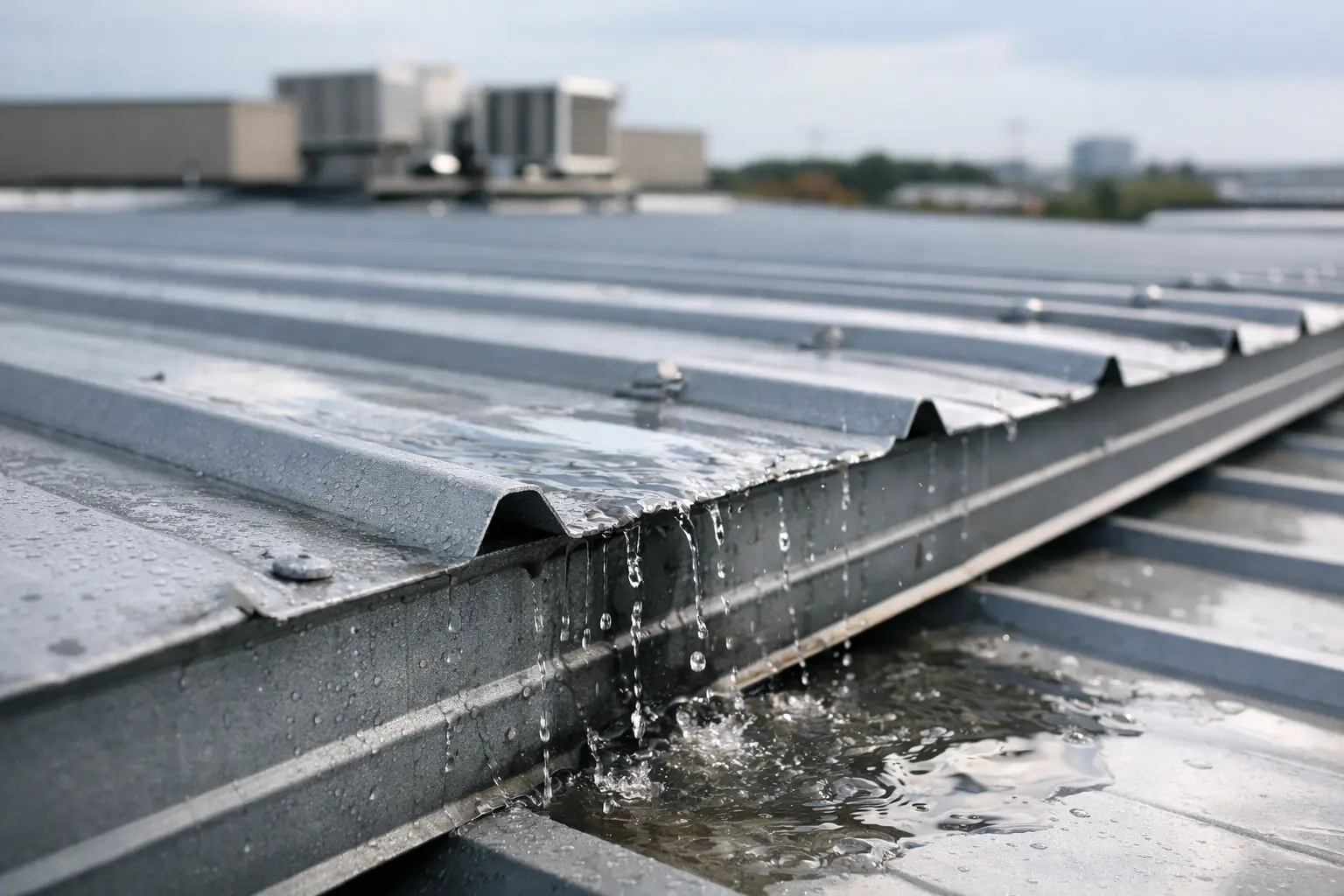
A metal roof is designed to shed water, not hold it. If gutters are undersized, downpipes are blocked, internal drains are overwhelmed, or roof slopes have settled, water can back up into laps and details that were never intended to remain submerged. In that condition, even a decent roof can leak.
This is where diagnosis matters. Some leaks are blamed on panel failure when the real issue is poor drainage capacity or long-term blockage. If the roof edge, valley, or gutter line is not draining freely, the leak will keep returning regardless of how much sealant is applied upstream.
Why temporary patching usually fails
Many leaking metal roofs have already been repaired two or three times before a proper inspection is requested. The common pattern is familiar: visible crack, quick sealant application, one rainfall event without leakage, then failure returns from the same zone or nearby.
That happens because surface patching does not address root causes such as movement, loose fasteners, rusted substrate, failed lap geometry, or water migration beneath the panel line. Some mastics also lose adhesion on weathered metal, especially where dust, oxidation, and heat have affected the surface. A patch may hold for a short period, but under thermal movement and UV exposure it separates again.
On industrial roofs, random patching can also make future repair harder. Multiple incompatible materials create uneven surfaces, trap moisture, and interfere with proper membrane or coating adhesion later.
How to identify the real source of a metal roof leak
A leak investigation should not start and end with the stain inside the building. Water rarely enters directly above the visible drip point. It often travels through insulation layers, along purlins, under laps, or around structural members before appearing indoors.
A proper inspection looks at panel condition, fastener lines, sealant failure, penetration details, ridge and eave conditions, gutter performance, and signs of corrosion or movement. It should also review whether recent rooftop works introduced new penetrations or disturbed the original detailing.
For commercial and industrial facilities, this assessment needs to be practical, not theoretical. The goal is to determine whether the roof needs localized repair, joint rehabilitation, membrane reinforcement, sheet replacement, drainage correction, or a larger waterproofing strategy. Without that distinction, repair budgets get spent in the wrong place.
When repair is enough and when the roof needs rehabilitation
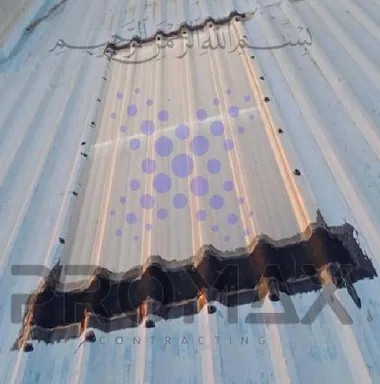
Not every leak means full roof replacement. If the metal panels remain structurally serviceable, many roofs can be restored effectively through targeted sheet replacement, fastener treatment, lap sealing, penetration waterproofing, rust treatment, and application of a compatible waterproofing system.
That said, it depends on the condition of the substrate and the spread of failure. If purlins are corroded, large sections of panel are deteriorated, or widespread movement has compromised detailing across the roof, sectional repairs may only delay a larger intervention. In those cases, a rehabilitation approach is more cost-effective than repeated emergency callouts.
This is where system selection matters. A commercial roof with recurring leakage around seams and penetrations may benefit from reinforced waterproofing using EPDM-based detailing and membrane treatment in critical zones. Another roof may require fabrication of new flashings, gutter replacement, pipe penetration sealing, and rust remediation before any waterproofing layer is applied. There is no single fix for every metal roof because the failure pattern is not the same on every building.
What building owners should do before the next rainy season
If your facility has already shown signs of metal roof leakage, waiting for the next storm is usually the most expensive option. Water ingress does not stay isolated. It affects insulation performance, internal finishes, stock, electrical reliability, and steel durability. Once corrosion and trapped moisture spread under the roof assembly, repair scope tends to increase.
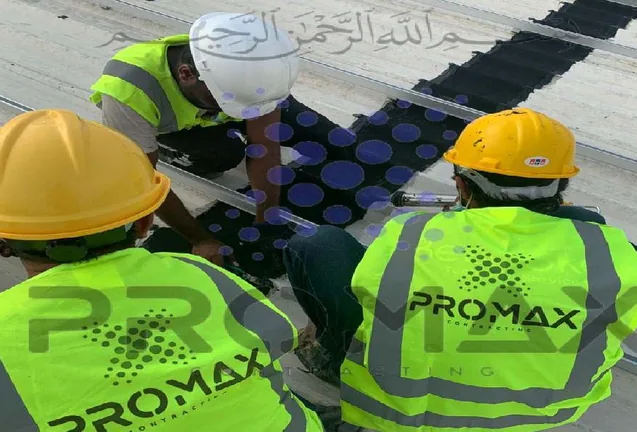
The right move is a technical site inspection focused on leak mapping, drainage behavior, fastener and lap condition, penetration detailing, and structural support areas. That gives you a realistic decision path instead of another reactive patch. For facility managers and industrial property teams, that is the difference between managing a roof and repeatedly chasing symptoms.
At Promax Contracting, most successful metal roof leak repairs start with that exact approach: inspect the system, identify the real water entry points, correct failed details, and install a durable waterproofing solution that matches the building’s operating conditions.
A metal roof does not usually fail all at once. It gives warnings through small leaks, rust lines, loose fixings, and drainage problems. Acting on those signs early is how you protect the building before a minor defect becomes a shutdown-level problem.
Talk to Promax
Need this on your roof? Call +971 56 727 4205 or request a free inspection. Promax provides EPDM metal-roof, concrete and industrial waterproofing across Dubai and the UAE with up to a 15-year warranty.