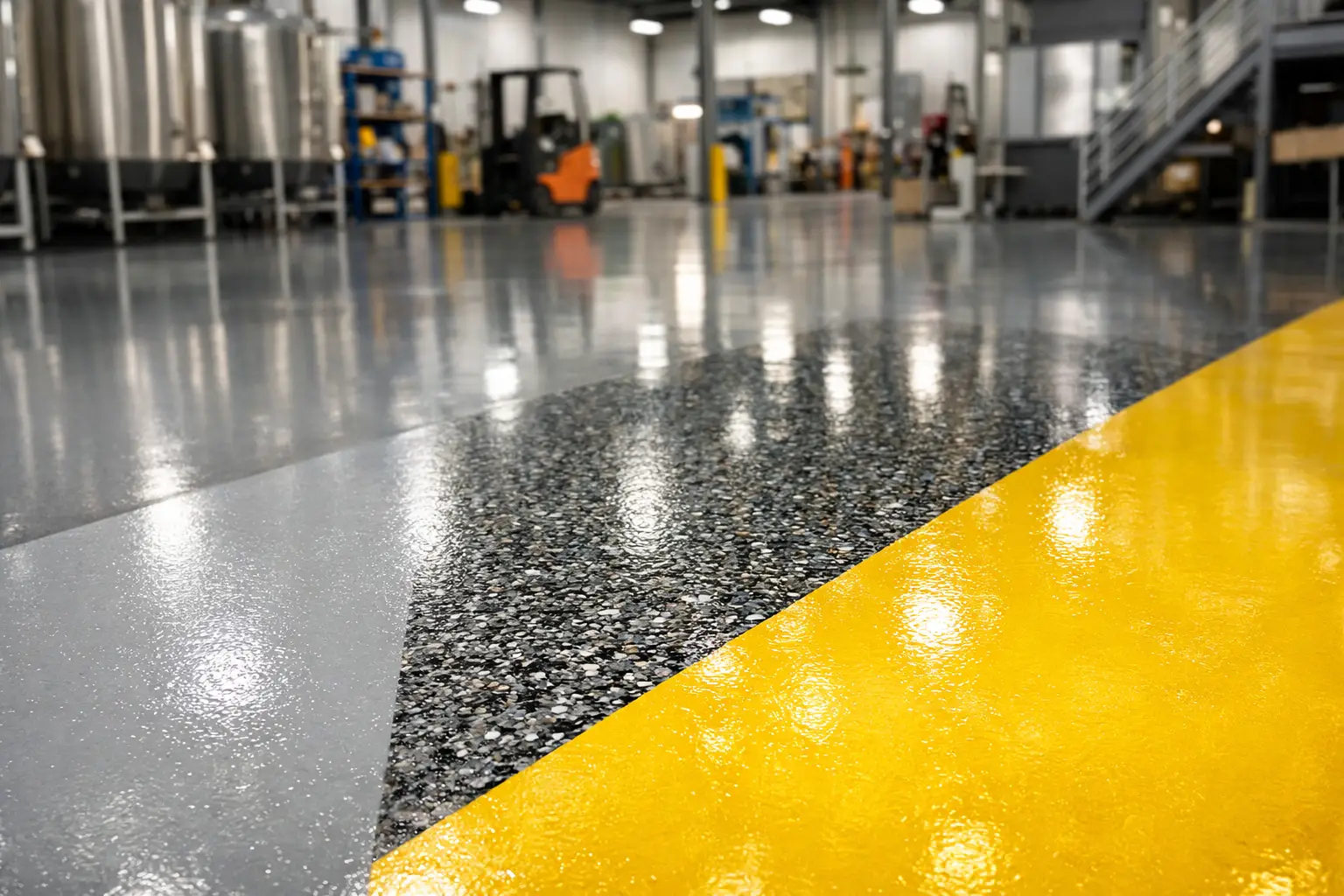
A failed floor coating usually does not fail quietly. It starts with tire marks that no longer clean off, then dusting, then peeling at joints, loading zones, and wash areas. For facility managers comparing the best industrial floor coating options, the real question is not which system looks good on day one. It is which system will hold under traffic, chemicals, heat, moisture, and shutdown constraints without creating another maintenance problem six months later.
Industrial floors take punishment from forklifts, pallet jacks, dropped tools, oil, water, cleaning agents, and thermal movement in the slab. That means floor coating selection should be treated like any other building protection decision. The substrate condition, operating environment, and installation method matter as much as the coating chemistry itself. A good specification starts with site inspection, moisture evaluation, surface preparation planning, and a clear understanding of how the space actually operates.
How to choose the best industrial floor coating options
There is no single coating that suits every warehouse, factory, workshop, or service corridor. The best system depends on three practical factors: exposure, traffic, and downtime.
If the floor sees chemical spills, the coating must resist attack without softening or staining. If the floor carries heavy wheeled traffic, compressive strength and abrasion resistance become more important. If the client cannot shut down operations for long, cure time becomes a deciding factor. This is where many coating failures begin - a good material is used in the wrong environment, or a technically correct system is rushed onto a poorly prepared slab.
Concrete condition is another major factor. New concrete can retain moisture. Old concrete may have contamination, laitance, cracks, or previous coating residue. Surface profiling, crack repair, and moisture mitigation are not optional extras. They are part of the floor system.
Epoxy coatings for general industrial use
Epoxy remains one of the most widely specified industrial flooring systems because it provides a strong balance of adhesion, chemical resistance, wear resistance, and cost control. In warehouses, production zones, utility rooms, and service areas, a properly installed epoxy system can provide a dense, easy-to-clean surface that improves both housekeeping and floor life.
This option works well where traffic is steady but not unusually aggressive, and where the client wants a practical finish with good thickness build. Epoxy can also be applied as self-leveling systems, high-build coatings, or mortar systems depending on the slab condition and performance target.
The trade-off is that epoxy is less forgiving under UV exposure and can amber over time in direct sunlight. It also has limits where thermal shock or significant substrate movement is expected. In food processing washdown zones, hot water areas, or outdoor service spaces, epoxy may not be the best long-term answer unless the system is specifically engineered for those conditions.
Polyurethane coatings where impact and flexibility matter
Polyurethane floor coatings are often chosen when the environment demands better flexibility, impact resistance, and UV stability than standard epoxy can provide. They perform well in facilities with temperature variation, mechanical stress, and occasional sunlight exposure.
For some industrial sites, polyurethane gives a better long-term result because it can tolerate substrate movement more effectively. It also tends to maintain appearance better in exposed areas. In service corridors, loading interfaces, and mixed-use industrial spaces, that matters.
The limitation is that not every polyurethane system is designed for severe chemical attack, and application conditions can be more sensitive. Product selection needs to match the exact environment. A thin polyurethane topcoat over the wrong base system will not solve a floor failure caused by moisture or weak concrete.
Polyaspartic coatings for fast turnaround projects
When shutdown windows are short, polyaspartic systems deserve serious consideration. Their main advantage is speed. In many commercial and industrial settings, they can be installed and returned to service much faster than traditional systems.
That makes them useful for active warehouses, retail back-of-house spaces, transport facilities, and maintenance zones where downtime is expensive. They also offer good abrasion resistance and UV stability, which can be useful in partially exposed areas.
The caution is that fast cure leaves less room for application error. Surface prep, mixing discipline, and crew experience matter even more. Inexperienced installation can lead to roller marks, poor bonding, or inconsistent finish. Polyaspartic is a strong operational solution, but it is not a shortcut around substrate preparation.
MMA systems for extreme speed and cold conditions
Methyl methacrylate, or MMA, is often selected when a floor must be returned to service in the shortest possible time or installed in lower-temperature conditions. This system can be highly effective in processing facilities, cold storage environments, and sites where shutdown planning is extremely tight.
MMA is known for rapid curing and good durability, but it comes with handling considerations. Odor during installation is a real issue, and application requires strict controls and experienced crews. For occupied buildings or enclosed operational facilities, coordination is essential.
This is not usually the first option for every warehouse or workshop, mainly because system cost and installation requirements can be higher. But in the right project, especially where time is the main constraint, it can outperform slower-curing alternatives.
Cementitious urethane for harsh industrial environments
If the facility deals with heat, washdowns, steam cleaning, aggressive chemicals, or repeated thermal cycling, cementitious urethane is often one of the best industrial floor coating options available. This system is widely used in heavy manufacturing, food and beverage plants, pharmaceutical facilities, and wet process areas for a reason.
It handles abuse that causes many conventional coatings to debond. It performs well under thermal shock and provides strong resistance to chemical and mechanical attack. For industrial operators who cannot afford recurring delamination in wet or high-temperature zones, this system is often worth the higher initial cost.
The trade-off is appearance and budget. Cementitious urethane is built for performance first. It is usually not selected for decorative finish expectations. Installation also requires solid technical control, especially at terminations, drains, coves, and repair interfaces.
Acrylic and thinner coating systems
Acrylic sealers and thinner film coatings have their place, but they should not be oversold. In light-duty areas, temporary protection applications, or low-budget maintenance programs, they can improve surface appearance and reduce dusting. However, they are generally not the right answer for heavy industrial traffic or demanding chemical environments.
If a facility runs forklifts, stores oils or solvents, or washes floors aggressively, thinner systems tend to wear faster and require more frequent recoating. That can make a cheaper system more expensive over time. For industrial decision-makers, lifecycle value matters more than material price alone.
Surface preparation decides the outcome
Most floor coating failures are preparation failures first and coating failures second. Shot blasting, grinding, crack routing, joint treatment, degreasing, moisture testing, and substrate repair should be planned before material selection is finalized.
This is especially important in Gulf-region facilities, where heat, humidity, cleaning regimes, and slab moisture can create difficult conditions. If the slab has rising moisture vapor or embedded contamination, even a premium coating can fail early. A contractor that only talks about product type without talking about profile, bond strength, and moisture is skipping the critical part of the job.
A proper system review should also consider edge details, drains, ramps, equipment plinths, and wall-to-floor junctions. Industrial floors do not fail only in open areas. They usually fail where detailing is weak.
Matching coating systems to facility type
Warehouses often do well with high-build epoxy or epoxy with a polyurethane topcoat, provided the slab is dry and traffic is predictable. Manufacturing spaces may require thicker self-leveling systems or cementitious urethane in process zones. Auto workshops and service bays often need stronger resistance to oil, tire traffic, and cleaning chemicals. Cold rooms, food plants, and wet production lines usually demand systems that can manage thermal movement and frequent washdowns.
This is why site-specific specification matters. The best coating on paper is not always the best coating for the operation. Promax Contracting approaches these decisions the same way it handles roof and waterproofing failures - by inspecting the actual condition, identifying the exposure points, and recommending a system that fits service conditions rather than a generic catalog answer.
Cost matters, but failure costs more
Buyers often compare floor coatings by installed square-foot rate, but that only tells part of the story. The better comparison is total interruption cost, maintenance frequency, patching risk, and expected service life.
A lower-cost epoxy may be perfectly suitable in a dry logistics area with controlled traffic. In a hot washdown zone, it may become a false economy if recoating and shutdown are required early. On the other hand, specifying a premium heavy-duty system in a low-exposure room may add cost without adding value. Good engineering is not about picking the most expensive option. It is about matching system performance to actual site demand.
The right floor coating should reduce cleaning time, improve safety, protect the concrete, and hold up under operational abuse. If it cannot do those four things reliably, it is not the right system, regardless of the brochure.
Before approving a flooring package, ask for a condition assessment, a preparation method, a realistic cure schedule, and a system recommendation tied to your traffic, chemicals, and maintenance routine. That conversation usually leads to a better floor than any product name ever will.
Talk to Promax
Need this on your roof? Call +971 56 727 4205 or request a free inspection. Promax provides EPDM metal-roof, concrete and industrial waterproofing across Dubai and the UAE with up to a 15-year warranty.