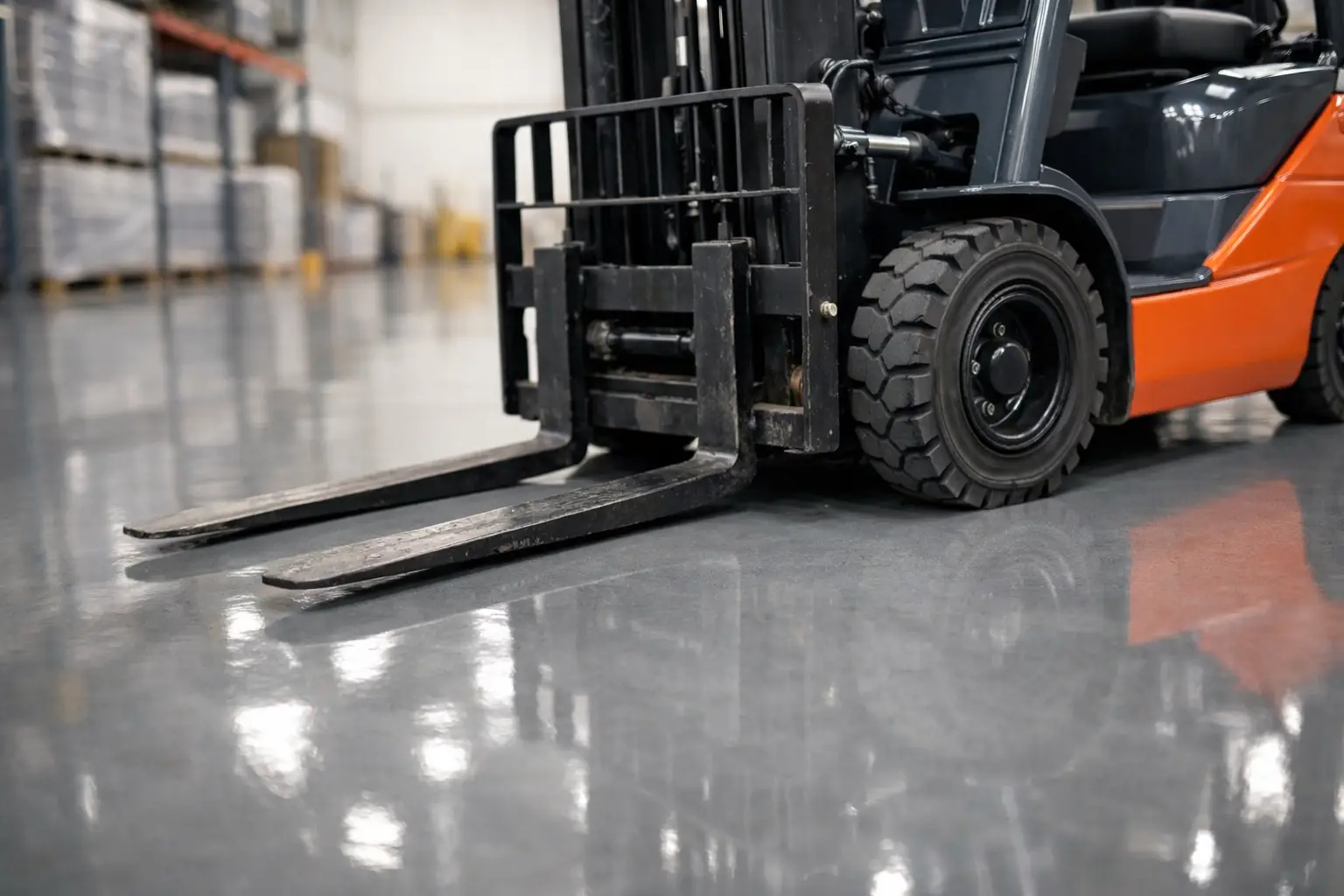
A warehouse floor usually fails long before the coating gets blamed for the real issue. Forklift traffic exposes every weakness in the concrete, surface prep, joint condition, and coating thickness. So if you are asking can epoxy flooring handle forklifts, the short answer is yes - but only when the floor system is engineered for the traffic, wheel type, load weight, and operating environment.
That distinction matters. A light-duty epoxy applied for appearance in a showroom is not the same as a heavy-build industrial flooring system installed over a sound slab in a working warehouse. Facility managers and project teams often hear "epoxy floor" as if it were one product. In practice, forklift performance depends on the full system, not the word epoxy alone.
Can epoxy flooring handle forklifts in real warehouses?
Yes, epoxy flooring can perform under forklift traffic in warehouses, production spaces, loading areas, and storage facilities. It is widely used in industrial buildings because it creates a dense, cleanable, chemical-resistant wearing surface that protects concrete from dusting, oil contamination, and surface abrasion.
But forklift traffic is one of the most demanding service conditions for any floor. The repetitive point loading from hard wheels, tight turning paths, pallet handling, and braking zones creates concentrated stress. That means the coating must do more than stick to the surface. It has to resist abrasion, impact, shear forces, and heat buildup at the tire contact area.
A properly specified epoxy system can do that. A thin decorative coating usually cannot.
What actually determines forklift performance
The first factor is the concrete slab itself. If the concrete is weak, cracked, moisture-affected, or already breaking down at the surface, the epoxy will not solve the underlying structural problem. Coatings follow the substrate. If the slab fails, the coating fails with it.
The second factor is surface preparation. Industrial epoxy needs mechanical preparation, typically by grinding or shot blasting, to create the right profile for adhesion. Poor prep is one of the fastest ways to get delamination under traffic, especially where forklifts pivot or brake.
The third factor is system thickness and formulation. Forklift areas usually need a heavier-duty build than pedestrian spaces. Depending on use, that may involve a high-build epoxy, epoxy screed, self-leveling system, or epoxy with a polyurethane topcoat for added wear resistance. The right build depends on how the facility operates, not just on square footage.
The fourth factor is traffic type. Not all forklifts create the same floor stress. Electric forklifts with cushion tires can be harder on coatings than some pneumatic tire units because the load is more concentrated. Reach trucks in narrow aisles create repeated wheel paths. Heavy loaded forklifts turning in staging zones can damage weak systems quickly.
Where epoxy works well under forklifts
Epoxy flooring performs well in warehouses with moderate to heavy traffic when the traffic pattern is predictable and the floor is installed to industrial standard. It is especially effective in distribution spaces, dry manufacturing zones, maintenance areas, and storage units where cleanliness, dust control, and chemical resistance are also priorities.
It also works well where operators want to improve line marking, reflectivity, and housekeeping. A sealed floor is easier to clean than untreated concrete, and that can reduce contamination in operational areas. For many facilities, that matters just as much as wear resistance.
If the environment includes oils, battery acid exposure, occasional chemical spill risk, or regular washing, epoxy systems can be built to address those conditions. That is where contractor-led system selection becomes critical. The floor has to match both mechanical traffic and chemical exposure.
Where epoxy can struggle
The problem is not that epoxy is weak. The problem is that some sites push beyond what a standard epoxy system should handle.
Very high-impact operations, aggressive steel-wheeled carts, constant turning in confined aisles, or badly damaged concrete may require a more specialized solution. Temperature also matters. In cold storage, hot process areas, or spaces with thermal shock, epoxy alone may not be the best answer.
Joint condition is another common failure point. Forklifts do not only stress the open floor field. They hammer slab joints and edges. If joints are broken, uneven, or moving excessively, coating damage is likely regardless of product quality. In these cases, joint repair and edge rebuilding should happen before any coating installation.
Common forklift-related epoxy floor failures
Most failures traced back to forklift traffic come from specification or installation mistakes, not from the idea of epoxy itself.
One common issue is tire marking and surface wear in high-turn zones. Another is peeling caused by weak preparation or moisture pressure from below the slab. Chipping at joints, gouging from impact, and worn-out top layers in pick lanes also show up when the system build is too light.
Hot tire pickup can happen in some settings, especially where tires generate heat and the coating has not fully cured or is not suited to the operating conditions. This is why downtime planning, cure schedule, and product chemistry matter. Rushing a return to service often creates expensive rework later.
How to specify epoxy flooring for forklift traffic
The right question is not simply can epoxy flooring handle forklifts. The better question is what epoxy flooring system can handle your forklifts.
That starts with a site inspection. A contractor should review slab condition, compressive strength, moisture behavior, existing coatings, traffic routes, axle loads, wheel types, and turning points. Areas such as receiving, dispatch, racking aisles, battery charging rooms, and dock approaches may need different treatments within the same facility.
For many industrial projects, a thin roll-on coating is not enough. Heavy-duty environments often need a thicker self-leveling epoxy or screed system with good compressive strength and abrasion resistance. In some cases, adding a urethane or polyurethane wear coat improves long-term performance, especially where tire movement and surface scuffing are severe.
Texture also needs attention. A highly glossy smooth floor may clean well, but if the site has dust, moisture, or ramp movement, slip resistance becomes part of the specification. The finish has to balance traction, cleanability, and forklift operation.
Slab repair comes before coating
No industrial floor system should be installed as a cosmetic layer over active floor defects. Cracks, spalls, weak surface laitance, moisture issues, and damaged joints all need treatment first. If the concrete is powdering or breaking under wheel load, the epoxy is not the first fix.
This is where experienced industrial contractors add value. Proper assessment can identify whether the project needs crack injection, patching, joint rebuilding, moisture mitigation, grinding, leveling, or full surface rehabilitation before coating begins. Skipping this stage may reduce the initial quote, but it usually increases lifecycle cost.
For operators trying to keep a warehouse live during repair, phased execution also matters. Working aisle by aisle or zone by zone can reduce disruption while still delivering a durable floor system.
Is epoxy the best choice for every forklift floor?
Not always. Epoxy is a strong solution for many forklift-operated facilities, but there are cases where another resin system or a hybrid build is more suitable. If the floor sees extreme thermal movement, very harsh washdown, or severe impact, a different chemistry may outperform standard epoxy.
That said, epoxy remains one of the most practical and cost-effective industrial flooring options when the slab is sound and the system is chosen correctly. It provides good mechanical strength, strong adhesion, easier cleaning, dust control, and a professional finish that supports warehouse operations.
For building owners and facility managers, the real decision is not whether epoxy is good in general. It is whether the contractor has correctly matched the flooring system to the operating load.
What facility teams should ask before approving the job
Before moving forward, ask for the expected forklift type and load assumptions, required slab repairs, proposed system thickness, cure time, joint treatment plan, and maintenance guidance. Ask which areas are highest risk and whether the contractor is designing for those zones or treating the whole building as if traffic is uniform.
A serious industrial flooring scope should be based on field conditions, not generic product language. That is especially true in active warehouses, factories, and service yards where downtime has a direct operational cost. Companies such as Promax Contracting typically approach these jobs through inspection, condition diagnosis, repair planning, and system execution rather than selling a one-size-fits-all coating.
If your forklifts are wearing out bare concrete, raising dust, or damaging weak coatings, the floor is already telling you what kind of specification it needs. The right epoxy system can carry that load - but only if the groundwork is done right.
Talk to Promax
Need this on your roof? Call +971 56 727 4205 or request a free inspection. Promax provides EPDM metal-roof, concrete and industrial waterproofing across Dubai and the UAE with up to a 15-year warranty.