A failed industrial floor rarely starts with a dramatic crack. More often, it starts with dusting at forklift lanes, staining near process areas, tire marks that stop cleaning crews from keeping up, or small coating breaks that turn into larger concrete damage. That is where the right industrial epoxy flooring contractor matters - not just for installing a coating, but for diagnosing substrate condition, traffic demand, chemical exposure, and shutdown constraints before work begins.
In industrial and commercial facilities, epoxy flooring is usually part of a wider maintenance strategy. It protects concrete, improves cleanability, supports safety markings, and helps control deterioration in warehouses, plants, workshops, service areas, and production spaces. But performance depends less on the brochure and more on surface preparation, moisture evaluation, detailing, and how the system is matched to the building's actual use.
What an industrial epoxy flooring contractor should actually handle
A qualified contractor does more than quote a square-foot rate and show color samples. In real operating environments, flooring work has to begin with inspection. The concrete may have latent moisture, oil contamination, weak laitance, previous coating failure, surface scaling, joint damage, or structural cracking. If those conditions are not addressed first, even a premium epoxy system can fail early.
This is why serious contractors start with site review, substrate testing, and practical specification. They look at wheel loads, point loads, washdown frequency, chemical contact, UV exposure, slip requirements, and how much downtime the facility can accept. In a warehouse, the focus may be abrasion resistance and traffic movement. In a maintenance bay, it may be oil resistance and impact. In a food-adjacent service zone, hygiene and easy cleaning may drive the system choice.
A dependable contractor also manages the edges of the job properly. That includes joints, floor-to-wall transitions, drains, ramps, equipment bases, and repaired sections where old and new surfaces meet. Floors usually fail first at transitions and details, not in the center of an open bay.
Choosing an industrial epoxy flooring contractor for the long term
If you are comparing contractors, the key question is not who can install epoxy. Many companies can apply resin. The better question is who can deliver a flooring system that fits your facility conditions and stays serviceable under pressure.
Look for a contractor that can explain preparation methods clearly. Grinding, shot blasting, crack routing, patch repair, joint rebuilding, and moisture mitigation should not be treated as optional add-ons if the floor needs them. They are often the main reason a system performs well.
You also want a contractor that speaks in system terms rather than generic product terms. A floor is not just epoxy. It is primer, body coat, aggregate if needed, topcoat, film thickness, curing schedule, and substrate profile. In some areas, epoxy is the correct answer. In others, a different resin or hybrid approach may be more suitable. That depends on temperature, exposure, and service demands.
For industrial clients, execution planning matters just as much as material selection. Can the work be phased aisle by aisle? Can critical access routes stay open? Will noisy preparation be scheduled around operations? Can the contractor coordinate with maintenance teams, rack installers, waterproofing crews, or civil repair teams if the floor issue is tied to broader building deterioration? Those questions separate basic applicators from experienced project contractors.
Why epoxy floors fail when the specification is wrong
Most coating failures are not random. They usually come back to one of four issues: weak substrate, poor preparation, trapped moisture, or a mismatch between the flooring system and site conditions.
Moisture is a common problem, especially in older slabs, ground-bearing concrete, washdown areas, or facilities with vapor drive. When moisture pressure is ignored, coatings can blister, debond, or peel. In heavy-use areas, inadequate surface profile or poor cleaning before application can cause similar failure. If oil has penetrated the slab, surface-level cleaning may not be enough.
Then there is the specification problem. A thin decorative coating might look acceptable on handover, but in a forklift corridor it may wear through quickly. A standard epoxy may perform well indoors but not where sunlight exposure is significant. A smooth finish may be easy to clean, yet too slippery for wet-process zones. Every flooring decision involves trade-offs.
That is why the right contractor does not oversell one universal system. Industrial flooring works best when the specification is honest about what the floor will face every day.
What to expect during a proper site inspection
A professional flooring assessment should be practical and technical at the same time. The contractor should review the age and condition of the slab, visible cracking, hollow or weak areas, prior repairs, contamination sources, drainage behavior, and traffic patterns. If the site has recurring roof leaks, pipe discharge, or wash water overflow, those conditions should be addressed too. Flooring and water ingress are often linked.
At this stage, an experienced contractor may also identify surrounding maintenance issues that affect floor life. Leaking joints, failed sealants, poor slope, corroded steel at thresholds, or damaged gutters at loading areas can all introduce water and accelerate coating failure. For industrial properties, that broader diagnosis matters. A floor system should not be installed in isolation if the building envelope is still feeding moisture into the slab.
This is one reason clients often prefer a contractor with wider repair capability. Companies such as Promax Contracting are brought in not only for flooring execution, but because they understand how waterproofing, drainage, structural wear, and industrial maintenance issues interact across the site.
System selection depends on the facility, not the sales pitch
There is no single best epoxy floor for every building. Warehouses, logistics centers, factories, utility rooms, workshops, and institutional back-of-house spaces all place different demands on concrete.
A high-build epoxy system may suit storage and circulation zones where cleanability and abrasion resistance are the priority. A self-leveling system may be useful where appearance, uniformity, and sanitation matter more. Quartz-filled or broadcast systems can add slip resistance and wear performance, but they also change cleaning behavior and texture. In chemical handling areas, topcoat selection becomes more critical. In exterior-adjacent spaces with sunlight exposure, another finish layer may be required to improve UV stability.
Budget also affects the decision, but not in a simple way. A lower upfront number can become the expensive option if shutdowns, patching, and early recoating arrive within a short period. For active facilities, service life and downtime cost usually matter more than material price alone.
The installation phase is where quality becomes visible
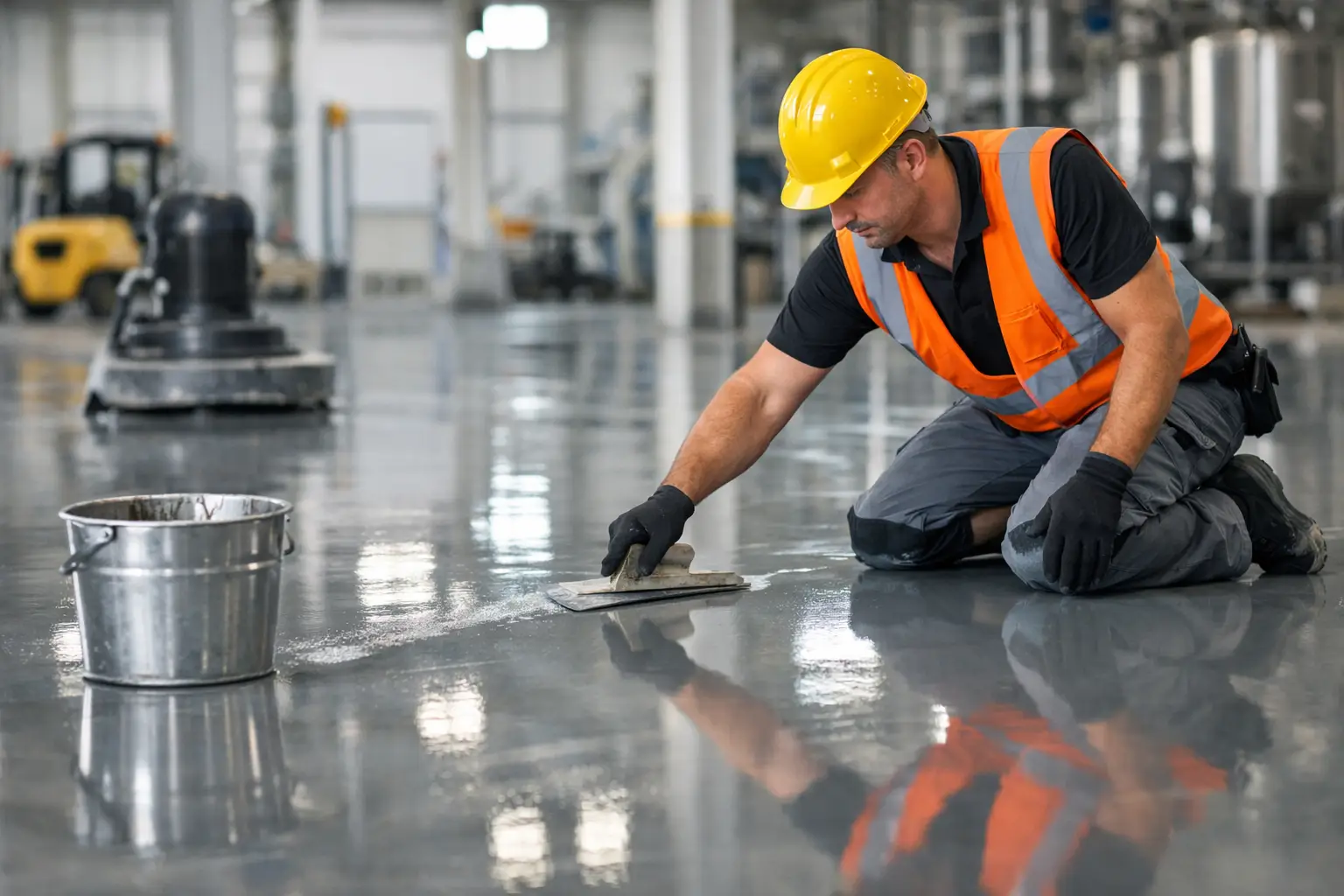
Once the floor is specified correctly, installation discipline becomes the next risk point. Surface preparation needs to achieve the right profile and remove weak material fully. Cracks and joints should be treated according to movement and service conditions, not just filled quickly to keep the schedule moving. Environmental controls, recoat windows, cure times, and thickness checks should be managed carefully.
Good contractors also protect adjacent assets. That means controlling dust during preparation, masking equipment, coordinating access, and keeping the site safe for operators and other trades. In industrial buildings, floor work often takes place around active operations. Clean execution is part of technical quality.
Closeout should include practical guidance, not just a handover invoice. Facility teams should know when the floor can accept foot traffic, pallet jacks, forklifts, chemical cleaning, and heavy equipment. They should also receive realistic maintenance instructions so the surface lasts as intended.
How to compare bids without getting trapped by the lowest number
When epoxy flooring proposals vary widely, the difference is often hidden in preparation scope and system thickness. One contractor may include grinding, repairs, moisture control, and detailed edge treatment. Another may be pricing little more than a light surface clean and thin coating application.
That is why bid review should focus on scope clarity. Ask what preparation method is included, what crack and joint repairs are covered, what thickness will be applied, what downtime is required, and what exclusions could trigger variations later. A cheap quote can become expensive once the slab condition is fully exposed.
For owners and facility managers, the strongest hire is usually the contractor that can inspect properly, specify honestly, and execute without creating avoidable disruption. Industrial floors are working assets. They need to perform under traffic, cleaning, impact, and time.
If your building is already showing wear, contamination, or repeated coating breakdown, treat it as a system problem, not just a cosmetic one. The right contractor will tell you what the concrete needs, what the operation requires, and what can realistically be delivered within your shutdown window. That is the kind of answer that protects the floor and the facility around it.
Talk to Promax
Need this on your roof? Call +971 56 727 4205 or request a free inspection. Promax provides EPDM metal-roof, concrete and industrial waterproofing across Dubai and the UAE with up to a 15-year warranty.