A refuse room that smells, leaks, jams, or requires daily cleaning is usually not a housekeeping problem. It is often the result of an undersized, poorly detailed, or poorly maintained chute. A properly specified garbage chute Dubai system gives high-rise residential buildings, hotels, staff accommodations, hospitals, and commercial facilities a controlled route for daily waste handling without creating an ongoing maintenance burden.
For facility managers, the objective is straightforward: contain waste, protect common areas, reduce manual handling, and keep the system operational under heavy daily use. That requires more than installing a vertical pipe. Material selection, shaft alignment, intake hopper design, discharge arrangement, ventilation, access for cleaning, and fire-rated interfaces all need to work together.
What a Garbage Chute System Must Handle
A chute is exposed to repeated impact, moisture, cleaning chemicals, food waste, heat, and frequent use. In a busy tower, residents or staff may use the chute at all hours, often with bags that are heavier or bulkier than intended. The system must tolerate that abuse without sharp edges, loose joints, corrosion, or blockages at transition points.
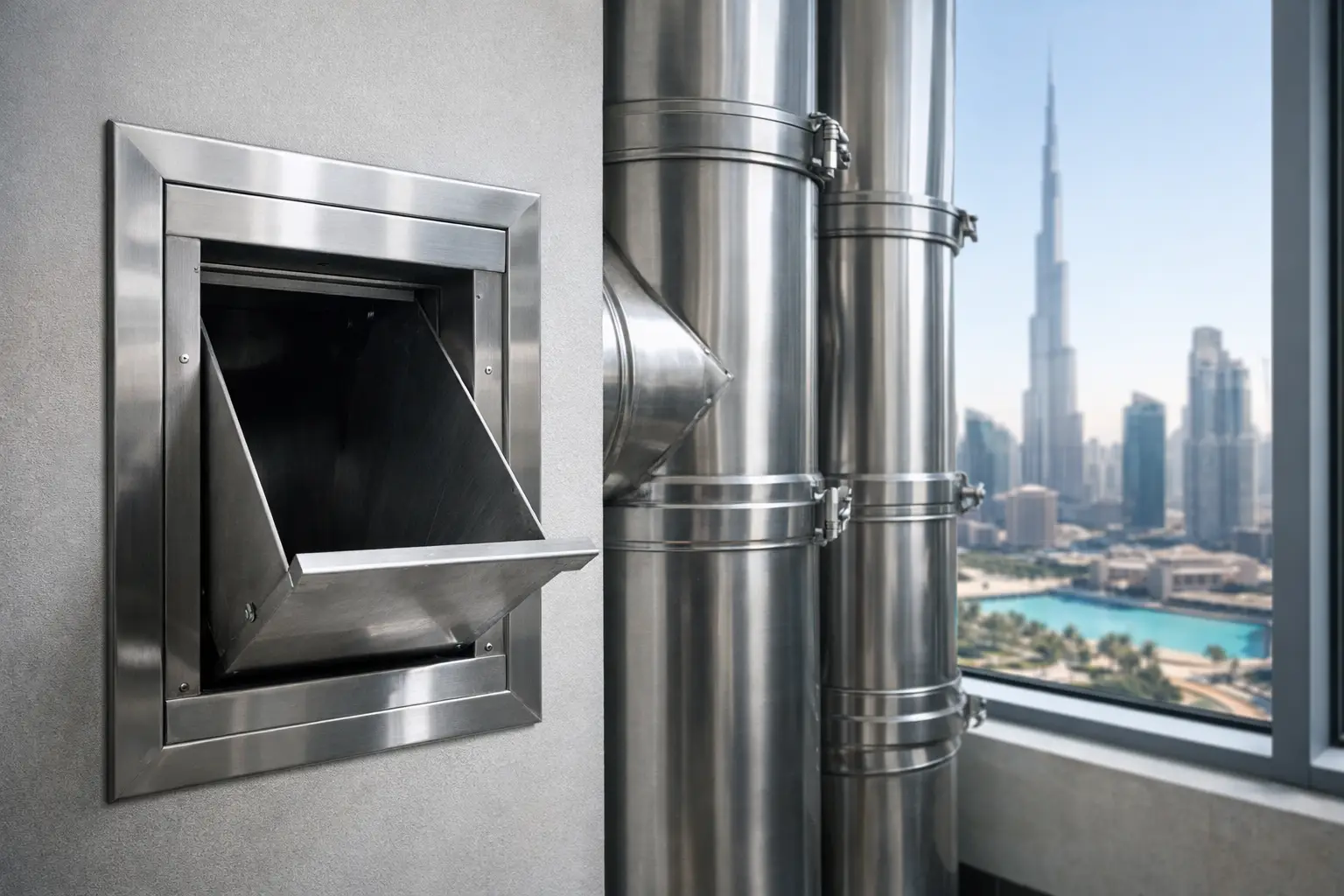
The basic assembly includes the vertical chute body, floor intake doors or hoppers, support brackets, vent section, discharge section, access doors, and waste collection interface at the lower level. Depending on the building design, the system may also require a linen chute, a separate waste stream, odor-control provisions, wash-down connections, and fire-rated components.
The weakest detail often determines the reliability of the whole installation. A chute can be made from good material but still fail operationally if the intake door is poorly aligned, the discharge is too tight, supports are spaced incorrectly, or access for cleaning has been ignored.
Why Stainless Steel 316 Is Commonly Specified
For many waste and linen chute applications, stainless steel 316 grade is a practical long-term choice. Its corrosion resistance is particularly valuable in humid coastal conditions, service areas exposed to wash-down routines, and facilities where moisture and organic waste are unavoidable.
A stainless steel chute also provides a smoother internal surface than many alternatives. That matters because waste bags should move through the chute with minimal snagging. Smooth, accurately joined sections reduce the chance of material catching at seams and becoming the starting point for a blockage.
Galvanized or GI chute sections can be suitable for selected projects where budget, duty cycle, and building conditions support that decision. However, they require careful consideration in wet and high-use environments. Once protective coatings are damaged, corrosion can develop around joints, doors, supports, and lower discharge areas. The lower initial cost may not represent the lower lifecycle cost when frequent repairs and replacement are considered.
Material selection should therefore follow the actual operating environment, not simply the lowest quotation. For premium residential towers, hotels, healthcare facilities, and heavily used commercial buildings, 316-grade stainless steel is often the more defensible specification.
Garbage Chute Dubai Design Starts With a Site Review
No two buildings have the same shaft dimensions, floor layouts, waste volumes, or collection arrangements. Before fabrication begins, the contractor should inspect the shaft and verify clear dimensions, structural support locations, floor penetrations, access constraints, and the final discharge point.
A practical review also examines how waste reaches the intake doors. A door placed in a narrow service corridor may need a different hopper arrangement than one installed in a dedicated refuse room. The door must be convenient for intended users while remaining secure, durable, and correctly positioned within the wall finish.
At the collection level, the discharge arrangement deserves equal attention. Waste should enter the collection area in a controlled manner, with enough room for bins, handling equipment, cleaning access, and safe staff movement. If this area is congested, teams may force bins into unsuitable positions or allow waste to accumulate below the chute, creating odor and pest-control concerns.
For replacement projects, a site inspection identifies whether the existing system can be repaired or whether full replacement is more economical. Localized corrosion, damaged doors, failed supports, and inaccessible cleaning points can sometimes be corrected. But where the chute body has widespread deterioration or the original installation has fundamental design defects, piecemeal repair may only postpone a larger failure.
Fabrication Details That Affect Daily Performance
Good fabrication is visible in the details. Chute sections should be accurately rolled, welded, finished, and aligned so internal joints do not create ledges. Supports must carry the load without allowing movement that can stress connections over time. Intake doors need positive latching, durable hinges, and reliable closing action.
The design should also account for practical maintenance. Access doors at suitable locations allow inspection and cleaning without unnecessary dismantling. At the lower levels, service personnel need adequate access to the discharge connection and nearby areas where waste can collect.
Four fabrication and installation controls make a measurable difference over the service life of the system:
- Correct chute diameter based on building occupancy and anticipated waste volume
- Smooth internal welds and properly aligned section joints to reduce snagging
- Securely engineered supports that prevent vibration and movement
- Durable intake doors and access panels sized for regular operation and maintenance
These are not cosmetic items. A minor fabrication defect inside a vertical chute can create recurring jams that affect multiple floors and require disruptive callouts.
Safety, Odor Control, and Building Coordination
A waste chute passes through multiple floors, which means it must be coordinated with the building's fire and life-safety strategy. Door assemblies, floor penetrations, shaft enclosure details, and related systems should be selected and installed in accordance with the approved project requirements and relevant authority standards.
Odor control depends on more than a deodorizer in the refuse room. The chute needs appropriate ventilation, properly closing intake doors, regular cleaning, and a collection area that is not allowed to overflow. If odors are persistent on upper floors, the cause may be a damaged door seal, a ventilation issue, buildup inside the chute, or a problem at the discharge level.
Noise is another issue that becomes noticeable after handover. Loose supports, thin material, poorly secured sections, and uncontrolled bag impact can cause disturbance in adjacent rooms. This is especially relevant in hotels, residential towers, and healthcare settings. A contractor should consider the shaft location and surrounding occupancy while planning the installation.
Installation Without Creating New Building Problems
Chute installation is not simply a fabrication activity. It requires coordination with civil works, wall openings, access doors, shaft finishing, ventilation provisions, and the building's waste collection process. Poor coordination can leave gaps around door frames, misaligned openings, unfinished penetrations, or discharge areas that are difficult to clean.
For occupied properties, installation sequencing is equally important. Work may need to be completed floor by floor, with temporary waste arrangements in place to avoid disrupting residents, hotel operations, or staff accommodation. The contractor should protect finished areas, control dust and debris, and keep the work zone organized.
Promax Contracting approaches garbage chute supply and installation as a field-execution scope: site measurement, fabrication planning, material supply, installation, inspection, and support after handover. This matters when a project requires more than standard sections and needs custom dimensions, replacement interfaces, or coordination with an existing building shaft.
Maintenance Is Part of the System, Not an Afterthought
Even a well-built chute requires scheduled attention. Waste bags can split, liquids can leak, and residue can build up at impact points and the discharge area. Without cleaning, odor, pest activity, corrosion, and restricted flow become more likely.
Facility teams should inspect intake doors for latch operation, hinge wear, damaged seals, and signs of rough use. The chute interior should be cleaned on a planned schedule appropriate to occupancy and waste type. The discharge area needs frequent checks because it is where most operational issues become visible first.
Warning signs should be acted on early: repeated blockages, unusual noise, slow-closing doors, stains around joints, odors on upper floors, visible rust, or waste collecting beneath the discharge. Waiting until the chute is fully blocked can turn a manageable repair into an urgent disruption affecting an entire building.
The right garbage chute system is one that remains easy to use after thousands of disposal cycles. Specify the material for the environment, fabricate it accurately, coordinate the installation carefully, and give maintenance teams the access they need. That is how a basic building service becomes a dependable part of daily operations.
Talk to Promax
Speak to Promax for expert help in Dubai & the UAE. Call +971 56 727 4205 or request a free consultation for metal-roof waterproofing, garbage & linen chute systems and LEXA KNX home automation.