
A damaged production floor usually announces itself late. By the time forklifts start bouncing over spalled concrete, joints begin breaking down, or coatings peel under pallet traffic, the problem has already moved beyond surface wear. This industrial floor repair guide is written for facility managers, engineers, and property teams who need repairs that hold up under real operating loads, not just cosmetic patching.
Industrial floors fail for different reasons, and the repair approach has to match the failure mode. A warehouse slab with joint edge breakdown needs a different solution than a food processing area with coating delamination, or a mechanical room floor affected by chemical attack. The costliest mistake is treating all floor damage as the same issue. Good repair work starts with diagnosis, not material selection.
What an industrial floor repair guide should address first
Before any repair product is specified, the floor has to be inspected as a working system. That means looking at concrete condition, traffic pattern, moisture behavior, drainage, substrate contamination, and operational exposure. A crack may be structural, shrinkage-related, impact-driven, or caused by slab movement. Surface dusting may point to weak concrete, but it can also be a sign of curing problems or long-term abrasion.
In active facilities, repair planning should also account for downtime, access restrictions, and sequencing. A technically correct repair that shuts down a loading bay for too long can become an operational problem. On the other hand, a fast repair that ignores substrate preparation usually fails early. The right balance depends on how critical the area is and what kind of traffic it carries.
Common types of industrial floor damage
Most industrial repair scopes fall into a few recurring categories. Surface spalling is common in logistics and warehouse environments where repeated wheel loads break down weak or exposed concrete. Joint failure is another major issue, especially where hard-wheeled traffic crosses unsupported slab edges. Cracks vary widely - some are stable and suitable for filling, while others indicate movement that needs a flexible or structural solution.
Coating failures also show up regularly in industrial settings. These include blistering, peeling, wear-through, and debonding caused by poor surface preparation, vapor transmission, thermal cycling, or chemical exposure. In wet process areas, drainage problems can accelerate floor deterioration and create ongoing slip and hygiene risks.
How to inspect before repair
A proper inspection should identify more than visible damage. The repair team needs to determine the depth of deterioration, whether reinforcing steel is affected, and whether the substrate is dry and sound enough for bond-critical materials. Hollow-sounding areas, active moisture, oil contamination, and weak laitance all change the repair method.
For coated floors, adhesion testing and moisture testing are often worth the time. For damaged concrete, hammer sounding, saw-cut inspection, and localized breakouts can reveal whether the problem is isolated or widespread. In heavy-use facilities, traffic mapping helps identify whether the damage is random or tied to turning zones, rack aisles, loading points, or washdown areas.
This is where an experienced contractor adds value. Repair scope should be based on field conditions, not assumptions from a photo or a generic bill of quantities. In many industrial sites, the visible defect is only the surface expression of a deeper issue such as substrate movement, water ingress, or ongoing contamination.
Choosing the right repair method
There is no universal repair system for industrial floors. Material selection depends on load demand, service environment, slab condition, and cure-time requirements.
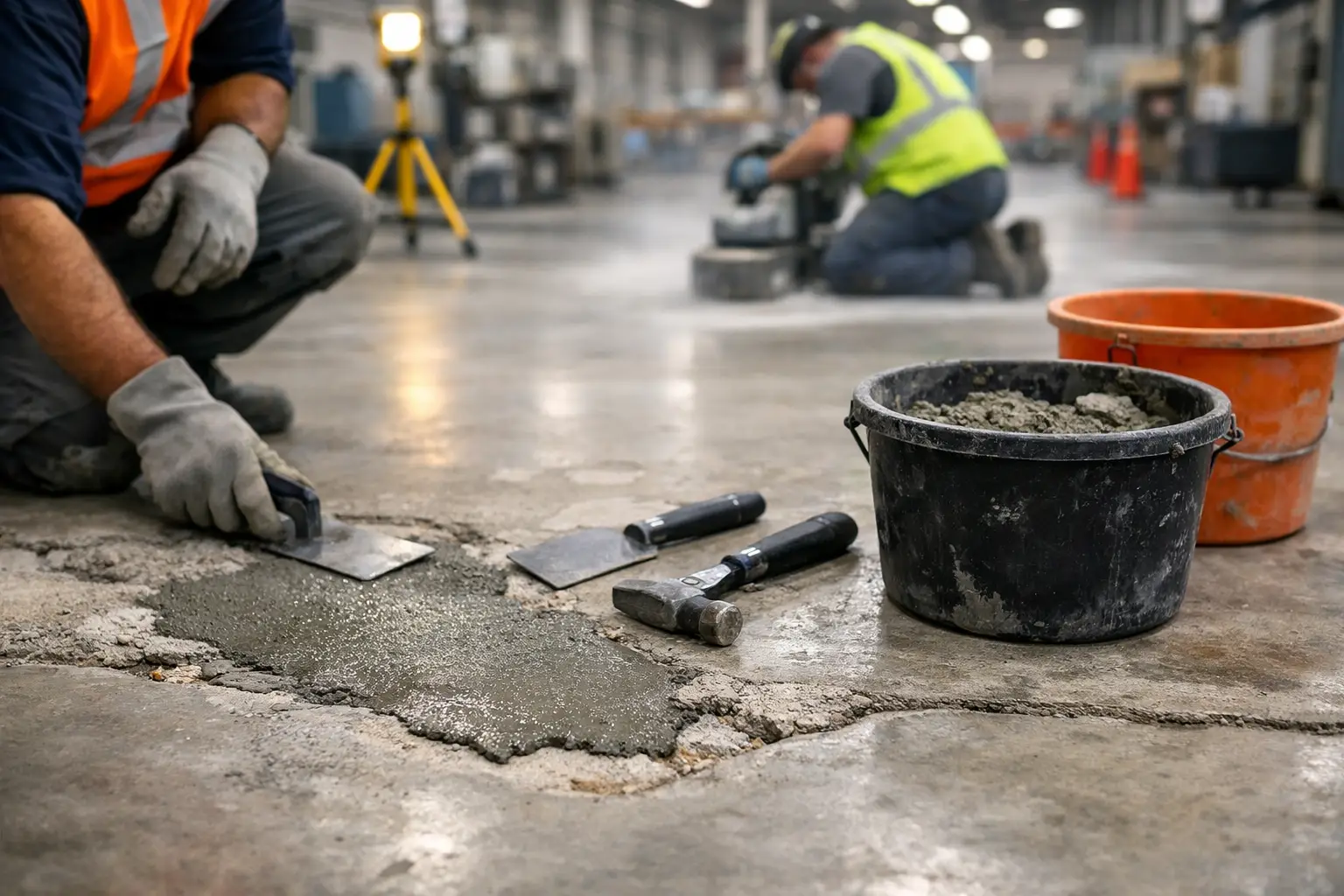
For shallow spalls and surface defects, polymer-modified repair mortars or epoxy mortars are often used, provided the edges are properly cut and the substrate is mechanically prepared. For heavier impact zones or rapid-return areas, faster-setting systems may be necessary. In chemical environments, standard cementitious repairs may not last, and a resin-based build-up with a compatible protective topping may perform better.
Crack repair also depends on function. If the goal is to restore monolithic behavior in a stable slab, low-viscosity resin injection may be suitable. If the crack is expected to move, rigid filling can simply transfer the problem elsewhere. In that case, a flexible joint or movement-tolerant sealant system may be the better choice.
Joint arris repair requires particular care. Many failures happen because broken edges are patched without addressing support at the joint. In forklift environments, semi-rigid joint fillers and properly rebuilt shoulders are often more effective than soft sealants alone. The details matter here - wheel load, wheel type, crossing frequency, and slab movement all affect performance.
When coatings should be repaired or replaced
A worn coating does not always need full replacement. If the substrate is sound and adhesion remains strong outside localized failure zones, selective repair followed by overcoating may be cost-effective. But if the coating is broadly debonding, if moisture vapor transmission is high, or if multiple incompatible layers are present, patch repairs can become a short-term expense.
In factories, workshops, and utility areas, epoxy systems remain common because they provide abrasion resistance, chemical resistance, and cleanability. That said, epoxy is not the answer for every floor. Areas exposed to thermal shock, UV, or movement may require a different resin system or a more flexible build-up. Repair decisions should be based on service conditions, not product popularity.
Surface preparation decides the outcome
Most repeat failures trace back to weak preparation. Industrial floor repair is not a paint-over job. Damaged concrete has to be cut back to sound edges. Contaminants have to be removed. Mechanical preparation such as grinding, scarifying, or shot blasting is usually required to achieve a reliable bond.
This is especially critical in facilities with oil, grease, dust, or process residues. If contamination remains in the slab, even a high-spec repair product can detach under load. Moisture is another common issue. Floors in coastal or high-humidity environments, including many sites across the UAE, can experience bond problems if vapor conditions are ignored during repair planning.
A disciplined repair team will also control edge detailing, profile depth, priming requirements, and curing conditions. These steps are not minor. They determine whether the repair integrates with the existing floor or begins separating within months.
Managing repairs in live facilities
Industrial repair work rarely happens in empty buildings. Warehouses, plants, and service yards usually need phased execution, night shifts, or sectional closures to keep operations moving. That changes how repairs should be designed.
Fast-curing systems can reduce downtime, but they also demand tighter control during installation. Wider repair areas may justify staged demolition and reinstatement rather than repeated emergency patching. In high-traffic buildings, it is often more practical to repair the worst zones immediately and schedule larger rehabilitation in planned shutdown windows.
Facility teams should also think beyond the repair itself. If the floor keeps seeing impact at dock entries, wash water accumulation at low points, or aggressive loading at rack aisles, the same damage will return. Sometimes the right solution includes drainage correction, joint redesign, traffic management, or protective topping systems rather than patching alone.
A practical industrial floor repair guide for better long-term value
The cheapest repair quote often delivers the highest lifecycle cost. Thin patches over weak concrete, coating application over contaminated substrates, and untested material combinations may look efficient at the approval stage but fail under traffic. Long-term value comes from scope accuracy, substrate preparation, and system compatibility.
When reviewing contractors, ask how they inspect, how they determine moisture and contamination risk, what preparation method they use, and how they stage work in live operations. Ask what happens at joints, edges, drains, and transition points. Those are the areas where industrial floors usually start failing first.
A capable contractor should be able to explain not only what will be installed, but why that repair method fits the service conditions. That level of technical clarity matters more than a generic promise of heavy-duty performance. Companies like Promax Contracting build their value around this type of execution - inspection-led recommendations, practical site coordination, and repair systems selected for actual field exposure.
If your floor is already showing repeated patch failure, widening cracks, coating peel, or dusting in traffic lanes, waiting rarely improves the scope. The right time to act is when repair can still be controlled, planned, and tied to the root cause. A floor that supports operations every day deserves the same level of technical attention as the roof, drainage, or structural envelope above it.
Talk to Promax
Need this on your roof? Call +971 56 727 4205 or request a free inspection. Promax provides EPDM metal-roof, concrete and industrial waterproofing across Dubai and the UAE with up to a 15-year warranty.