

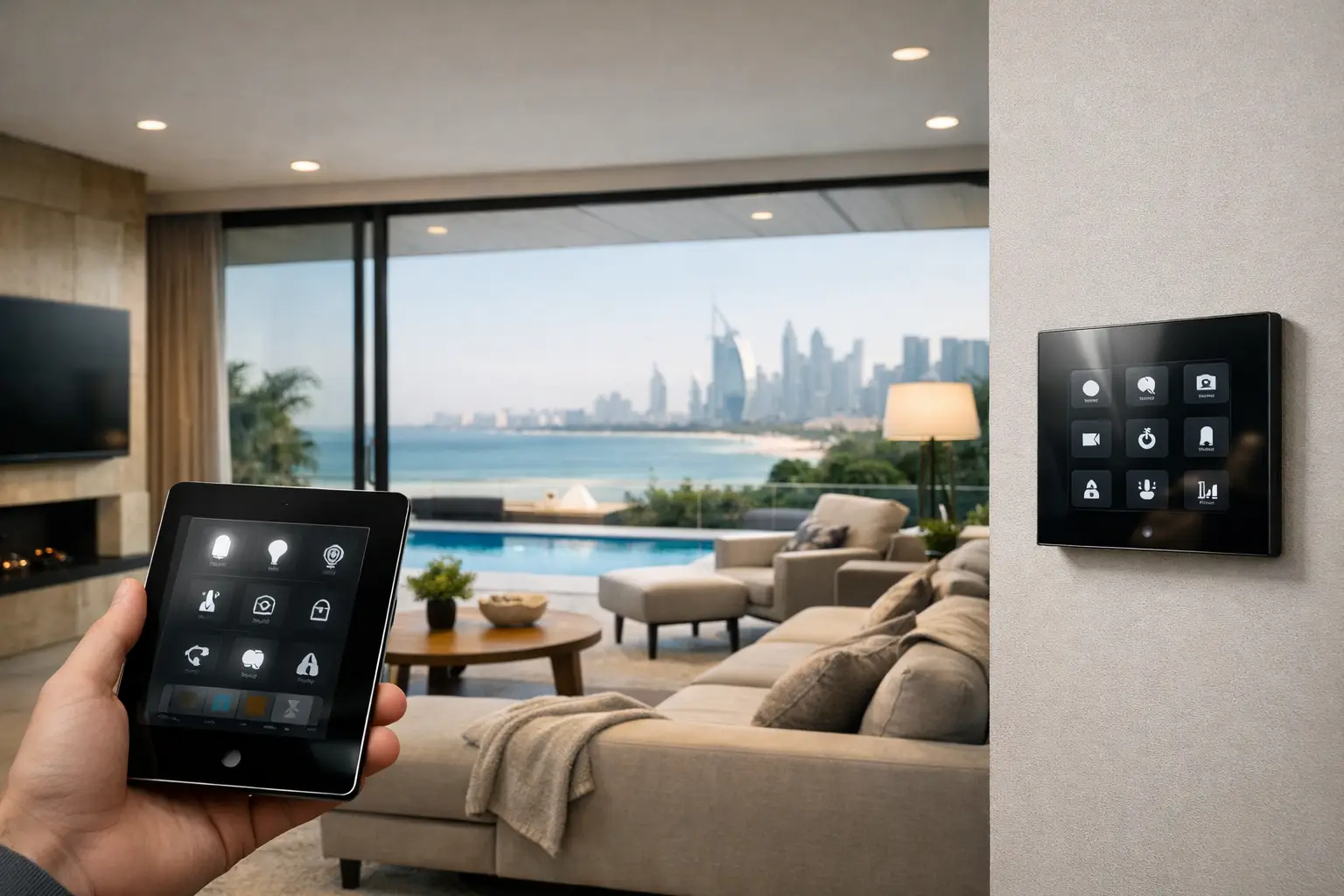
A villa owner should not need six separate apps to turn off lights, adjust air conditioning, close curtains, and secure the property before travel. A hotel operator should not rely on staff memory to manage guest-room lighting and unoccupied areas. KNX home automation UAE provides a practical alternative: one wired building-control standard that brings key electrical functions under a coordinated, configurable system.
For villas, hotels, offices, retail spaces, and private projects, the value is not simply convenience. Properly designed KNX automation reduces unnecessary energy use, gives occupants clearer control, and makes future alterations more manageable. The quality of the result, however, depends on the design, panel work, installation discipline, programming, and handover process.
What KNX Controls in a Property
KNX is an open international standard for building automation. Rather than making every device operate independently, a KNX bus connects compatible sensors, switches, actuators, thermostats, and controllers. These devices exchange commands and status information through a common system architecture.
At the user level, the system can be as simple as a wall switch that controls several lighting circuits. At a larger project scale, it can coordinate lighting, air conditioning setpoints, curtains, blinds, motion detection, timed functions, and selected access-related signals. A scenario panel can activate a set of pre-programmed actions with one command. For example, a "Welcome" scenario can switch on entrance lighting, set a comfortable temperature, and open selected curtains. A "Leave" scenario can turn off nonessential loads and place the property in an energy-saving mode.
This approach is particularly useful where a property has many circuits, multiple zones, or different user groups. It prevents the control strategy from becoming a collection of disconnected devices with uncertain responsibility when something needs adjustment.
Why KNX Home Automation UAE Projects Need Proper Design
The UAE climate creates a clear case for controlled lighting and HVAC operation. Long cooling seasons, high solar exposure, and large villa or hospitality footprints can make waste from poorly managed loads expensive over time. Automation cannot solve inefficient equipment or poor building-envelope performance by itself, but it can prevent systems from operating when they are not needed.
For example, occupancy sensing may reduce lighting operation in low-traffic spaces. Scheduled scenes can change external and common-area lighting according to actual operating hours. Thermostats can manage room temperatures by zone instead of treating an entire property as one condition. Curtain and blind control can be programmed to support comfort and reduce direct glare during periods of high sun exposure.
The correct strategy depends on the building. A frequently occupied family villa needs simple controls that remain intuitive for every resident. A hotel requires repeatable room logic, staff controls, and reliable operation across a large number of rooms. A commercial project may prioritize scheduled loads, meeting-room scenes, and centralized status visibility. Applying the same device count and programming approach to each project is poor engineering.
Wired Infrastructure Is a Long-Term Advantage
Wireless products have a place in limited retrofit work, especially where opening walls is not practical. But for new construction, major renovation, and high-value properties, KNX is commonly selected because the control backbone is wired. This provides a stable platform that is not dependent on changing consumer-device ecosystems or inconsistent wireless coverage.
A wired system also supports clear fault finding. A trained technician can inspect power supplies, bus communication, actuators, labeling, and panel connections using a documented installation plan. That matters after handover, when another contractor may need to understand the system years later.
KNX does not eliminate the need for proper electrical installation. It raises the need for it. Cable routing, separation of power and control wiring, enclosure space, terminal labeling, protective devices, and accessible panel locations must be addressed before finishes are complete.
Core Components for a Practical KNX Installation
A useful KNX scope starts with function, not with a device catalog. The usual system includes scenario panels, KNX switches and sockets where required, dimming actuators, switching actuators, thermostats, motion sensors, and smart lighting controls. Each item must be selected for the actual load, room function, and user expectation.
Dimming actuators are used where lighting levels need adjustment rather than simple on-off control. They are valuable in living areas, dining rooms, lounges, meeting rooms, and hospitality spaces, but fixture compatibility must be checked early. A dimming actuator cannot correct a lamp or driver that is not designed for the selected dimming method.
Switching actuators provide controlled on-off operation for lighting circuits and other approved loads. Motion sensors can provide occupancy-based functions in corridors, washrooms, utility areas, and circulation routes. KNX thermostats allow zone-based control logic, while scenario panels give users a straightforward way to manage multiple functions without learning complex menus.
LEXA KNX products can support these functions across villas, hotels, commercial sites, and private projects. The right selection should be based on circuit schedules, anticipated occupancy, interface requirements, finish expectations, and maintenance access, not just the initial product cost.
Start With a Site Review and Functional Schedule
A reliable project begins before devices are ordered. The electrical design should be reviewed alongside the owner’s operating requirements. This is where the project team identifies lighting groups, dimming zones, HVAC zones, curtain motors, sensor locations, panel capacity, and the scenes each area actually needs.
A functional schedule is the working document that defines how the building will behave. It should state what happens when a room is occupied, when a scene is selected, when a thermostat changes mode, or when a timer reaches a defined period. It should also identify manual override requirements. Users must be able to operate critical functions normally even when they do not want to use a scenario.
For a villa, the schedule may cover arrival, entertaining, night, prayer, away, and vacation modes. For a hotel, it may define guest-room entry behavior, corridor operation, service modes, and energy-saving actions for vacant rooms. For commercial areas, it may cover opening and closing sequences, meeting-room presets, and common-area time schedules.
The best schedules are specific. "Smart lighting" is not a scope. "Reception lights at 70 percent from 7:00 AM to 7:00 PM, with manual local control and an after-hours mode" is a scope that can be built, tested, and maintained.
Installation Quality Determines System Reliability
KNX programming receives attention because it is visible at handover. Yet many later issues begin with basic execution failures: undocumented wiring changes, overloaded actuator channels, weak panel labeling, missing spare capacity, or devices installed where access is difficult.
Control panels should be organized so technicians can identify each actuator and corresponding circuit without guesswork. Device addresses, circuit identifiers, and drawings should match. Power supplies and bus connections need to be installed according to the approved design. Where lighting fixtures, air conditioning equipment, curtain motors, or third-party systems are included, interface compatibility must be confirmed before final commissioning.
Commissioning should be carried out room by room and function by function. This includes testing every switch command, dimming response, sensor trigger, thermostat function, scenario, timer, and manual override. The client team should not be asked to discover unfinished logic after occupancy.
Promax Contracting approaches KNX work as an installation and execution scope, supported by site review, system selection, panel coordination, programming, testing, and after-sales response. That structure is valuable when the automation package must coordinate with electrical contractors, interior teams, HVAC specialists, and the final operator.
Plan for Changes After Handover
A building changes after it opens. A child’s room becomes a study. A villa gains a new extension. A hotel revises operating hours. A tenant changes how meeting rooms are used. KNX can adapt to these changes, but only if the original work is documented and administered correctly.
The handover package should include final device lists, panel schedules, operating instructions, scene descriptions, and clear responsibility for programming updates. Property managers should know who can modify the system, how backup files are protected, and which changes require a qualified KNX system integrator.
Avoid creating too many scenes just because the system can support them. A practical interface with clearly named functions is more likely to be used correctly than a decorative panel loaded with confusing options. Automation should reduce daily decisions, not add another layer of technical complexity.
For any KNX home automation UAE project, start by defining the operating problem you want to solve: wasted cooling, inconsistent lighting control, difficult room management, or limited visibility of electrical functions. A properly inspected, documented, and commissioned system will serve the property far better than a long feature list chosen without a clear site requirement.
Talk to Promax
Speak to Promax for expert help in Dubai & the UAE. Call +971 56 727 4205 or request a free consultation for metal-roof waterproofing, industrial roofing and LEXA KNX home automation.