
A leaking planter rarely stays a planter problem. In commercial buildings, podium decks, facades, terraces, and entrance landscapes, failed planter box waterproofing details often show up first as staining in occupied areas, concrete spalling, peeling paint, corroded steel, or persistent dampness near walls and soffits. By the time the leak is visible inside, the repair scope is usually larger than the original planter footprint.
That is why the waterproofing detail matters more than the planter finish. Tiles, stone, and landscaping create the appearance. The system below them controls service life. For facility managers, consultants, and project teams, the goal is straightforward - build a planter assembly that manages standing water, root activity, thermal movement, and maintenance access without allowing moisture to migrate into the structure.
Why planter box waterproofing details fail
Most failures come from the same few conditions. The first is treating the planter like a wet area instead of a permanently damp containment zone. A planter holds moisture for long periods, and irrigation can keep the substrate wet even when there is no rain. That exposure level is closer to a water-retaining structure than a typical balcony.
The second issue is poor continuity. The base membrane may be installed correctly, but the corners, wall-to-floor junctions, penetrations, drain flanges, coping edges, and terminations are weak. Water does not need a large opening. It follows laps, pinholes, unsealed fasteners, and badly finished upturns.
The third is drainage design. When a planter stays saturated, hydrostatic pressure increases, salts migrate, and the membrane works harder than it should. If water cannot move efficiently to the drain layer and outlet, the assembly remains under constant stress.
Root attack is another common problem. Some membranes resist water but not root penetration. Once roots find a vulnerable seam or soft spot, they enlarge it over time. In large commercial planters, this can turn a localized defect into a widespread failure under soil and hardscape.
Core planter box waterproofing details to get right
Good planter box waterproofing details are not complicated, but they need disciplined execution. The substrate must be sound, clean, dry to specification, and properly sloped where required. A flat base with random depressions encourages ponding and sediment buildup around the drain zone.
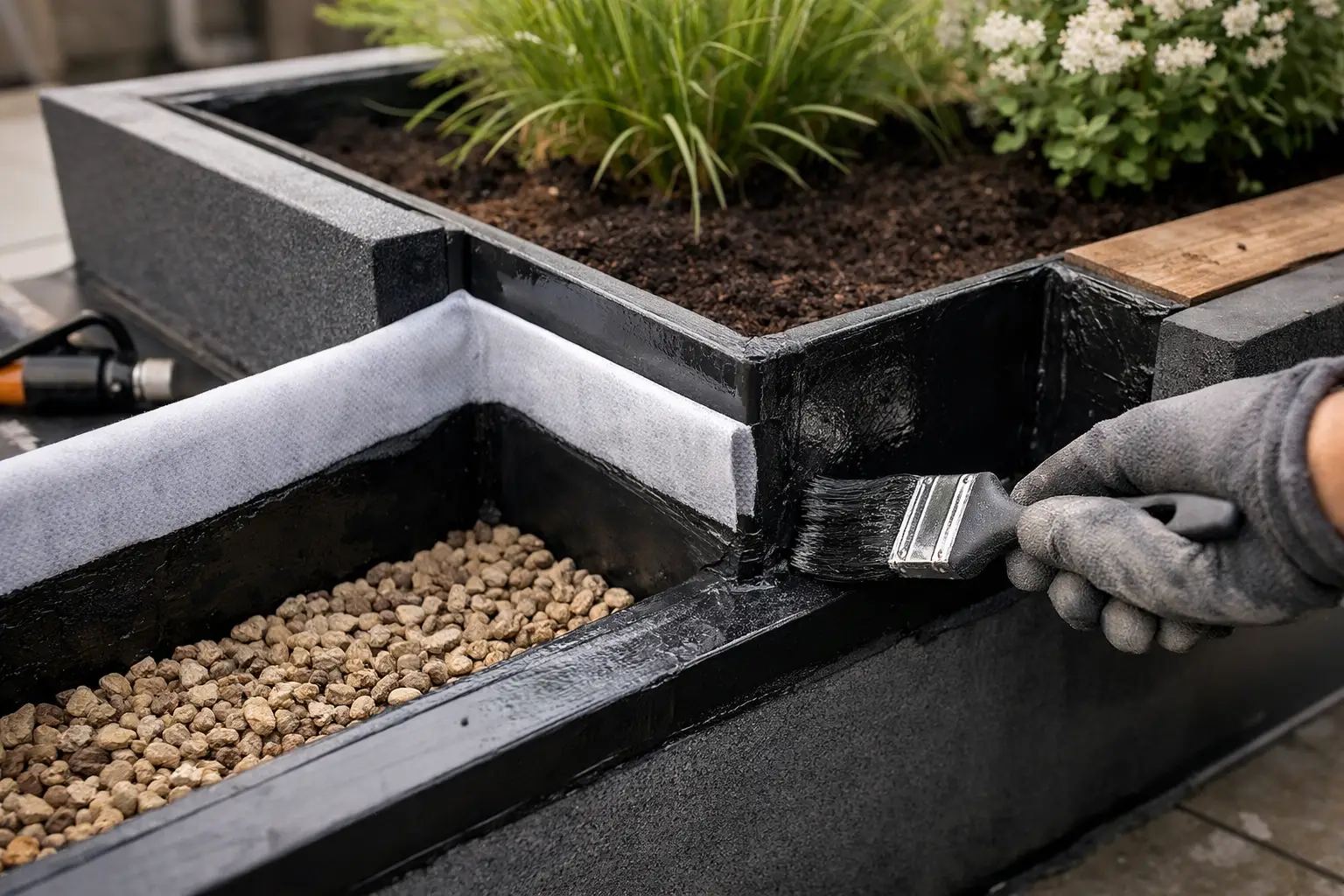
At the structural slab and wall junction, a cant or reinforced angle treatment is often required so the membrane can transition without stress concentration. Sharp 90-degree corners are common failure points, especially with sheet membranes that need full contact and tight adhesion.
Upturn height matters. The membrane should continue vertically high enough to stay above soil level, irrigation splash, and any possible backup condition. In practice, low upturns are one of the easiest ways to create hidden leakage paths behind finishes. Protective board or protection layers are then needed so backfilling and later maintenance do not damage the membrane.
Drain detailing is equally critical. The drain body must be compatible with the waterproofing system, securely fixed, and integrated with a proper clamping or bonded flange detail. Simply cutting the membrane around a drain opening and sealing it with mastic is not a durable solution for a commercial installation.
Penetrations for irrigation, lighting, overflow pipes, or sleeves should be minimized. Every penetration adds risk. Where unavoidable, they should be sealed with prefabricated collars or reinforced field-formed detailing that matches the primary membrane system.
Membrane selection depends on exposure and build-up
There is no single membrane that fits every planter. The right system depends on structural movement, substrate condition, exposure to heat, planter size, and whether the box is cast in place or part of a retrofit over an occupied area.
Liquid-applied systems can work well where geometry is irregular and penetrations are numerous. They conform to corners and complex shapes, but thickness control and curing conditions are critical. Poor application discipline usually shows up later as weak spots or inconsistent coverage.
Sheet membranes, including EPDM-based systems, are often preferred where long-term watertightness and controlled installation quality are priorities. They provide uniform thickness and strong crack-bridging performance when detailed correctly. In planter boxes with multiple corners and penetrations, however, detailing quality becomes the deciding factor. The material may be excellent, but the assembly still fails if laps, terminations, and edge treatments are rushed.
Root resistance should never be assumed. If the membrane itself is not root-resistant, the design should include a dedicated root barrier above the waterproofing layer. This is especially relevant for deep planters, trees, and aggressive planting schemes.
Drainage and protection are part of the waterproofing system
A membrane alone is not a complete planter system. Proper planter box waterproofing details include drainage composite layers, filter fabric, and a soil build-up that does not choke the outlet path. When drainage boards are omitted, wet soil bears directly on the membrane and slows water movement. That increases the likelihood of saturation, root pressure, and membrane distress.
The drainage layer should create a path for excess water to move laterally toward the outlet. Above that, a filter fabric helps prevent fines from clogging the drainage medium. The growing medium itself must suit the landscape design without becoming overly compacted. If the soil mix is too dense, water movement slows and the entire assembly stays wet.
Overflow control is often missed. In commercial and institutional properties, planters can receive heavy irrigation, washdown water, or seasonal rain far beyond normal assumptions. An overflow outlet at the correct level reduces the chance of water backing up against door thresholds, wall interfaces, or façade joints.
High-risk areas in planter box waterproofing details
Corners are always high risk, but terminations are usually where major failures begin. If the membrane terminates below coping level or behind poorly sealed edge metal, water can travel behind the system unnoticed. On facades and podium edges, this often appears later as staining below the planter line.
Wall interfaces deserve special attention. Where a planter touches an external wall, curtain wall base, or parapet, the membrane and flashing sequence must be coordinated. If cladding, insulation, or plaster systems cover the transition without a clear drainage and termination strategy, repairs become disruptive and expensive.
Movement joints require their own detail. A planter spanning structural joints without a flexible waterproofing joint treatment will crack or split under thermal and structural movement. This is common on roof decks and podium slabs where heat exposure is high.
Retrofit work has another challenge: unknown substrate condition. Existing coatings, laitance, moisture content, and crack patterns can all affect adhesion and detailing. A site inspection is necessary before selecting the repair method. Surface preparation is not a side task here. It is a major part of system performance.
Installation quality controls that reduce callbacks
Even the best specification can fail in the field if sequencing is poor. Waterproofing should start only after substrate repairs, slope corrections, and embedded item coordination are complete. If other trades cut, puncture, or contaminate the membrane afterward, leak risk rises immediately.
Flood testing or electronic leak detection should be considered before protection layers and soil are placed. Testing is the point where minor detailing issues can still be corrected at a reasonable cost. After planting and hardscape installation, locating defects becomes slower and far more expensive.
Documentation also matters. For commercial maintenance teams, photographs of the membrane, corners, drains, and terminations before concealment provide a record for future repairs and warranty review. This is especially useful on large sites with repeated planter modules.
A contractor with waterproofing and fabrication capability can usually manage interfaces more effectively, particularly where edge metal, drain adaptation, access hatches, or custom protection elements are needed. On technically demanding sites, that coordination reduces delays and finger-pointing between trades.
What facility teams should ask before approving the system
The practical questions are simple. Is the membrane suited for permanent damp exposure and root risk? Are the upturns, drains, overflows, and penetrations shown in detail, not left to site interpretation? Is there a protection and drainage layer above the waterproofing? Has the assembly been tested before covering?
If any of those answers are vague, the system is not ready. Planter leaks are rarely caused by one dramatic error. More often, they come from several small omissions that line up under wet conditions.
For owners and project teams managing active buildings, the right approach is to treat planters as part of the building envelope, not just landscape decoration. That means inspection, detail review, system compatibility, and controlled installation. Companies such as Promax Contracting typically approach these areas the same way they handle roof and podium waterproofing - by focusing on substrate condition, membrane continuity, drainage performance, and durable field execution.
A planter box should hold soil and water where they belong, not send them looking for a path into the structure. When the details are right, the planter stays an asset instead of becoming a recurring leak source.
Talk to Promax
Need this on your roof? Call +971 56 727 4205 or request a free inspection. Promax provides EPDM metal-roof, concrete and industrial waterproofing across Dubai and the UAE with up to a 15-year warranty.