A forklift lane does not fail all at once. It starts with tire marks that no longer clean off, then fine cracking at impact points, then dusting, staining, and surface wear that spreads faster than maintenance teams can keep up with. In facilities that need a hard-wearing, easy-to-clean finish, a self leveling epoxy floor system is often the right answer - but only when the substrate, traffic profile, and installation conditions are handled correctly.
For industrial and commercial buildings, the floor is not cosmetic. It carries traffic, supports hygiene requirements, resists chemical exposure, and affects safety under daily operating pressure. That is why epoxy flooring decisions should be made the same way roof waterproofing or structural repair decisions are made - based on inspection, system selection, and execution quality.
What a self leveling epoxy floor system actually does
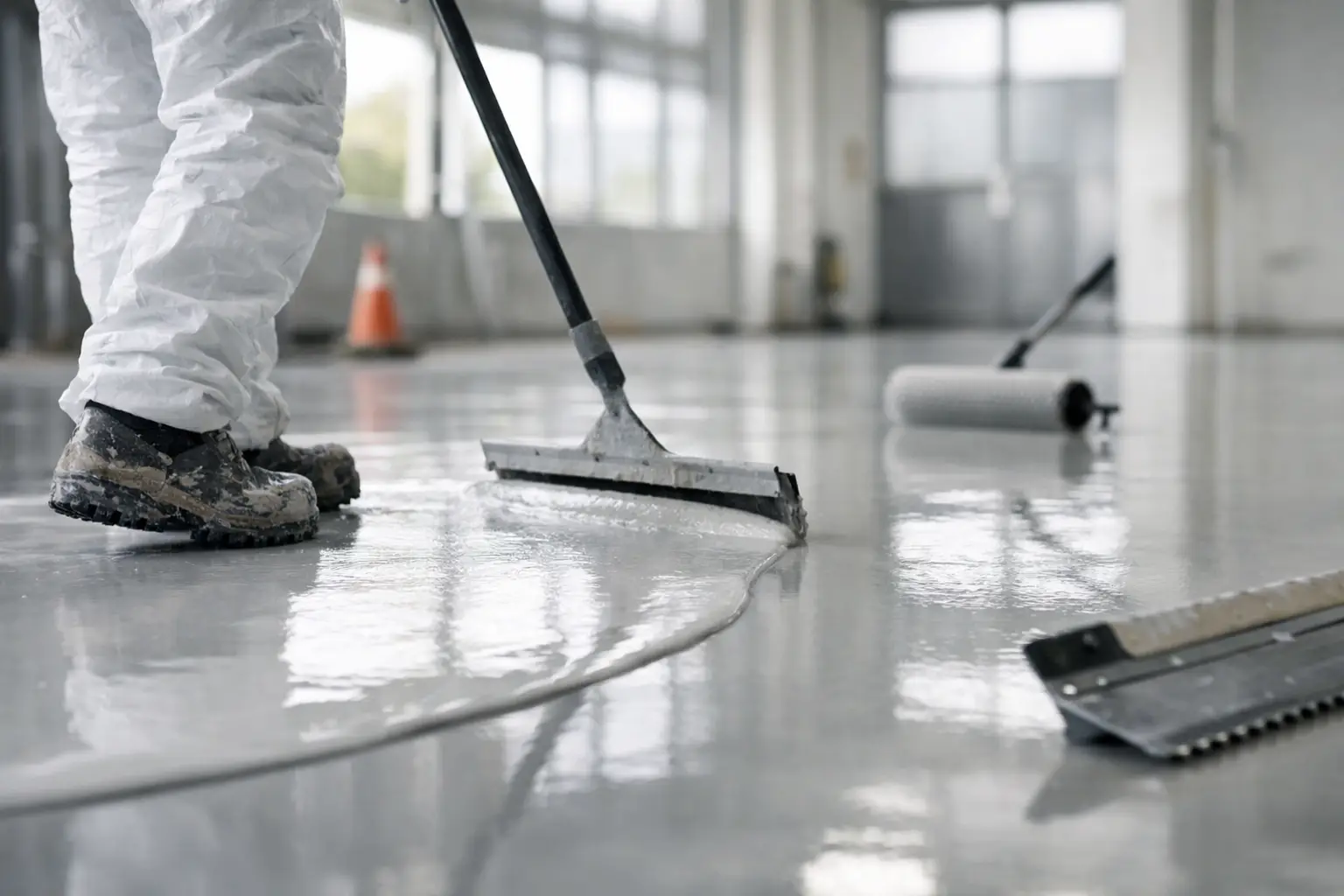
A self leveling epoxy floor system is a resin-based coating build-up designed to flow across properly prepared concrete and create a smooth, continuous surface. It is commonly used where owners want a cleanable, durable, joint-minimizing finish with better resistance than standard paint or thin sealers.
The term "self leveling" can be misleading if taken too literally. The material does not fix major slab defects on its own, and it does not replace proper substrate repair. What it does well is settle into a uniform film that reduces minor irregularities and creates a flatter, more consistent wearing layer. In warehouses, production areas, workshops, utility rooms, showrooms, and back-of-house commercial spaces, that can make a major difference in serviceability.
The system usually includes surface preparation, crack or patch repair, primer, body coat, and topcoat where required. Depending on the facility, anti-slip additives, chemical-resistant top layers, or static-control properties may also be specified. Thickness matters. So does curing time. So does the condition of the concrete underneath.
Where self leveling epoxy floor system installations make sense
This type of flooring performs best where the owner needs a combination of abrasion resistance, dust control, hygiene, and visual uniformity. Distribution centers use it to improve cleanability and reduce concrete dust. Manufacturing spaces use it to support maintenance and spill management. Commercial buildings use it where appearance and durability need to work together.
It is also a practical option when older concrete is sound but worn at the surface. If the slab has enough structural integrity and moisture is under control, epoxy can upgrade the floor without the disruption of full replacement. That said, not every damaged floor is a coating candidate. If the slab is moving, contaminated deep into the surface, or failing due to moisture vapor transmission, putting epoxy on top of it will not solve the root problem.
This is where site inspection matters. A contractor should be looking at compressive condition, laitance, old coating residues, oil penetration, joint movement, moisture levels, and operational constraints before recommending any build-up.
Substrate preparation decides performance
Most epoxy flooring failures are not product failures. They are preparation failures.
If the concrete is not mechanically prepared to the correct profile, the bond will be compromised. If cracks are simply covered instead of repaired, they will reflect through. If moisture is ignored, blistering or delamination becomes likely. If grease, chemicals, or curing compounds remain in the slab, the resin may not adhere consistently.
A proper installation starts with inspection and testing, followed by grinding or shot blasting, vacuum cleaning, repair of cracks and localized damage, and priming to suit the substrate condition. In active facilities, staging and phasing also matter. There is no value in selecting a high-performance floor system if traffic is allowed back on it before cure is complete.
For decision-makers, this is the point to pay attention to method statements, not just material brochures. A good flooring contractor should be able to explain how the slab will be prepared, how problem areas will be treated, what thickness will be applied, and how downtime will be managed.
Performance benefits and realistic trade-offs
A self leveling epoxy floor system offers several practical advantages. It creates a dense surface that is easier to clean than bare concrete. It improves resistance to many common industrial contaminants. It reduces dusting. It can brighten interior spaces by increasing light reflectivity. It also gives facilities a more controlled, professional finish in areas where clients, auditors, or operators expect a higher standard.
But there are trade-offs, and serious buyers should want them stated clearly.
Epoxy can become slippery if texture is not specified for wet areas. It is not the best choice for every high-temperature environment. UV exposure can affect appearance in some formulations, especially in sunlit spaces. Heavy impact and substrate movement can still cause cracking. Installation is sensitive to surface condition, ambient temperature, and moisture. And while self leveling systems can hide minor unevenness, they do not correct poor slab design or structural defects.
That is why system selection should follow actual use conditions. A packaging plant, a parking deck ramp room, a laboratory wash area, and a showroom do not need the same finish even if all are technically "epoxy floors."
Choosing the right build for industrial and commercial use
The right specification depends on how the space operates.
In a warehouse with pallet traffic, abrasion resistance and repair of wheel-path damage may be the main priorities. In a food-related or hygiene-sensitive area, cleanability and joint detailing may be more important. In an engineering workshop, resistance to oils and intermittent chemical exposure matters more. In commercial interiors, appearance and fast return to service may drive the decision.
This is also where thickness and topcoat type come into play. A thinner decorative system and a heavier-duty industrial build are not interchangeable. Some areas need anti-slip aggregates. Some need a higher-build body coat to absorb wear. Some need a chemical-resistant top layer. Some need coving at perimeter edges to improve washdown performance.
For large facilities, phasing the work is often as important as the material itself. Shutdown windows, equipment access, curing periods, and odor sensitivity all affect the installation plan. A contractor with real field experience will build the flooring scope around operations, not force operations to fit the flooring crew.
Common failure points to watch before you approve the work
Buyers often compare epoxy proposals based on price per square foot, but that only tells part of the story. The lower number may exclude repairs, moisture mitigation, edge treatment, or proper surface preparation. Those exclusions tend to show up later as peeling, pinholes, soft spots, or visible substrate defects.
Watch for vague language around preparation. Watch for no mention of moisture testing. Watch for systems specified without reference to traffic type or chemical exposure. Watch for unrealistic curing promises in active industrial settings. And watch for contractors who talk only about product brands without talking about substrate condition.
Good execution is disciplined. It includes inspection, repair detailing, material compatibility, controlled mixing, thickness control, and after-installation protection. In many facilities, the floor fails first at the edges, joints, drains, and repaired patches - not in the open field. Those details need as much attention as the main application area.
Why contractor capability matters as much as the material
A self leveling epoxy floor system is not a one-product purchase. It is an installed system, and installed systems are only as good as the team putting them down.
For facility managers and project engineers, that means evaluating site readiness, manpower, equipment, sequencing, and response capability. The contractor should understand concrete behavior, moisture risks, repair methods, and the realities of operating facilities under pressure. If the project includes adjacent waterproofing defects, joint failures, drainage issues, or other building envelope problems affecting the slab, those need to be identified early instead of buried under a coating scope.
This is where a technically led contractor brings more value than a basic applicator. The floor may look similar on handover day, but the difference shows up months later in adhesion, wear, cleanability, and maintenance calls. Companies such as Promax Contracting work best on these scopes when the requirement is not just installation, but inspection-led execution with attention to the whole asset condition.
If your floor is already showing wear, contamination, or dusting, the right next step is not guessing the finish from a catalog. It is getting the slab assessed properly, matching the system to actual use, and making sure the installation plan is built around performance, not just price.
Talk to Promax
Need this on your roof? Call +971 56 727 4205 or request a free inspection. Promax provides EPDM metal-roof, concrete and industrial waterproofing across Dubai and the UAE with up to a 15-year warranty.