
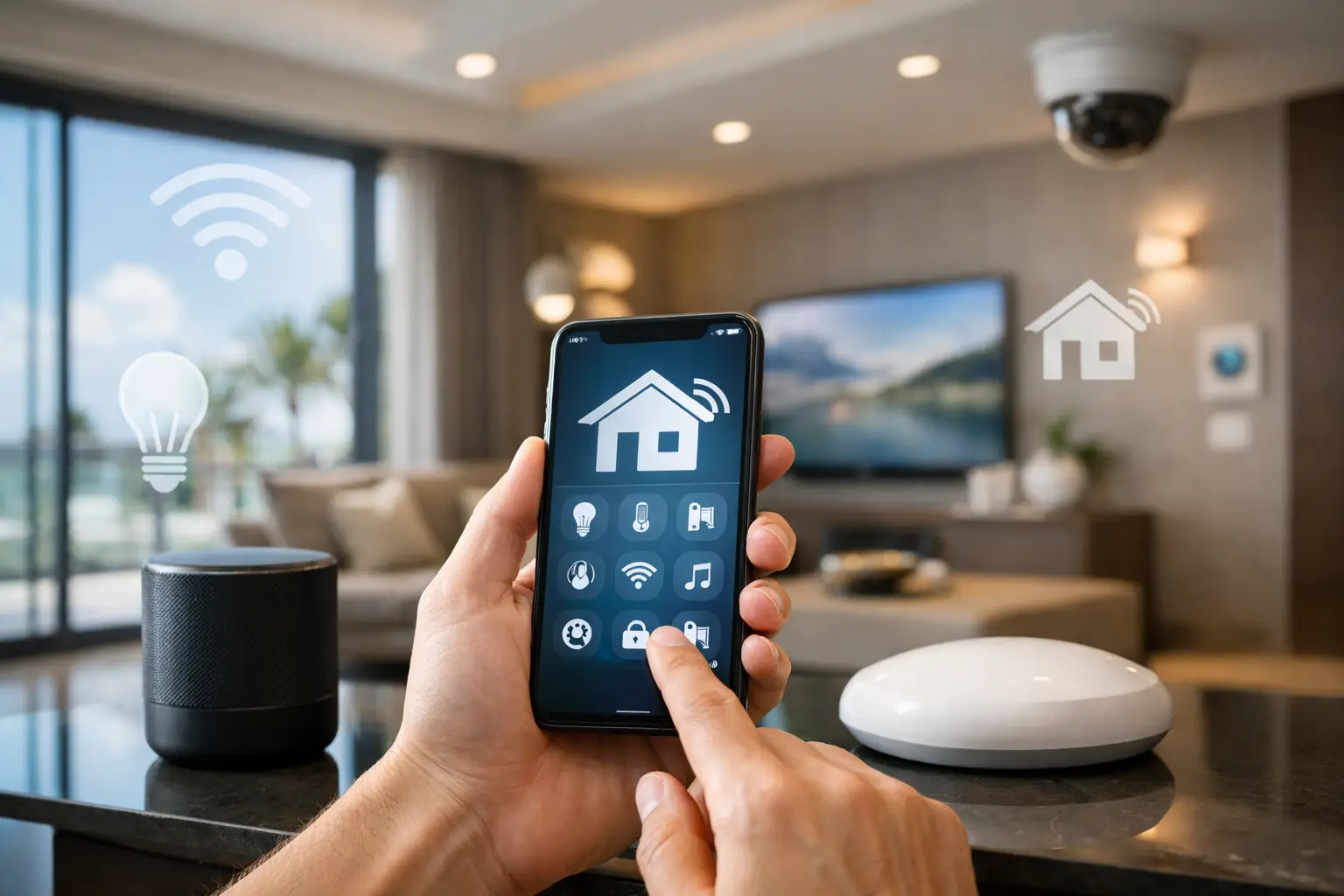
A villa that relies on separate remotes, wall switches, timer plugs, and disconnected apps is not truly automated. It is harder to operate, harder to maintain, and easy for occupants to override by mistake. Smart home automation UAE projects work best when the control system is planned as part of the building infrastructure, with reliable wiring, defined operating logic, and practical access for owners, guests, and maintenance teams.
For villas, hotels, and commercial properties, KNX-based automation provides a structured way to control lighting, air conditioning, curtains, blinds, security interfaces, and scenario settings from one coordinated system. The objective is not to add technology for its own sake. It is to reduce daily operating friction, manage energy use, improve comfort, and give the property team dependable control over critical functions.
What Smart Home Automation UAE Should Deliver
A properly designed automation system should make a building easier to run whether it is occupied by a family, hotel guests, tenants, or staff. The system needs to respond consistently, including when internet service is unavailable. That is one reason wired KNX automation remains a strong option for permanent properties where reliability and long-term serviceability matter.
Instead of depending on multiple standalone devices, a KNX system connects field equipment through a common building control platform. Push buttons, thermostats, motion sensors, dimming actuators, switching actuators, and scenario panels can be programmed to work together. A single command can set the required lighting level, adjust climate settings, close curtains, and switch selected circuits off.
For a villa, that may mean an “Away” scene that turns off nonessential loads, raises the AC temperature setpoint, closes curtains, and activates selected perimeter lighting. In a hotel, it may mean guest room controls that respond to room occupancy and approved access status. In a commercial facility, the same approach can simplify common-area lighting schedules and reduce unnecessary runtime.
The value depends on how clearly the operating requirements are defined before installation. Automation cannot correct a poorly planned electrical layout or solve every occupant preference automatically. It must be engineered around actual room use, available circuits, control priorities, and future maintenance access.
Why KNX Is Suitable for Permanent Properties
KNX is a building automation standard used for residential, hospitality, and commercial applications. It is particularly suitable where the client wants a system that can expand over time without replacing the full control infrastructure. Devices from compatible manufacturers can be integrated within a properly designed KNX installation, giving project teams more flexibility than a closed, app-only system.
A wired system also reduces dependence on batteries and wireless signal conditions. Wireless products may be appropriate for limited retrofits or small additions, but large villas and hotels require careful consideration of wall construction, range, device density, and long-term replacement needs. A structured KNX installation provides a more stable foundation for projects that need consistent operation across many rooms and control points.
The practical advantages are clear:
- Centralized control can coordinate lighting, climate, curtains, and selected electrical functions.
- Scenario programming allows a room or zone to respond to a single wall-panel command.
- Motion sensors can control circulation areas based on occupancy and time settings.
- Dimming and switching actuators provide accurate control over compatible lighting circuits.
- KNX thermostats can manage room-level climate requirements without relying on disconnected controllers.
These functions must still be selected according to the project. A guest bedroom, formal majlis, office meeting room, corridor, and external entrance all require different control logic. Copying the same automation settings throughout a property usually creates unnecessary complexity.
Start With a Site Review and Control Schedule
The first stage is not product selection. It is a site review and a detailed control schedule. The contractor and project team should identify which loads are being controlled, where control points are required, what must remain manually operable, and how each zone should behave during normal use, vacancy, and emergency conditions.
For new construction, automation planning should begin before electrical containment, cable routing, and distribution board work are finalized. This allows the required control cables, panel space, power supplies, and access provisions to be included correctly. Retrofitting is possible, but it often involves more limitations, particularly where walls are complete and existing circuits are not separated by room or function.
A control schedule should record the purpose of each circuit and device. For example, decorative lighting, general lighting, curtain motors, fan coil units, and outdoor lighting should not simply be grouped because they are physically close. They should be separated according to how users need to operate them.
This is also the stage to agree on ownership and access. A villa owner may want simple local control with a few family scenarios. A hotel operator may require authorized central monitoring, guest room templates, and clear procedures for maintenance staff. The interface should match the people who will use it every day, not just the person approving the project.
Lighting Control Requires More Than Dimmers
Smart lighting control is often the first feature clients request, but its performance depends on circuit design, fixture compatibility, and programming. Not every LED fitting dims in the same way. Drivers, load types, minimum dimming levels, and control protocols must be checked before actuators are specified.
In a well-planned villa automation project, lighting is organized by activity rather than only by room. A living area may need separate control for general lighting, feature lighting, reading lights, and curtains. This supports useful scenes such as Entertain, Relax, Night, and Cleaning. The names can be simple, but the control response behind them should be tested carefully.
Hotel applications require another level of discipline. Guest room scenes should be intuitive and should not create confusion when a guest uses a normal wall switch. Housekeeping and maintenance teams also need a clear way to access the room functions permitted for their role. Automation should support operations, not add a training burden.
Climate, Curtains, and Sensors Need Coordinated Logic
Climate control can create significant comfort and energy benefits when it is connected to occupancy, setpoints, door or window status, and room schedules. However, aggressive automatic shutdown rules can frustrate occupants in hot conditions. The correct approach is balanced logic: protect against waste while retaining reasonable comfort and local override capability.
Curtain and blind control is especially useful in UAE properties exposed to strong daylight and solar heat. Timed operation, room scenes, and sun-position logic can help reduce direct glare and manage heat gain. Yet the settings must respect privacy, façade design, and occupant preference. A curtain system that opens at the wrong time can quickly become an annoyance rather than a benefit.
Motion sensors are best used where occupancy behavior is predictable, such as corridors, stairways, washrooms, service areas, and selected external zones. They are less suitable as the only control method in spaces where people sit still for long periods. Sensor placement, detection range, delay times, and daylight thresholds all need on-site adjustment after installation.
Installation Quality Determines Long-Term Reliability
Even premium automation devices will underperform if the panel assembly, labeling, cable routing, and programming are poorly executed. Control cabinets must be organized, accessible, and clearly identified. Every actuator, power supply, circuit, and data connection should be documented for future service.
Commissioning is equally important. Each scenario, switch function, thermostat setting, sensor response, and safety-related interface must be tested under actual site conditions. This includes checking what happens after a power interruption, how systems restart, and whether local control remains clear for occupants.
Promax Contracting supports KNX automation projects with LEXA scenario panels, switches, sockets, dimming actuators, switching actuators, motion sensors, thermostats, and smart lighting controls. The priority is practical execution: review the site condition, define the required scope, install the right components, and provide a system that can be maintained after handover.
Plan for Maintenance Before Handover
A smart property should not become dependent on the original installer for every small adjustment. At handover, the client should receive clear documentation, including panel schedules, device records, programming backups, operating instructions, and defined contacts for after-sales support.
It is also sensible to retain spare capacity in the control panel and allow for future cable pathways where possible. Owners often add a new room function, change a lighting layout, or expand control requirements after moving in. A system designed with no spare capacity can make a minor upgrade unnecessarily disruptive.
The most successful smart home automation UAE projects are not the ones with the longest feature list. They are the properties where every control has a purpose, every scene works as expected, and the system remains understandable long after the installation team leaves. Start with the way the building is actually used, then build the automation around that reality.
Talk to Promax
Speak to Promax for expert help in Dubai & the UAE. Call +971 56 727 4205 or request a free consultation for metal-roof waterproofing, industrial roofing and LEXA KNX home automation.