A failed epoxy floor usually does not fail because of the coating. It fails because the slab was rushed, contaminated, cracked, damp, or mechanically weak before the first primer coat went down. If you need to prepare factory floor for epoxy, the real work starts well before mixing materials. On industrial sites, surface preparation is what determines whether the floor holds up under forklifts, chemical exposure, washdowns, and constant traffic - or starts peeling in months.
Factory floors are rarely clean, dry, and uniform enough for direct coating. In active facilities, concrete absorbs oil, process dust, tire residue, cleaning chemicals, and moisture over years of use. Some slabs are power-troweled too tightly for proper adhesion. Others have old coatings, patchwork repairs, movement cracks, or weak laitance at the surface. Treating all floors the same is where coating systems start going wrong.
Why surface preparation matters before epoxy
Epoxy performs best when it bonds into a sound, open concrete profile. That bond is mechanical as much as chemical. If the substrate is soft, smooth, damp, or contaminated, the coating sits on the surface instead of locking into it. Under traffic and thermal movement, that weak bond becomes blistering, delamination, hot-tire pickup, or edge failure around joints and repairs.
This is especially relevant in factories, warehouses, and production areas where the floor is part of daily operations. Once a coating fails, the issue is not cosmetic. Dusting increases, cleaning becomes harder, pallet movement is affected, and shutdown costs go up because the whole system often has to be removed and rebuilt.
Inspect before you prepare factory floor for epoxy
A proper site inspection should come first. This is not just a walkthrough with a moisture meter. The condition of the slab, the age of the concrete, previous coating history, contamination level, joint condition, and intended service load all affect the preparation method.
A coating for a light storage area is not prepared the same way as a floor in a manufacturing line, service bay, food process area, or loading zone. The inspection should identify whether the concrete is structurally sound, whether moisture vapor transmission is present, and whether any repairs are still active and moving. If the slab has ongoing settlement or active cracks, epoxy alone will not solve that issue.
It also helps to define the end use early. If the floor needs chemical resistance, antislip texture, line marking, or heavy impact tolerance, the preparation standard may need to be more aggressive. The wrong profile or repair detail at this stage can compromise the full floor system later.
Remove oil, grease, dust, and embedded contamination
Industrial concrete often carries deep contamination, not just visible dirt. Oil from machinery, hydraulic leaks, battery acid, lubricants, and cleaning agents can migrate into the slab over time. Standard sweeping is not enough. Even pressure washing is often not enough if contaminants have soaked below the surface.
Degreasing and detergent scrubbing may be required before mechanical preparation begins. In some cases, heavily contaminated concrete has to be removed to reach a clean, bondable substrate. This is where many projects become case-specific. If contamination is light and recent, cleaning may be enough. If the floor has absorbed years of oil, the top layer of concrete may simply not be suitable for coating.
Dust control also matters. Fine powder left behind after preparation can interfere with primer adhesion. Industrial vacuuming is part of the process, not an afterthought. The slab needs to be clean enough for the coating to contact concrete directly, not a film of residue.
Mechanical preparation is the core step
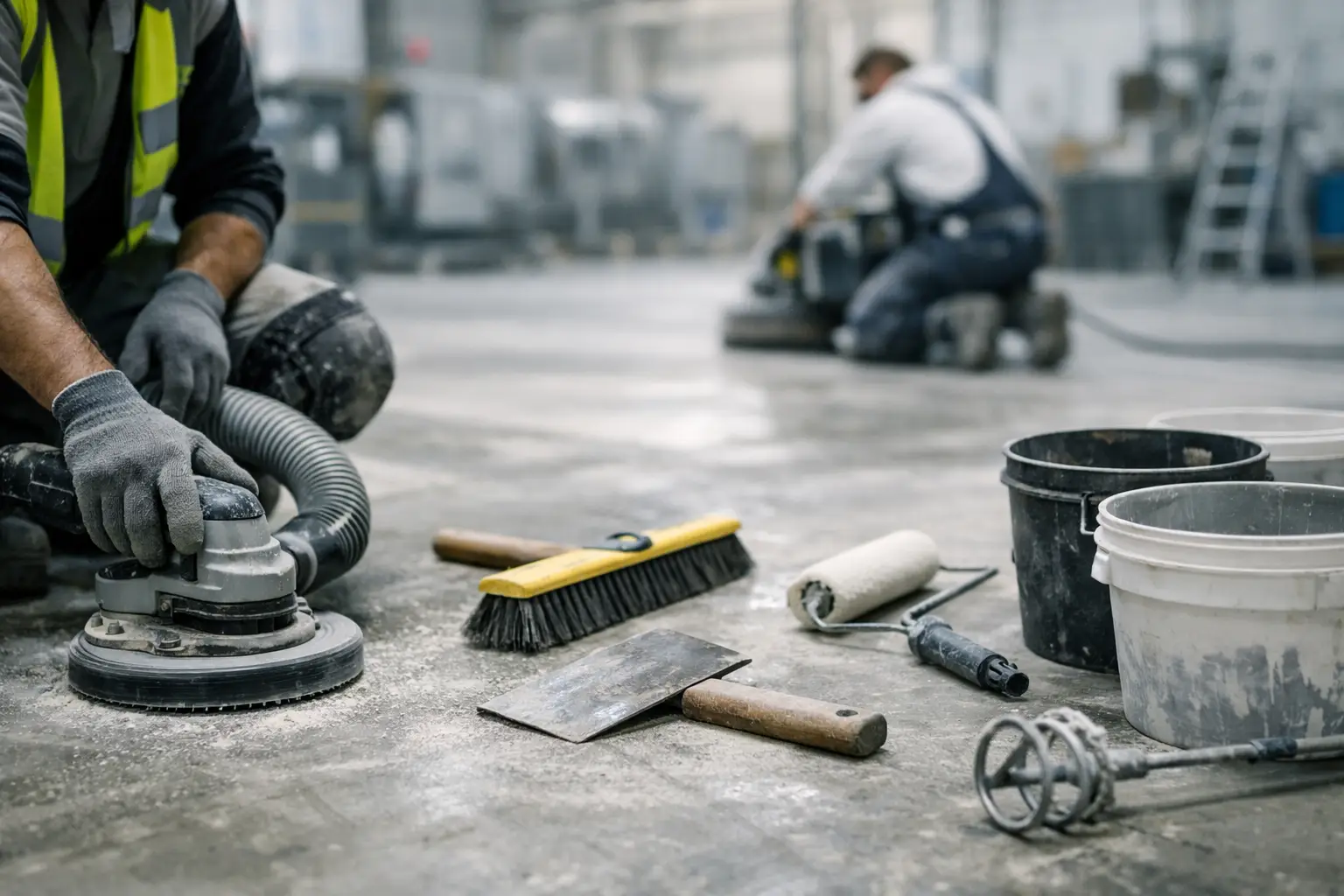
When contractors talk about how to prepare factory floor for epoxy correctly, they are usually talking about mechanical surface preparation. This is the stage that creates the concrete surface profile needed for adhesion.
For most factory floors, diamond grinding or shot blasting is the preferred method. The choice depends on slab condition, coating specification, contamination level, and required profile. Grinding works well for smoothing high spots, removing thin coatings, and opening dense concrete. Shot blasting is often better where a more uniform profile is needed across large open areas. In many projects, both methods are used together.
Acid etching is generally not the right standard for industrial epoxy flooring. It is inconsistent, difficult to control on active sites, and does not remove contamination or weak surface layers effectively. For demanding factory environments, mechanical preparation is the reliable route.
The surface should be free of laitance, curing compounds, old adhesives, paint residue, and loose material. If the slab was previously coated, all unsound areas need to be removed. Coating over partially bonded material only transfers the failure to the new system.
Repair cracks, joints, holes, and weak concrete
No epoxy system should be installed over damaged concrete without repair. Cracks need to be assessed first. Static cracks can often be routed and filled with suitable repair material. Moving cracks are different. If there is live movement in the slab, a rigid repair can reflect through the coating and reopen under service.
Spalls, impact damage, honeycombing, and surface voids should be cut back to sound concrete and rebuilt with appropriate repair mortar. Feather-edge patching tends to fail in traffic areas, so repairs should be detailed to hold under load. Weak or crumbling sections must be removed fully. Surface cosmetics are not enough in forklift lanes or production aisles.
Joints also need a clear plan. Some floors are coated up to the joints and then resealed. Others use joint filling before final topcoats. It depends on movement, traffic type, and hygiene requirements. Closing joints without accounting for slab movement can lead to cracking and edge breakdown.
Moisture testing is not optional
Moisture is one of the biggest causes of epoxy failure on concrete floors. A slab may look dry at the surface while still releasing vapor from below. That vapor pressure can break the bond between concrete and coating, especially in enclosed spaces or where ground moisture is present.
This is why moisture testing needs to be part of pre-installation work. The right method depends on the project specification, but the point is simple: do not assume dryness. New concrete may need more curing time than planned. Older slabs can still have moisture issues due to failed vapor barriers, washdown operations, or environmental conditions.
If test results are high, the solution may involve a moisture-tolerant primer or vapor mitigation system before epoxy. Skipping this step to save time usually creates a much bigger problem after handover.
Check ambient conditions and sequencing
Preparation does not stop at the concrete itself. Site temperature, humidity, ventilation, and shutdown planning all affect epoxy application. If the floor is prepared but left exposed too long, it can pick up dust, moisture, or fresh contamination before coating starts.
That is why preparation and application should be sequenced tightly. In operating factories, work often needs to be phased zone by zone to limit disruption. This calls for a contractor who can inspect, prepare, repair, and coat in a controlled sequence rather than treating the job as a simple paint application.
Temperature also affects repair materials, primers, and cure times. In some environments, the slab temperature can differ significantly from the surrounding air. That matters for bonding and finish quality. Industrial flooring needs site control, not just material supply.
What a properly prepared floor should look like
Before epoxy installation, the slab should be clean, dry within specification, structurally sound, and mechanically profiled for adhesion. Repairs should be cured and flush where required. There should be no visible grease film, no weak surface dust, and no loose edges around old repairs or joints.
Just as important, the preparation standard should match the service environment. A floor exposed to chemical spill risk, rolling loads, impact, or frequent washdowns needs more discipline than a low-traffic back-of-house area. Good preparation is not about making concrete look clean. It is about making it coating-ready under real operating conditions.
On industrial sites, this is where experienced execution matters. A contractor with field inspection capability, repair knowledge, and the right preparation equipment will usually spot failure points before they are covered. That is the difference between a floor that performs and a floor that becomes a maintenance issue.
If you are planning an epoxy floor for a factory, warehouse, or processing space, treat preparation as the main scope, not the preliminary scope. The coating is only as reliable as the slab under it, and the best time to solve floor problems is before the first coat goes down.
Talk to Promax
Need this on your roof? Call +971 56 727 4205 or request a free inspection. Promax provides EPDM metal-roof, concrete and industrial waterproofing across Dubai and the UAE with up to a 15-year warranty.