

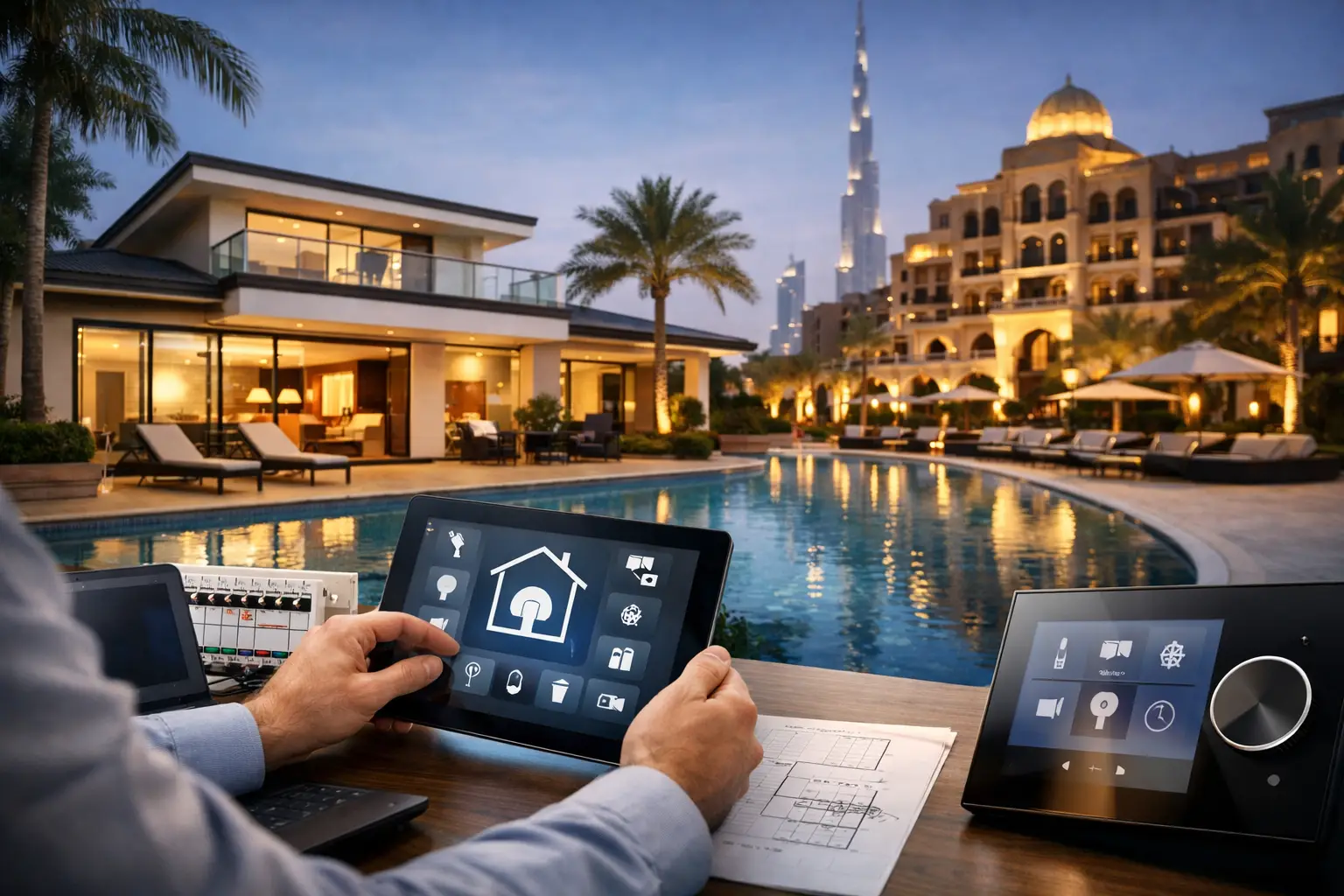
A KNX system integrator UAE property teams choose is not simply a supplier of switches, sensors, or touch panels. The integrator is responsible for turning separate building services into a controlled operating system that works reliably after handover. For villas, hotels, offices, and private developments, that means coordinating lighting, air conditioning, shading, scene control, occupancy detection, and user interfaces around how the property will actually be used.
A poorly planned automation package can look impressive at commissioning and become difficult to operate within months. Circuits may be labeled inconsistently, scenes may not match room use, and future changes may require unnecessary rewiring or programming work. A properly engineered KNX installation avoids those problems through clear design, compatible equipment selection, disciplined panel construction, testing, and documented commissioning.
What a KNX System Integrator UAE Should Deliver
KNX is an open building automation standard used to control and monitor electrical systems through a common communication bus. It is well suited to projects where owners need dependable local control alongside automation logic. Unlike isolated smart devices that depend heavily on wireless connections or separate apps, KNX is designed as a structured installation with dedicated devices, programmed functions, and expandable control architecture.
The practical value is not in adding automation everywhere. It is in applying it where it reduces waste, improves comfort, simplifies operation, or gives facilities teams better visibility. In a hotel, that may mean guest-room scenes, corridor occupancy control, and centralized status monitoring. In a villa, it may mean tailored lighting scenes, climate control by zone, curtain or blind control, and simple wall-mounted scenario panels that all family members can use.
A capable integrator should take responsibility for the full technical chain. This starts with reviewing drawings and room functions, then defining loads, circuits, control zones, panel requirements, device locations, and control sequences. The work continues through supply, installation coordination, programming, testing, client demonstration, and handover documentation.
The result should be a system that is understandable to the owner and maintainable by the team that will support the building later.
Start With Building Operation, Not Devices
Many automation specifications start by selecting attractive keypads or requesting app control. That is the wrong starting point. The first question is how each space operates at different times of day and under different occupancy conditions.
For example, a hotel guest room may require an entry scene that activates selected lights, sets a comfortable temperature range, and indicates occupancy status. When the guest leaves, the room should move to an energy-saving mode without interfering with essential services. A meeting room may need presentation, cleaning, and after-hours scenes. A villa majlis may need different lighting levels for daily use, entertaining, and late evening use.
These requirements should be written as operating sequences before equipment is finalized. This prevents a common failure: installing many control points without a clear logic behind them. More buttons do not create better control. A concise set of scenes, correctly programmed and clearly labeled, usually performs better.
Define Control Zones Carefully
Lighting and climate zones must follow real room use, not only electrical circuit convenience. Large open areas may require multiple zones near windows, seating areas, entrances, or display surfaces. Bedrooms require controls that are accessible from the entry and bedside positions. Service spaces may benefit from occupancy-based operation, but only where timing and sensor coverage have been properly assessed.
Over-zoning increases equipment cost and programming complexity. Under-zoning limits comfort and can waste energy. The right balance depends on the room layout, user expectations, daylight exposure, operating hours, and the ability to access controls without confusion.
Key KNX Components and Their Site Role
A KNX automation system is made up of devices that each perform a defined function. The equipment must be selected as part of one coordinated design rather than assembled as unrelated products.
KNX switches and sockets UAE projects use should be specified for both appearance and function. A wall control may operate a single circuit, call a complete scene, adjust brightness, control blinds, or set a climate mode. The labeling and button layout must match the room's intended use. In higher-end residential and hospitality projects, scenario panels are often more practical than multiple conventional switches because they reduce wall clutter and make common actions easier.
A KNX dimming actuator controls compatible dimmable lighting circuits. It must be matched to the load type, driver characteristics, circuit capacity, and dimming performance required on site. Incorrect compatibility checks can lead to flickering, limited dimming range, or premature equipment issues.
A KNX switch actuator is used for on-off loads such as standard lighting circuits, selected appliances, and other approved electrical points. These actuators are normally installed in the control panel, where correct termination, labeling, protection coordination, and access for maintenance are essential.
KNX thermostats and motion sensors support room-based climate and occupancy logic. Their placement matters. A thermostat installed near a heat source, direct sunlight, or supply air may read the room condition incorrectly. A motion sensor with poor coverage may switch lights off while a space is still occupied. Site review is more valuable than copying a typical layout from another project.
Design the Panels and Infrastructure for Serviceability
Automation panels are the working center of a KNX installation. A neat panel is not just a visual standard. It reduces troubleshooting time, helps future modifications, and makes handover more professional.
The panel design should allow adequate space for actuators, power supplies, protection devices, terminal blocks, cable management, labeling, and reasonable future capacity. Each outgoing circuit and KNX device should be identified consistently with the drawings and programming records. If a facility manager cannot trace a circuit, identify the related actuator channel, and understand its assigned function, maintenance becomes unnecessarily slow.
Bus cables and power wiring must be routed and terminated according to the approved design and applicable electrical requirements. Control wiring should not be treated as an afterthought after ceilings and finishes are complete. Early coordination with electrical, mechanical, interior, and site teams prevents blocked sensor positions, inaccessible panels, and missed cable routes.
Commissioning Is Where the System Proves Itself
Programming is only one part of commissioning. The real test is whether every control sequence performs correctly under normal and abnormal conditions.
Each circuit should be checked from its local control point, the relevant scenario panel, and any approved central interface. Dimming levels should be observed at low and high output. Motion sensor timing should be verified in the actual room. Climate setpoints should be tested against the connected control method. Curtains or blinds, where included, should be checked for correct direction, limit behavior, and scene response.
Commissioning should also cover failure behavior. What happens after a power interruption? Do critical settings return correctly? Can users still operate essential functions locally if a network-connected interface is unavailable? For commercial and hospitality properties, these details matter more than app features.
A professional handover includes updated control drawings, panel schedules, device addresses, programmed functions, user instructions, and a clear support contact. Promax Contracting approaches KNX work with the same execution focus used across technical building services: inspect the requirement, define the workable scope, install with discipline, and remain available when adjustments are needed.
Choose an Integrator for Long-Term Support
The lowest initial quotation is rarely the full cost of a KNX system. A lower-priced scope may exclude detailed design, adequate panel space, testing time, documentation, or post-handover support. Those omissions often become expensive when a room layout changes, a tenant requests a new scene, or a fault needs quick diagnosis.
When evaluating a KNX partner, ask how the controls will be documented, who will program and commission the system, what devices are proposed, and how support requests are handled after handover. Confirm whether the integrator can coordinate with the electrical contractor and other site disciplines rather than leaving interface issues to the client.
The right KNX installation should not feel complicated to the people using the building. It should make routine actions predictable, reduce unnecessary energy use, and give owners a control system that can grow with the property. Start with a site review and operating plan, then build the automation around real building use.
Talk to Promax
Speak to Promax for expert help in Dubai & the UAE. Call +971 56 727 4205 or request a free consultation for metal-roof waterproofing, garbage & linen chute systems and LEXA KNX home automation.