
A warehouse roof can appear sound through months of dry weather, then reveal its weakest points during one heavy storm. Rainwater drainage for warehouses is not simply a matter of fitting gutters at the roof edge. It is a coordinated roof protection system that must move high volumes of water away from membranes, joints, structural steel, loading areas, and building entrances without allowing ponding, backflow, or uncontrolled discharge.
For facility teams, the cost of poor drainage is rarely limited to a blocked outlet. Standing water increases the loading on roof areas, accelerates deterioration around fasteners and seams, drives leaks through penetrations, and can create corrosion below the roof line. Water reaching warehouse operations may damage stock, interrupt dispatch, and create avoidable safety exposure. The correct approach starts with inspection and drainage design, then continues with disciplined maintenance.
Why rainwater drainage for warehouses fails
Most drainage failures develop gradually. Dust, leaves, packaging debris, bird nesting material, and windblown sand collect in gutters and roof outlets. In Gulf conditions, fine sand can form a compact sediment layer that restricts flow even when a gutter does not look fully blocked. A sudden rain event then exceeds the restricted capacity, causing water to overtop the gutter or back up across the roof.
Incorrect roof falls are another common issue. Large metal and concrete roof areas may have low spots created by age, settlement, inadequate original design, or previous repair work. Water naturally gathers at these points instead of reaching the intended outlet. If ponding remains after rainfall, the drainage route, the roof level, or both need technical review.
Undersized gutters and downpipes also create problems. A system that handled normal rainfall may not safely manage short, intense storms. This is particularly relevant for wide warehouse roof spans, where a large catchment area can direct a substantial volume of water toward one gutter run. The design must consider roof area, roof geometry, rainfall intensity, outlet locations, gutter gradient, and the capacity of every downpipe.
Finally, drainage components often fail at connections rather than along open gutter lengths. Corroded brackets, separated joints, worn sealant, unprotected screws, cracked outlet collars, and damaged downpipe offsets allow water to escape into places it was never meant to reach.
Start with a site drainage assessment
A practical drainage solution should be based on what is happening at the facility, not a generic gutter replacement specification. A site inspection should trace the complete water path from roof surface to final discharge point. This includes roof slopes, valleys, gutters, outlets, downpipes, brackets, expansion joints, overflow points, discharge areas, and interfaces with roof waterproofing.
The inspection should also identify the evidence left by previous storms. Water marks on cladding, rust streaks, stained soffits, loose insulation, sagging gutter sections, recurring ceiling leaks, and damaged sealant around roof penetrations are useful indicators. Operations staff often know where water first appears, but the visible leak point may be far from the actual entry point. Water can travel along purlins, roof sheets, and internal channels before it becomes visible.
For operational warehouses, timing matters. Inspections and corrective work should be planned around loading schedules, access restrictions, safety requirements, and sensitive storage zones. A contractor with roof access capability and fabrication support can reduce delays by measuring, producing, and installing custom gutter sections, flashings, brackets, and drainage transitions to suit actual site conditions.
Verify the roof slope and ponding areas
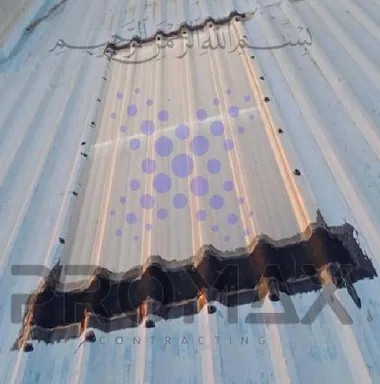
Drainage cannot compensate fully for a roof that does not guide water toward its outlets. On metal roofing, check for deflection between supports, displaced sheets, poorly formed valley details, and local areas where water sits around fasteners. On concrete roofs, examine falls, drain bowl levels, parapet outlets, and areas where previous coating or repair layers may have changed the water path.
Some localized ponding can be addressed by improving outlets or adjusting drainage details. More extensive ponding may require corrective slope work or a redesigned drainage layout. The right option depends on the roof construction, the condition of the existing waterproofing, the operational life expected from the asset, and whether the roof can be taken out of service in sections.
Calculate capacity, not appearance
A large-looking gutter is not automatically adequate. Capacity depends on its width, depth, slope, outlet size, outlet spacing, and condition. A gutter with poor fall or sediment buildup can carry far less water than its physical size suggests.
The same applies to downpipes. A downpipe must accept water from the gutter at the expected storm flow rate and discharge it without backing up at bends or lower-level connections. Where roof geometry concentrates water at valleys or internal channels, additional outlets or emergency overflow provisions may be necessary. These measures are not optional extras when the consequence of overflow is water entering a working warehouse.
Components of an effective warehouse drainage system
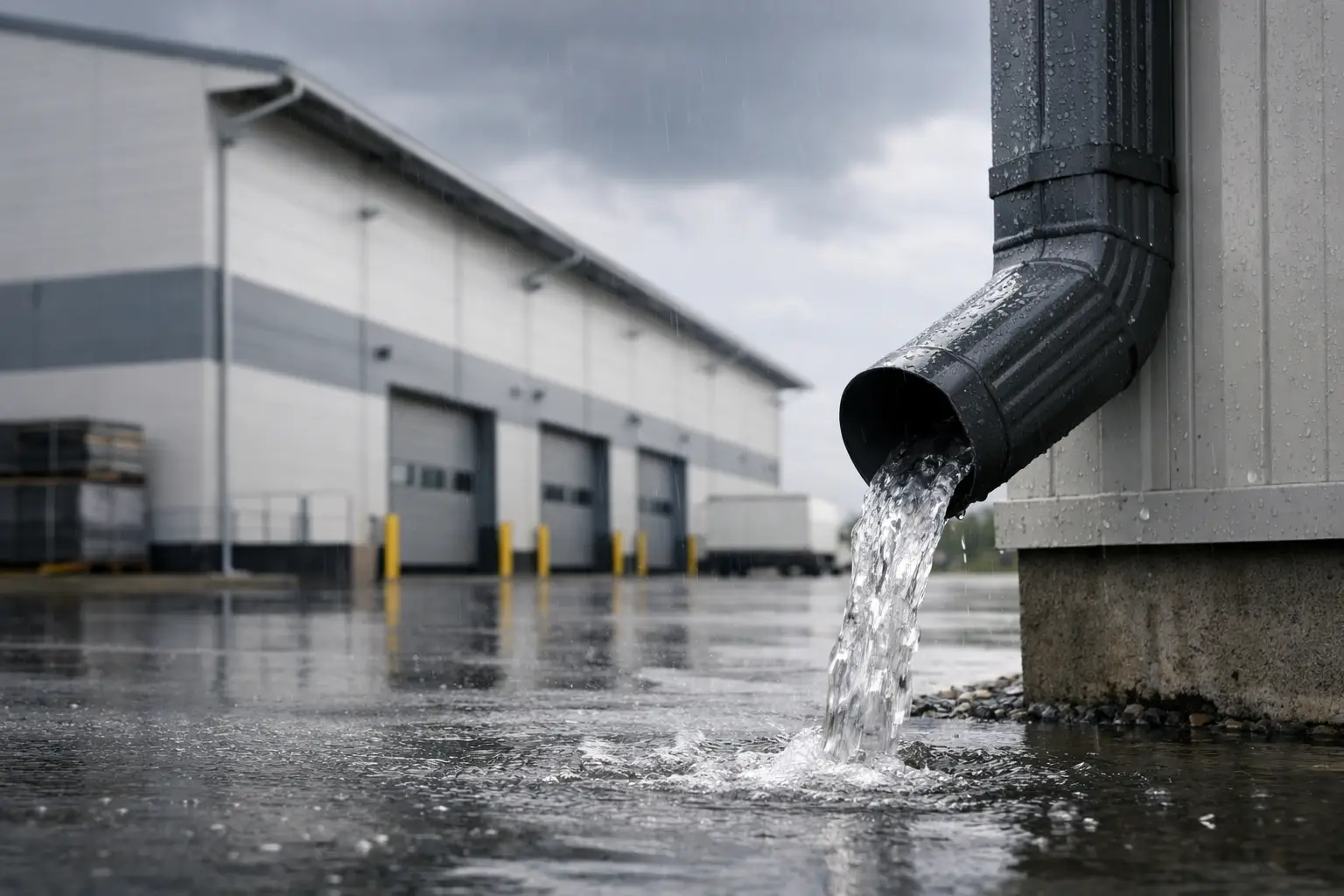
The right system varies by roof type and building layout, but it usually combines several connected components. Gutters collect edge runoff, valleys direct water from roof planes, outlets transfer water into downpipes, and downpipes carry it to a controlled discharge location. Every connection must be mechanically secure and sealed for the expected movement, weather exposure, and service conditions.
For metal warehouses, gutter replacement often needs more than a like-for-like swap. The contractor should assess corrosion at fascia edges, brackets, roof sheet ends, and adjoining flashings. If rusted components are covered without treatment, corrosion can continue behind the new work. Surface preparation, rust treatment, compatible protective coatings, and properly fabricated replacement sections extend the useful life of the repair.
Waterproofing details are equally critical at roof outlets, valley terminations, skylights, pipe penetrations, and parapet interfaces. An EPDM-based waterproofing system can provide durable coverage at complex details when it is selected for the substrate and installed with correct preparation, adhesion, termination, and drainage integration. The drainage system must never cut across or compromise the waterproofing line.
Overflow provisions deserve special attention. When primary outlets block during a severe storm, water needs a predictable route that prevents uncontrolled entry into the building. An emergency overflow route should discharge visibly and safely so that maintenance teams can recognize the problem early. It should not direct water onto pedestrian paths, loading doors, electrical equipment, or adjacent property.
Drainage maintenance prevents emergency repairs
Even a correctly designed system will fail if it is not maintained. Warehouse drainage should be inspected before the expected rainy period, after major storms, and whenever new leakage or overflow marks appear. Facilities located near open land, construction activity, trees, or high-dust areas may need more frequent cleaning.
A useful maintenance visit checks for sediment in gutters, blocked outlets, loose guards, standing water, damaged sealant, corrosion, failed brackets, and downpipes that are disconnected or crushed. It should also confirm that discharge points remain open and that no later site modifications have obstructed the drainage path.
Avoid treating gutter cleaning as a standalone housekeeping task. Cleaning removes debris, but it does not resolve inadequate slope, poor outlet positioning, failing waterproofing, or corrosion hidden at joints. When a blockage is cleared, the team should observe how water flows and record any areas where it remains trapped. This turns routine maintenance into an early-warning process.
Selecting the right repair scope
Minor leakage at a gutter joint may only require cleaning, resealing, and localized bracket repair. Repeated overflow across several roof elevations usually indicates a larger issue involving capacity or geometry. If gutters are extensively corroded, sagging, or patched repeatedly, replacement with correctly sized fabricated sections is typically more cost-effective than continuing isolated repairs.
For a warehouse with recurring roof leaks, drainage and waterproofing should be evaluated together. Replacing gutters without correcting failed outlet details or roof sheet penetrations can leave the facility exposed. Likewise, applying a new waterproofing layer without resolving ponding may shorten the performance of that system.
Promax Contracting approaches these works through site inspection, technical recommendations, fabrication where required, controlled installation, and after-sales response. This is especially valuable when drainage repairs must be coordinated with active warehouse operations and existing roof protection systems.
Keep water moving before the next storm
The most effective drainage strategy is proactive: inspect the water path, correct the restrictions, protect vulnerable roof details, and maintain the system before rainfall exposes the problem. For warehouse operators, a clear gutter and a sealed outlet are small details with direct value. They protect stock, keep work areas usable, and help the roof deliver the service life the building depends on.
Talk to Promax
Speak to Promax for expert help in Dubai & the UAE. Call +971 56 727 4205 or request a free consultation for metal-roof waterproofing, industrial roofing and concrete & structural waterproofing.